-in-fmcg-maintenance-small-changes,-big-impact.png)
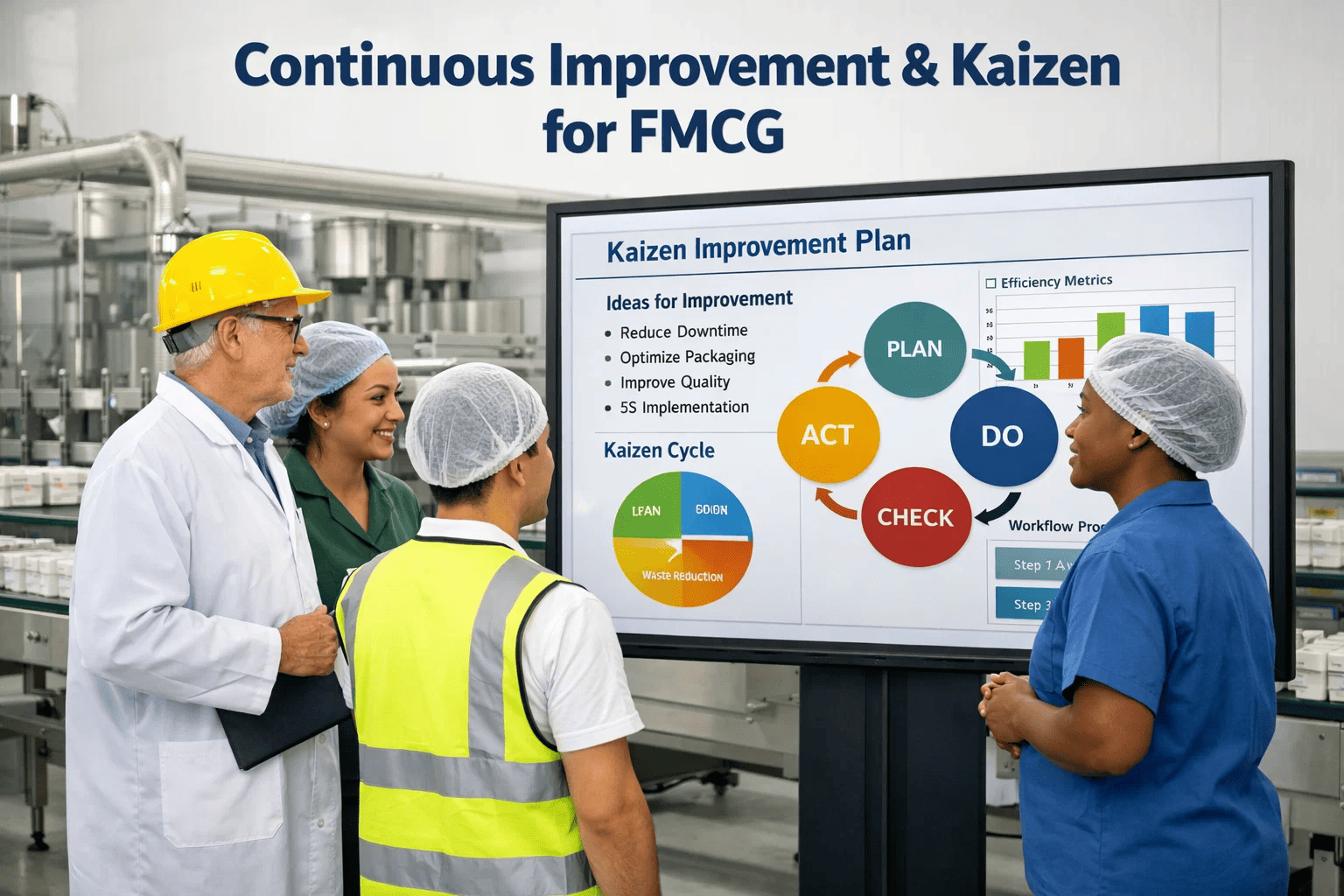
A mid-size FMCG plant reduced unplanned downtime by 37% in just 90 days — not through a $240,000 equipment overhaul, but through 148 small Kaizen improvements submitted by floor operators and maintenance technicians. The cumulative impact: $81,600 in annual savings from reduced breakdowns, faster changeovers, and lower spare parts consumption. This is the power of Kaizen in maintenance — systematic, incremental improvements that compound into transformational results. Unlike capital projects requiring board approval and 12-month lead times, Kaizen delivers value every week with near-zero investment. FMCG plants running structured Kaizen programs through Oxmaint's Kaizen module report 40–60% fewer emergency work orders within the first year. Book a demo with our FMCG maintenance specialists to see how it works.
Kaizen Workflow — Oxmaint CMMS
Stop Waiting for Big Budgets. Start Improving Today with Kaizen.
Oxmaint digitises your Kaizen workflow — capturing operator ideas in seconds via mobile, tracking implementation with owner accountability, measuring before and after impact automatically, and building a searchable improvement database across every shift and plant.
37%
Unplanned Downtime Reduction Achieved in 90 Days Through 148 Operator-Driven Kaizens
62%
Less Downtime Per Line in Kaizen-Driven Plants vs Traditional Reactive Maintenance
150+
Average Annual Kaizen Submissions Per Plant in Mature FMCG Programs
12–30×
ROI on Structured Kaizen Program Investment Within the First Year
TRADITIONAL vs KAIZEN
Traditional Maintenance vs Kaizen-Driven Maintenance
How continuous small improvements outperform periodic large overhauls in FMCG production environments — and why the cost difference is 100× in favour of Kaizen
Traditional / Reactive Approach
Improvement Frequency
Annual capital projects only — improvements tied to budget cycles, not operational need
Average Downtime Per Line
12–18 hours per month unplanned — crews respond after failures occur, not before
Employee Involvement
Top-down directives only — operators execute instructions without contributing observations
Cost of Improvement
$18,000–$240,000 per project — long lead times, committee approvals, contractor dependency
Kaizen / Continuous Improvement
Improvement Frequency
Daily micro-improvements — every shift generates new observations, ideas, and implemented fixes
Average Downtime Per Line
4–7 hours per month (62% less) — problems eliminated at source before they escalate to failures
Employee Involvement
Every operator and technician — the people closest to the equipment drive the improvements
Cost of Improvement
$6–$600 per Kaizen — most implemented during scheduled maintenance windows with zero downtime
Average Annual Savings from Kaizen Programs in FMCG Plants
$54K – $144K
SIX PILLARS
Six Pillars of Kaizen for FMCG Maintenance Excellence
Kaizen is not a suggestion box — it is a structured methodology built on six interconnected pillars that systematically eliminate waste, reduce variability, and build maintenance capability from the shop floor up
35%
Eliminate Waste (Muda)
Reduction in unnecessary maintenance steps, excess spare parts inventory, and waiting time between tasks — every wasted motion identified and removed
48%
Standardize Processes
Fewer deviations when SOPs are refined through operator-driven Kaizen cycles with visual work instructions updated from the shop floor
28%
5S Workplace Organisation
Faster tool retrieval and cleaner work areas reduce maintenance task completion time by nearly a third — shadow boards, visual labels, organised stores
52%
Visual Management
Faster anomaly detection when equipment status, lubrication schedules, and wear indicators are visually displayed at the point of maintenance
3×
Gemba Walks
More issues identified when managers observe maintenance work at the actual location rather than reviewing shift reports in an office removed from the floor
74%
PDCA Cycles
Of Kaizen improvements sustained long-term when validated through Plan-Do-Check-Act methodology before being written into the standard work procedure
KAIZEN IMPACT BY CATEGORY
High-Impact Kaizen Categories for FMCG Maintenance
Six categories consistently produce the highest ROI because they target the root causes of downtime, energy waste, and spare parts overconsumption
Changeover Reduction
SMED-based Kaizen reduces SKU changeover time — pre-staged tools, visual setup guides, colour-coded quick-connects at every station
38% Faster
Lubrication Optimisation
Right lubricant, right quantity, right frequency — operator-driven lubrication routes with colour-coded guns reduce bearing failures by half
52% Less Wear
Cleaning and CIP Efficiency
Kaizen-optimised cleaning sequences reduce water, chemical, and time consumption without compromising hygiene standard or audit compliance
26% Time Saved
Spare Parts Management
Visual min-max systems, standardised parts across lines, reduced emergency procurement cycles, and eliminated duplicate stocking
$14,400 Saved
Energy and Utility Waste
Compressed air leaks, steam trap failures, idle equipment running unnecessarily — small targeted fixes with compounding energy savings
18% Reduction
Safety and Ergonomics
Guard improvements, access modifications, tool placement — reducing maintenance injury risk and technician fatigue across all shifts
44% Fewer Incidents
Average Kaizen Submissions Per Plant Per Year
150+
Results measured across FMCG plants with 3–6 production lines operating structured Kaizen programs for 12+ months. Individual results vary based on baseline maintenance maturity and employee participation rates.
Mobile Kaizen Submissions — Instant Supervisor Routing
Turn Every Operator Into an Improvement Engine
Oxmaint captures Kaizen ideas from the shop floor in seconds — photo submissions from mobile, instant routing to supervisors, automatic before and after impact tracking, and recognition workflows that keep participation rates high across all shifts.
IMPLEMENTATION ROADMAP
Four-Phase Kaizen Deployment for FMCG Maintenance Teams
A phased approach that builds capability while delivering quick wins — the critical success factor is a structured system for capturing, evaluating, implementing, and sustaining improvements
01
Week 1–2: Foundation
Train operators on Kaizen principles and submission process
Establish Kaizen board — physical and digital — for idea tracking
Identify 3 pilot equipment areas with highest breakdown frequency
Output: Culture Shift
02
Week 3–6: Quick Wins
Implement first 20–30 small improvements from operator suggestions
Track before and after metrics per Kaizen — downtime, MTTR, cost
Celebrate wins publicly — recognition drives participation volume
Output: $6K–$14K Saved
03
Month 2–4: Scale
Expand to all production lines and utility systems
Introduce Kaizen events — focused 3–5 day improvement blitzes
Link Kaizen outputs directly to preventive maintenance schedules
Output: $30K–$60K Saved
04
Month 6+: Sustain
Monthly Kaizen review meetings with cross-functional teams
Integrate Kaizen metrics into maintenance KPI dashboards
Build Kaizen database for knowledge sharing across shifts and sites
Output: 12–30× ROI
REAL-WORLD WINS
Documented Kaizen Wins on FMCG Production Lines
Real improvements implemented by operators and technicians — minimal cost, maximum impact, submitted by the people closest to the equipment
Kaizen Win — Filling Machine Downtime
Problem Identified
Filling nozzle O-rings failing every 3 weeks, causing 4-hour unplanned stops — root cause: wrong lubricant grade applied at maintenance
Submitted By
Night shift operator — noticed lubricant smell difference vs OEM specification sheet posted on machine
Kaizen Solution
Food-grade silicone lubricant specified, visual lubrication schedule posted at machine, colour-coded grease guns per asset
Implementation Cost
$34 — lubricant specification update and visual board printing
Annual Savings
$10,080 — O-ring service life extended from 3 weeks to 14 weeks
Kaizen Win — Packaging Line Changeover
Problem Identified
SKU changeover taking 48 minutes — technicians searching for tools, format parts, and adjustment specs every single time
Submitted By
Packaging technician — documented 23 minutes of pure non-value-added search time per changeover event
Kaizen Solution
Shadow boards for format parts, colour-coded quick-connects, laminated setup cards mounted at each changeover station
Implementation Cost
$222 — boards, colour coding materials, and lamination
Annual Savings
$17,040 — changeover reduced from 48 minutes to 22 minutes across all shifts
Combined implementation cost of both Kaizens
→
Combined annual savings
106× return on implementation cost
ANNUAL ROI
Annual ROI of a Structured Kaizen Maintenance Program
Mid-size FMCG plant — 4 production lines — 120 equipment assets — 3-shift operation — structured Kaizen program running 12 months
Unplanned Downtime Reduction
37% fewer breakdowns × $2,160 average downtime cost × 24 prevented events per year — production recovered permanently
$51,840
Changeover Time Savings
38% faster changeovers × 6 changeovers per day × $102 production value per hour saved — line utilisation improved every shift
$34,080
Spare Parts Optimisation
Standardised parts across lines, reduced emergency orders, visual inventory management eliminating excess stocking and procurement premiums
$14,400
Energy and Utility Savings
Leak repairs, idle equipment shutdowns, optimised operating parameters from operator Kaizens — sustained utility bill reduction
$18,720
MTTR Improvement
Visual SOPs, pre-staged tools, and standardised repair procedures reduce mean time to repair by 42% — every breakdown costs less to fix
$22,560
Safety Incident Reduction
44% fewer maintenance injuries — reduced medical costs, lost production time, insurance premiums, and regulatory exposure
$9,600
Total Annual Value Delivered
$151,200
Program investment: $4,800–$12,000/year including software, training, recognition programs, and facilitator time. Net ROI: $139,200–$146,400. Return: 12–30× in the first year. ROI accelerates as Kaizen culture matures and participation rates increase across shifts.
COMMON MISTAKES
Six Kaizen Mistakes in FMCG Maintenance — and How to Fix Them
Kaizen programs fail not because small improvements lack value but because organisations undermine the system — these six errors account for the majority of stalled programs
No Follow-Through
Every Kaizen idea needs an owner, deadline, and verification step — untracked suggestions kill participation within weeks and destroy the culture
Management-Only Ideas
80% of high-impact maintenance Kaizens come from floor operators — managers must enable and recognise, not dictate and replace their contributions
No Before / After Data
Without measurable metrics, Kaizen becomes opinion-based — always record downtime, MTTR, or cost before and after every implemented improvement
Too Complex to Start
Start with 5-minute Kaizens that operators can implement immediately during their shift — complexity and committee approval kill momentum in early stages
No Recognition System
Public recognition drives 3× more submissions than financial rewards — celebrate every implemented Kaizen visually on the board and in team meetings
Not Standardising Wins
Improvements revert within 60 days without SOP updates — every successful Kaizen must update the standard work procedure before being marked complete
Frequently Asked Questions
Kaizen is a Japanese management philosophy meaning "continuous improvement" — a structured approach to making small, incremental improvements every day rather than waiting for large capital projects. In FMCG maintenance, Kaizen empowers operators and technicians to identify and implement improvements in equipment reliability, changeover speed, cleaning efficiency, spare parts management, and safety. FMCG plants are ideal for Kaizen because they run high-speed, repetitive processes where small improvements on each cycle compound into massive annual savings. A lubrication fix that saves 4 hours of downtime per month delivers $2,160 of recovered production capacity per year — multiplied across 150 similar improvements, this is the Kaizen economic model.
Plants in the early stages — months 1 through 3 — typically generate 8–15 Kaizens per month as the culture develops and operators build confidence submitting observations. Mature programs running for 12 or more months consistently produce 15–25 Kaizens per month across all shifts. The key metric is not submission volume but implementation rate — aim for 70% or more of submitted ideas implemented within 30 days. Quality matters more than quantity: one Kaizen that eliminates a recurring 4-hour breakdown is worth more than twenty that reorganise tool drawers. Use CMMS data to direct operator attention toward the highest-value improvement opportunities.
Daily Kaizen refers to small, continuous improvements that operators implement as part of their normal work — fixing a lubricant specification, adding a visual indicator, repositioning a tool holder. These typically take 5–30 minutes and cost under $60. Kaizen events (also called Kaizen blitzes) are focused 3–5 day improvement workshops where a cross-functional team tackles a specific, larger problem — such as reducing changeover time on a filling line from 48 minutes to 22 minutes. Both are essential: daily Kaizen maintains cultural momentum and delivers the volume of improvements that compounds into significant annual savings, while Kaizen events deliver breakthrough improvements on high-priority constraints that daily observation alone cannot resolve.
Kaizen is the continuous improvement engine that makes preventive and predictive maintenance programs better over time. When an operator notices that a PM task is redundant, takes too long, misses a critical inspection point, or uses the wrong lubricant specification — that observation becomes a Kaizen that updates the PM procedure. Over time, Kaizen refines PM task lists to remove waste, optimises inspection frequencies based on actual wear patterns, improves lubrication routes, and standardises repair procedures across shifts. Oxmaint connects Kaizen outputs directly to PM schedules in the CMMS, ensuring every improvement is automatically reflected in future maintenance workflows rather than remaining as a standalone suggestion.
Kaizen Module — Oxmaint CMMS
148 Small Changes. $81,600 Saved. Zero Capital Investment.
Oxmaint turns your maintenance team's daily observations into a structured improvement engine — capturing every Kaizen idea from the shop floor, tracking implementation with owner accountability, measuring before and after impact automatically, and building a searchable improvement database across your entire plant.
Mobile Kaizen Submissions — Photo Capture, Instant Supervisor Routing
Owner Assignment — Every Idea Gets an Owner, Deadline, and Verification
Before and After Metrics — Downtime, MTTR, and Cost Tracked Automatically
Kaizen-to-PM Link — Improvements Auto-Update Preventive Maintenance Tasks
Recognition Dashboard — Celebrate Wins, Drive Participation Across Shifts
Searchable Database — Knowledge Shared Across Lines, Shifts, and Sites
Kaizen module included on all plans · Mobile app included · No minimum contract