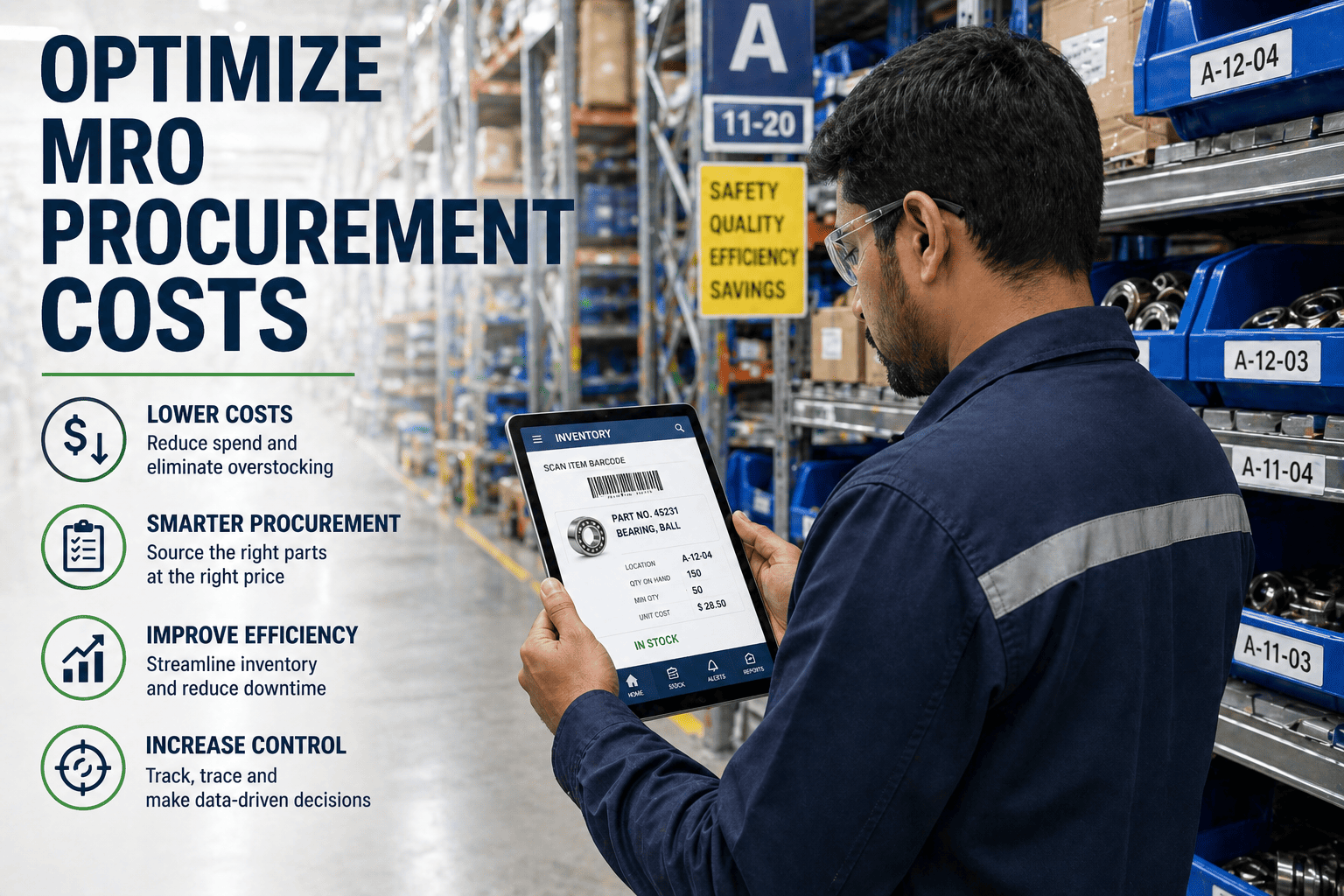
A mid-size FMCG plant in Pune was spending ₹2.8 Cr annually on MRO procurement — spare parts, lubricants, filters, belts, bearings, and consumables that keep production lines running. Yet 34% of that spend was unmanaged: emergency purchases at premium prices, duplicate orders across departments, and 120+ suppliers with no negotiated contracts. No single purchase was alarming. Collectively, the unmanaged tail spend drained ₹58L per year in avoidable cost. Within 16 weeks of implementing a structured MRO procurement strategy linked to CMMS consumption data, total maintenance purchasing costs dropped 22%. Across FMCG manufacturing, plants that connect procurement to maintenance data achieve 15–25% cost reduction without compromising part quality or availability. Start your free trial today and begin turning your maintenance spend into a strategic cost lever. Schedule a 30-minute MRO procurement assessment with our FMCG specialists.
Unmanaged / Reactive Purchasing
Purchase Trigger
Technician or Storekeeper Notices Part Missing
Supplier Selection
Whoever Can Deliver Fastest Regardless of Price
Emergency Purchase Premium
35–60% Above Contracted Rates for Rush Orders
Spend Visibility
Known Only After Monthly Finance Reconciliation
Strategic / CMMS-Integrated Procurement
Purchase Trigger
Auto-Reorder at Min Threshold From Consumption Data
Supplier Selection
Pre-Negotiated Contracts With Scored Vendors
Emergency Purchase Premium
Under 5% of Total MRO Spend on Rush Orders
Spend Visibility
Real-Time Dashboard by Category, Vendor, and Asset
Average Annual MRO Cost Reduction: ₹42L – ₹85L
Six Strategic MRO Procurement Levers for FMCG Plants
MRO procurement in FMCG plants is typically treated as a transactional function — buy what maintenance asks for, as fast as possible. Strategic procurement flips this model: it uses consumption data, vendor performance metrics, and spend analysis to reduce cost while improving availability. Plants using Oxmaint implement all six levers concurrently, tracking savings per initiative on a single procurement dashboard.
01
MRO Spend Analysis
Categorize all MRO spend by type, vendor, and asset
Identify top 20% of SKUs driving 80% of spend
Flag emergency purchases and price variance patterns
Typical Savings: 5–8% From Visibility Alone
02
Vendor Consolidation
Reduce 120+ suppliers to 25–40 strategic partners
Negotiate volume-based pricing with consolidated vendors
Eliminate administrative overhead of fragmented POs
Typical Savings: 8–12% on Consolidated SKUs
03
Contract Negotiation
Annual rate agreements for high-consumption parts
Blanket POs eliminating per-order processing costs
Payment term optimization for cash flow improvement
Typical Savings: 10–15% vs Spot Purchasing
04
E-Procurement Automation
CMMS-triggered purchase requisitions at min threshold
Digital approval workflows replacing paper-based PRs
Auto-matching PO, GRN, and invoice for 3-way match
Typical Savings: ₹12–₹18L in Admin Costs
05
Vendor Performance Scoring
Track fill rate, on-time delivery, and defect rates
Quarterly vendor scorecards auto-generated from data
Underperformers replaced with backup vendors on standby
Impact: 97%+ Fill Rate Achieved
06
Inventory Right-Sizing
Min/max levels set from actual CMMS consumption data
Eliminate dead stock and obsolete parts carrying cost
ABC classification linking criticality to stocking rules
Typical Savings: 20–30% Less Working Capital
Where FMCG Plants Lose Money on MRO: Spend Breakdown
MRO procurement leakage is distributed across multiple cost buckets — but the largest losses come from emergency purchasing premiums, fragmented supplier pricing, and excess inventory carrying costs. Understanding where each rupee leaks helps prioritize sourcing fixes. Schedule a demo to see how spend analytics maps to your specific procurement structure.
Emergency Purchase Premiums
Rush orders at 35–60% above contracted rates — caused by stockouts from manual reorder processes
₹14–₹22L
Fragmented Supplier Pricing
Same parts purchased from multiple vendors at different prices — no consolidated volume leverage
₹10–₹16L
Excess Inventory Carrying Cost
30–40% overstocking as safety buffer — tying up ₹45–₹80L in working capital at 18–22% carrying cost
₹8–₹15L
Purchase Order Processing
Manual PR-to-PO cycle consuming 15–20 hrs/week — paper-based approvals taking 3–8 days per order
₹6–₹10L
Obsolete Parts Write-Off
12–18% of spare parts inventory becomes obsolete before use — parts ordered for retired assets still on shelf
₹5–₹9L
Vendor Non-Performance Costs
Late deliveries causing production delays, defective parts requiring returns, and incorrect shipments needing rework
₹4–₹8L
Total Recoverable MRO Procurement Cost
₹47L–₹80L
Savings ranges reflect plant size, current vendor count, and procurement maturity. Plants with no prior strategic sourcing program typically achieve upper-range results within 120 days.
Your Maintenance Team Shouldn't Be Your Purchasing Department
Oxmaint connects real-time parts consumption to automated procurement workflows — so the right parts arrive before they are needed, at contracted prices, from scored vendors.
The 14-Week MRO Procurement Transformation Roadmap
Shifting from reactive purchasing to strategic MRO procurement follows a structured program that delivers quick wins in weeks 1–4, systematic improvements in weeks 5–10, and sustained optimization from week 11 onward. Each phase builds on spend data from the previous one. Schedule a demo to see how the platform tracks savings against each initiative automatically.
01
Week 1–3: Analyze Spend
Extract 12-month MRO purchase history from ERP
Categorize by vendor, part type, and asset consumed
Identify emergency purchase frequency and premium costs
Output: Spend Baseline Map
02
Week 4–7: Consolidate
Shortlist strategic vendors for top 80% of spend
Negotiate annual rate agreements and blanket POs
Set min/max inventory levels from CMMS consumption
Savings: 10–12% Cost Drop
03
Week 8–10: Automate
CMMS auto-triggers PRs at reorder thresholds
Digital approval workflows replacing paper chains
Vendor scorecards activated with delivery tracking
Savings: 16–18% Cost Drop
04
Week 11–14: Sustain
Monthly procurement reviews with spend vs budget
Quarterly vendor performance reviews and renegotiation
Dead stock liquidation and ABC reclassification
Sustained: 20%+ Cost Reduction
Real-World MRO Procurement Catches: What Data Revealed
The most impactful procurement improvements come from what spend analysis catches — the hidden cost patterns that operated for months or years because nobody connected purchasing data to maintenance consumption patterns.
Catch 1: Bearing Price Variance — Packaging Line
What Analysis Detected
Same SKF 6205 bearing purchased from 4 different suppliers at prices ranging from ₹420 to ₹1,180 — a 181% variance on the plant's most consumed bearing.
Duration of Hidden Waste
Estimated 2+ Years With No Price Benchmarking
Correction
Single-Vendor Annual Contract at ₹385/Unit — Volume Discount
Annual Savings Recovered
₹4.8L on This Single SKU Alone
Catch 2: Obsolete Parts Inventory — Legacy Equipment
What Analysis Detected
₹18.4L worth of spare parts stocked for 3 machines that had been decommissioned 14 months prior — no consumption in 420+ days.
Duration of Hidden Waste
14 Months of Carrying Costs on Dead Stock
Correction
Parts Sold Back to Supplier + Shelf Space Recovered
Working Capital Freed
₹18.4L Returned to Operations Budget
Two Data-Driven Catches Recovered ₹23.2L in Annual Value
MRO Procurement KPIs Every FMCG Plant Should Track
Strategic procurement without KPIs is guesswork with a purchase order. These six metrics form the performance framework that turns raw spend data into actionable sourcing intelligence — enabling procurement and maintenance teams to make evidence-based decisions continuously.
MRO Cost as % of Asset Value
Primary
Total MRO spend divided by replacement asset value. Best-in-class FMCG plants target 2.5–3.5% versus the 5–7% industry average.
Emergency Purchase Ratio
Under 5%
Percentage of total MRO spend on rush/emergency orders. Above 15% signals broken reorder processes and poor demand forecasting.
Vendor Fill Rate
97%+
Percentage of orders delivered complete by each vendor. Below 95% triggers vendor scorecard review and potential replacement.
Inventory Turnover Ratio
6–8x
How many times MRO inventory cycles per year. Below 4x indicates overstocking. Above 10x risks stockouts on critical spares.
PO Processing Cycle Time
Under 24h
Time from requisition to approved PO. Manual processes average 3–8 days. CMMS-automated workflows achieve same-day processing.
Contract Coverage Ratio
80%+
Percentage of MRO spend covered by negotiated contracts versus spot purchases. Higher coverage means lower unit costs and predictable pricing.
Overcoming Common MRO Procurement Barriers in FMCG
Every FMCG plant faces obstacles when transitioning from reactive purchasing to strategic MRO procurement. Understanding these barriers — and how CMMS-integrated procurement solves them — accelerates the path from cost drain to cost advantage.
No Spend Visibility
Solved
CMMS tracks every part consumed per work order — procurement sees real-time spend by category, vendor, asset, and department automatically.
Maintenance Resists Change
Solved
Technicians still request parts the same way — the system handles vendor selection and pricing behind the scenes without changing field workflows.
Too Many Small Vendors
Solved
Spend analysis identifies consolidation opportunities — 70% of spend typically concentrates into 15–20 vendors who get volume-based contracts.
No Demand Forecasting
Solved
Upcoming PM schedules show exactly which parts will be needed and when — enabling pre-staging instead of reactive ordering after the fact.
Procurement-Maintenance Silos
Solved
Single platform connects work orders, parts consumption, inventory levels, and purchase orders — eliminating the information gap between departments.
Manual Approval Delays
Solved
Digital approval workflows with mobile notifications reduce PR-to-PO cycle from 3–8 days to under 24 hours — even with multi-level authorization.
Frequently Asked Questions
How can an FMCG plant reduce MRO procurement costs by 20% without affecting part quality?
The 20% reduction comes from eliminating procurement inefficiencies — not buying cheaper parts. Emergency purchase premiums of 35–60% disappear when consumption-linked reordering prevents stockouts. Vendor consolidation unlocks volume discounts of 8–12% on identical SKUs. Blanket PO agreements lock in annual rates below spot pricing. And eliminating dead stock frees 20–30% of working capital. At no point does the strategy involve substituting lower-quality parts — it uses the same specifications at lower cost through better sourcing discipline.
Sign up free to start analyzing your MRO spend patterns.
How does a CMMS like Oxmaint integrate with MRO procurement workflows?
Integration happens at three levels. First, every work order that consumes a part updates the inventory ledger in real time — giving procurement live visibility into consumption velocity. Second, when inventory hits the minimum threshold, the platform auto-generates a purchase requisition routed through digital approval workflows. Third, vendor performance data — fill rates, delivery times, defect rates — flows automatically from receiving records into vendor scorecards. This eliminates the manual PR-to-PO process, connects demand forecasting to PM schedules, and enables data-driven vendor negotiations.
What is vendor consolidation and how does it reduce MRO costs?
Most FMCG plants purchase from 100–150+ MRO suppliers with no volume leverage. Vendor consolidation reduces this to 25–40 strategic partners who receive larger order volumes in exchange for contracted pricing, priority delivery, and performance guarantees. The savings come from three sources: volume-based unit price reductions of 8–12%, elimination of per-vendor administrative overhead worth ₹6–₹10L annually, and improved fill rates from vendors who prioritize your account. The 80/20 rule applies — typically 15–20 vendors cover 70–80% of total spend.
How quickly does a strategic MRO procurement program deliver measurable savings?
Quick wins appear within 4–6 weeks. Eliminating emergency purchase premiums by setting auto-reorder points delivers immediate cost reduction on the first replenishment cycle. Vendor consolidation negotiations typically complete by week 7 with new pricing effective immediately. E-procurement automation reduces processing costs from the day digital workflows go live. The cumulative effect reaches 15–18% cost reduction within 10 weeks and 20%+ by week 14. The platform tracks savings per initiative so finance can verify every rupee recovered.
Book a consultation to scope your savings timeline.
Every Unmanaged Purchase Order Is Money Left on the Table
Oxmaint transforms your MRO procurement from reactive spending to strategic sourcing — connecting consumption data, vendor performance, and automated workflows to cut maintenance purchasing costs by 20% or more.