A chiller that runs 20% below its design efficiency costs more to operate every single day than an annual service contract that would have prevented the degradation. Industrial process chillers — centrifugal, screw, and scroll — are among the most energy-intensive assets on any plant floor, often accounting for a significant portion of total electrical consumption. The three leading causes of chiller failure are refrigerant leaks that go undetected for months, condenser tube fouling that raises discharge pressure beyond safe limits, and lubrication failures from missed oil analysis cycles. All three are preventable. This checklist covers daily parameter logging, weekly inspections, monthly refrigerant and water treatment tasks, and quarterly through annual deep inspection intervals — structured for industrial process cooling environments where unplanned downtime directly halts production. Start your free Oxmaint trial to digitise your chiller PM programme and receive automated alerts before efficiency loss becomes equipment failure.
Industrial Process Cooling · EPA Section 608 · ASHRAE Compliance
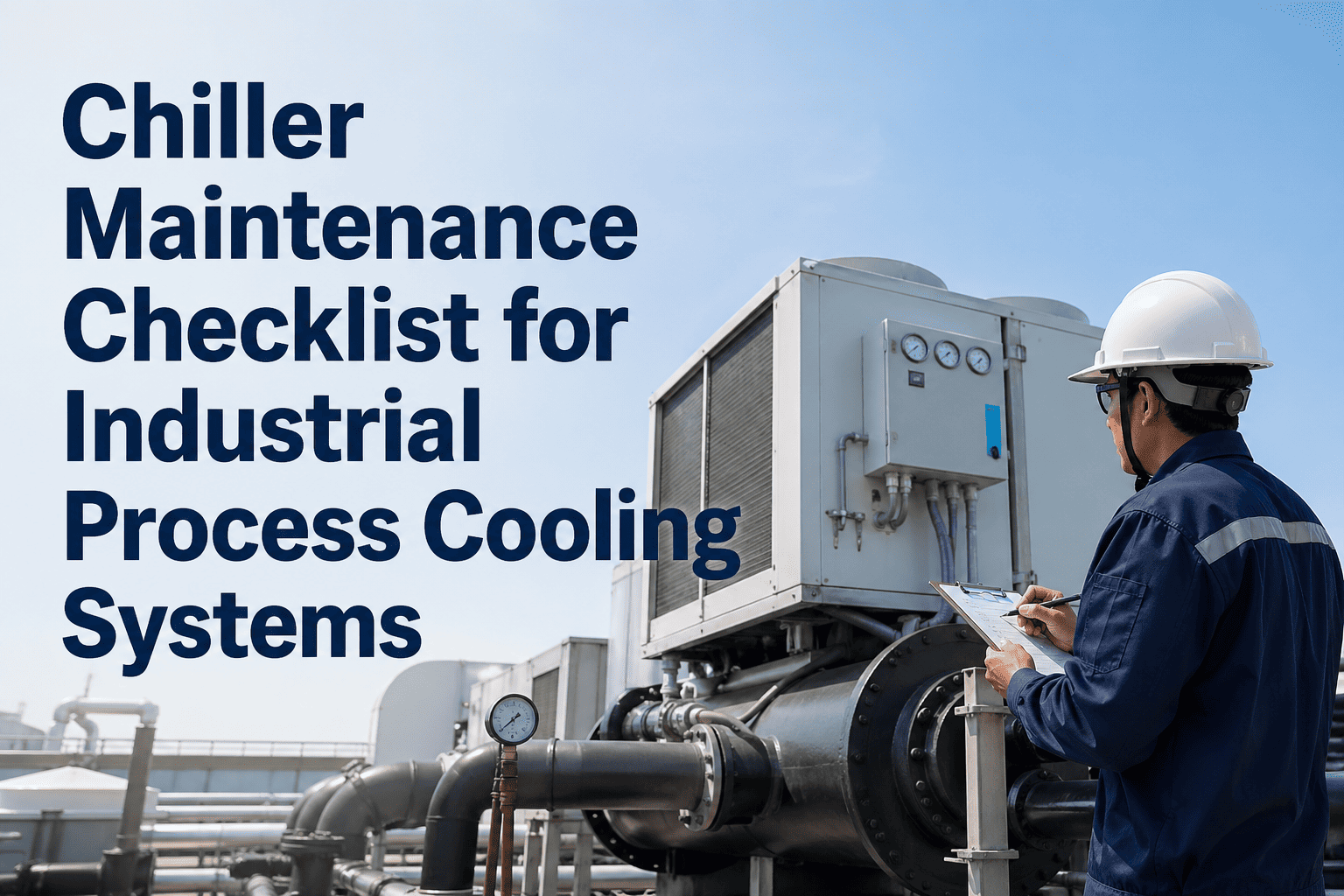
Chiller Maintenance Checklist for Industrial Process Cooling
Daily operating logs, monthly refrigerant integrity checks, and annual compressor inspections — every PM interval your chiller needs to protect efficiency, warranty coverage, and regulatory compliance.
40%
Of building energy use
Attributable to chiller systems in commercial and industrial facilities
$16K+
Per unplanned shutdown
Average cost including emergency labour and parts (ASHRAE data)
30%
Efficiency loss
From just 0.25mm of scale fouling on heat exchanger tubes
25 yrs
Service life
Achievable with consistent PM vs. 12–15 yrs on reactive-only programmes
3°F
Rise in approach temperature on condenser or evaporator above design spec triggers an immediate tube-cleaning inspection
10%
kW/ton rise above nameplate baseline is the ASHRAE-standard threshold that triggers a full efficiency investigation
50 lbs
Refrigerant charge threshold above which EPA Section 608 mandates annual leak inspection and repair documentation
3%
Annual refrigerant leak rate requiring mandatory repair notification under EPA Section 608 comfort cooling rules
Chiller PM requires precise scheduling across daily, monthly, and annual intervals. Oxmaint automates every recurring task, logs operating readings with pass/fail thresholds, and generates compliance-ready reports for EPA and OEM warranty reviews.
Daily — Shift Log
Daily Operating Parameter Log
Daily chiller logs take 15 to 20 minutes per shift and are the earliest warning system available for developing problems. Trending these readings over time reveals efficiency degradation weeks before a fault code or safety shutdown appears.
Refrigerant System Readings
Suction pressure
Record psig → convert to saturated temperature; approach above 3°F above chilled water leaving temp indicates evaporator fouling
Discharge pressure
Record psig; rising trend without load change indicates condenser fouling or refrigerant overcharge
Subcooling / superheat
Compare to manufacturer setpoint; deviation indicates charge loss or metering device drift
Refrigerant sight glass
Bubbles in sight glass at rated load indicate low refrigerant charge requiring investigation
Electrical & Efficiency Readings
Motor amps (all phases)
Record L1, L2, L3; amps above 10% of nameplate FLA at current load require immediate investigation
kW input / kW per ton
Calculate and log; kW/ton trending 10% above nameplate at equivalent load signals degradation
Phase voltage balance
Unbalanced phase current above 2% indicates an electrical issue affecting motor life
Oil pressure (if applicable)
Verify oil pressure differential is within manufacturer-specified range; low differential indicates pump wear
Water System Temperatures
Chilled water supply temp
Confirm at or within ±1°F of setpoint; persistent deviation indicates system fault or control drift
Chilled water return temp
Calculate Delta-T; low Delta-T indicates reduced building load or bypassing in the distribution system
Condenser water supply temp
Every 1°F rise in condenser water temp increases chiller energy consumption by 1.5 to 2 percent
Condenser water return temp
Compare to design specification; high return temp indicates cooling tower performance degradation
Weekly Inspection
Weekly Visual & System Inspection
Mechanical & Refrigerant Visual
ASHRAE 15 / OEM Spec
Chiller exterior inspected for oil staining at refrigerant connections, service valves, and brazed joints — oil migration is the primary visible sign of a refrigerant leak
Record: Weekly inspection form · Role: Refrigeration Technician
Compressor oil level verified at sight glass — log level and note any colour change from clear to dark brown or black, which indicates contamination
Record: Weekly inspection form · Role: Refrigeration Technician
Air-cooled condenser coil fins inspected — light must be visible through the coil; blocked fins reduce heat rejection and raise discharge pressure
Record: Weekly inspection form · Role: Maintenance Lead
Vibration isolator pads and mounting bolts checked — loose mounts transmit vibration to pipework and refrigerant connections, accelerating leak development
Record: Weekly inspection form · Role: Maintenance Lead
Electrical & Controls
OEM Spec / NEC
Electrical control panels visually inspected — look for discoloration on terminals, loose wiring, or trip indicators that were reset without investigation
Record: Weekly inspection form · Role: Electrical Technician
Chilled water flow switch interlock tested — verify proper interlock with compressor controls; a failed flow switch can allow the chiller to start with no water flow
Record: Weekly inspection form · Role: Refrigeration Technician
BAS/controls trend logs reviewed — confirm no missed data points, erratic sensor readings, or unexplained setpoint deviations from the past 7 days
Record: Controls log · Role: Controls / BAS Technician
Y-strainer on chilled water and condenser water circuits inspected and cleaned — blocked strainers reduce flow and increase pump energy consumption
Record: Weekly inspection form · Role: Maintenance Lead
Monthly PM
Monthly Preventive Maintenance Tasks
Monthly tasks cover refrigerant system integrity, water treatment, and safety control calibration — three areas where deferred action consistently results in either EPA compliance violations or compressor failure events.
Refrigerant Integrity
- Electronic leak detection survey of all refrigerant fittings, valve packing, evaporator and condenser heads — EPA Section 608 requires repair of leaks exceeding 10% annual charge loss
- Refrigerant charge verified by measuring subcooling and superheat at full load against manufacturer specification — any addition documented with technician certification number
- Filter dryer condition assessed — rising pressure drop across filter dryer indicates moisture contamination requiring replacement
Water Treatment
- Cooling tower fill, basin, and drift eliminators inspected — check for scaling, biological growth, or physical damage; verify drift eliminators are seated to manage Legionella risk
- Condenser water pH, hardness, and biocide concentration tested — values outside treatment range accelerate tube fouling and corrosion
- Chilled water loop chemistry verified — pH target typically 7.5–9.0; inhibitor concentration per treatment programme specification
Safety Controls
- High-pressure cutout, low-pressure cutout, and oil pressure differential switch verified against setpoint specification — test under controlled conditions, not just visual check
- Motor overcurrent protection and freeze protection setpoints confirmed active and within range
- Safety shutdown log reviewed — any safety fault trip in the past 30 days must be investigated and root-caused before the unit returns to unattended operation
Quarterly to Annual
Quarterly & Annual Deep Inspection Tasks
Compressor & Lubrication (Every 1,000 hrs or Quarterly)
ASHRAE / OEM Spec
Compressor oil sample submitted for spectrographic laboratory analysis — rising metal content across consecutive samples is early warning of bearing wear; most OEMs recommend analysis every 1,000 hours minimum
Record: Oil analysis report on file · Role: Refrigeration Technician
Refrigerant oil changed per oil analysis recommendation — when oil is changed, oil filter must also be replaced and logged regardless of appearance
Record: PM work order with oil analysis results · Role: Refrigeration Technician
Screw compressor slide valve operation tested across full modulation range — sticking slide valve causes partial load issues and excessive unloaded compressor run time
Record: PM work order · Role: Refrigeration Technician
Heat Exchanger & Tube Inspection (Semi-Annual / Annual)
ASHRAE 90.1 / OEM Spec
Condenser and evaporator tubes eddy-current tested or mechanically brushed — tube cleaning is required when approach temperature rises more than 3°F above original design specification
Record: Tube cleaning report with before/after approach temperatures · Role: Specialist Contractor
Comprehensive refrigerant leak test at all joints, connections, valve stems, and shaft seals using calibrated electronic detector — EPA Section 608 requires annual inspection for systems with more than 50 lbs refrigerant
Record: Leak test record with all test points documented · Role: EPA-certified Technician
Motor winding insulation resistance tested with megohmmeter — document and trend results annually; declining megohm values predict insulation failure before motor fails in service
Record: Megohm test record with historical trend · Role: Electrical Technician
High-pressure relief valve and rupture disc (centrifugal chillers) certified — verify relief valve is not corroded or weeping; confirm relief line terminates correctly per ASHRAE 15
Record: Annual certification record · Role: Qualified Pressure Technician
Variable frequency drive (VFD) inspected — check for DC bus capacitor condition, cooling fan operation, and drive output harmonics; VFDs require annual internal inspection after 5 years of service
Record: VFD inspection record · Role: Electrical Technician
PM Reference Table
Chiller Maintenance Frequency & Compliance Reference
| System / Component |
Inspection Task |
Frequency |
Standard / Reference |
| Operating Parameters |
Pressure, temperature, amps, kW/ton log |
Daily (every shift) |
ASHRAE 180 / OEM Spec |
| Refrigerant Leak Detection |
Electronic survey of all joints and valves |
Monthly + annual certified test |
EPA Section 608 |
| Condenser Tubes (Water-Cooled) |
Approach temp measurement + tube brushing |
Quarterly to annual (water quality dependent) |
ASHRAE 90.1 / OEM Spec |
| Air-Cooled Condenser Coil |
Fin cleaning (blow-back or coil cleaner) |
Monthly to quarterly (environment dependent) |
OEM Spec |
| Compressor Oil |
Lab oil analysis |
Every 1,000 operating hours or quarterly |
ASHRAE / OEM Spec |
| Cooling Tower |
Fill, basin, drift eliminator inspection |
Monthly |
ASHRAE 188 (Legionella) |
| Water Treatment |
pH, hardness, biocide, inhibitor concentration |
Weekly to monthly |
ASHRAE 188 / Local Code |
| Motor Windings |
Megohm insulation resistance test |
Annual (trend year-over-year) |
NEMA MG1 / OEM Spec |
| Safety Controls |
High/low pressure cutout calibration |
Monthly verification + annual certification |
ASHRAE 15 / OEM Spec |
| Pressure Relief Valve |
Physical inspection and relief line check |
Annual |
ASHRAE 15 Section 9.7 |
Efficiency Impact
What Deferred Maintenance Costs You in Real Numbers
Condenser Tube Fouling
+30% energy waste
Just 0.25mm of scale on heat exchanger tubes reduces heat transfer efficiency by 30%. On a 500-ton chiller running at $0.10/kWh, this adds $25,000 to $35,000 in annual electricity costs above baseline.
Refrigerant Undercharge
+10% compressor strain
A charge 10% below design strains the compressor while reducing cooling capacity simultaneously. This condition is invisible without refrigerant pressure readings — and catastrophic if ignored through a full cooling season.
Condenser Water Temperature
+1.5–2% energy per 1°F
Every 1°F rise in condenser water temperature increases chiller energy consumption by 1.5 to 2 percent. A poorly maintained cooling tower adds 5–8°F to condenser entering water — a 10–16% energy penalty with no operational warning.
FAQs
Frequently Asked Questions
How often should a chiller compressor oil be sampled and analysed?
Most chiller manufacturers recommend oil analysis every 1,000 operating hours or quarterly, whichever comes first. High-runtime facilities (5,000+ hours per year) should analyse oil semi-annually at minimum. Rising metal content across consecutive samples is the earliest reliable indicator of bearing wear before catastrophic failure.
When is an EPA Section 608 refrigerant leak inspection required?
EPA Section 608 mandates an annual leak inspection for systems containing more than 50 lbs of refrigerant. Repairs are required when annual leak rate exceeds 10% of system charge for comfort cooling equipment. All refrigerant additions must be documented with the certified technician's EPA Section 608 certification number.
What is approach temperature and why does it matter for chiller maintenance?
Approach temperature is the difference between refrigerant saturation temperature and the water temperature at the evaporator or condenser. When approach temperature rises more than 3°F above the original design specification, it indicates heat exchanger tube fouling. Most OEMs require tube cleaning at this threshold to prevent efficiency loss and compressor overloading.
Does this checklist apply to both air-cooled and water-cooled chillers?
The majority of tasks apply to both types. Air-cooled chillers replace the condenser tube cleaning tasks with coil fin cleaning and do not require cooling tower or condenser water treatment checks. Water-cooled chillers require full Legionella risk management for the cooling tower per ASHRAE 188 in addition to the chiller PM tasks above.
How can Oxmaint help manage the multi-frequency nature of chiller PM programmes?
Oxmaint schedules daily, weekly, monthly, and annual PM tasks as separate recurring work orders, assigns them to the right technicians, captures numeric readings with pass/fail thresholds, and escalates anomalies automatically. Compliance-ready audit reports are generated on demand — no manual reporting needed for EPA, OEM warranty, or insurance reviews.
Keep Your Process Cooling Running at Peak Efficiency — Every Month, Every Year.
Oxmaint's chiller PM module automates daily log scheduling, monthly refrigerant tracking, annual inspection reminders, and generates the maintenance history your OEM warranty and EPA compliance programme requires.
-inspection-checklist-for-industrial-facilities.png)