Predictive Maintenance ROI Calculator (Manufacturing Guide)

By Johnson on March 30, 2026

predictive-maintenance-roi-calculator-manufacturing-downtime-savings

Manufacturing plants that still rely on reactive maintenance are losing a median $125,000 every hour equipment sits idle — a cost that has grown 50% since 2019. Predictive maintenance flips that equation: the U.S. Department of Energy documents a 10:1 ROI, 95% of adopters report positive returns, and a single prevented failure routinely covers an entire year of program cost. This guide walks through exactly how to calculate your facility's predictive maintenance ROI, what inputs matter most, and how to build a business case your CFO will approve — so you can book a demo and get your plant-specific numbers before the next unplanned outage hits your production schedule.

10–30×
ROI within 12–18 months
U.S. Dept. of Energy & McKinsey
$125K
Median cost per downtime hour
Industry median across manufacturing
45%
Reduction in unplanned downtime
Consistent across PdM adopters
6–14 mo
Typical full payback period
Based on 25+ asset deployments

Why Most ROI Calculations Miss the Real Number

The obvious costs — repair bills and lost production — are just the surface. A complete predictive maintenance ROI model captures six financial layers that most maintenance teams never quantify.

Cost Category
Reactive Maintenance
With Predictive Maintenance
Typical Saving
Unplanned Downtime
323 hrs/yr average
145–177 hrs/yr
30–45% less
Emergency Repair Labor
4–5× standard rate
Planned labor windows
25–40% saved
Spare Parts Inventory
Overstocked, reactive orders
Just-in-time, demand-driven
20–30% reduced
Asset Lifespan
Shortened by shock failures
Extended 20–40%
CapEx deferred
Energy Consumption
Degraded equipment wastes energy
Optimized running conditions
15–20% lower
Combined Annual Impact
$172M avg per mid-size plant
Recovers $250K–$600K/yr
10:1 DOE ROI
Stop Estimating. Start Calculating.

Get Your Facility's Actual ROI Number

Oxmaint connects sensor data to automated work orders and tracks every avoided failure against your actual maintenance spend — giving you a live ROI dashboard, not a spreadsheet estimate. See it running on your asset inventory in 30 minutes.

The ROI Formula: Step-by-Step for Manufacturing

The core formula is straightforward. The value is in knowing which inputs to use and where most plants underestimate their baseline losses.

Step 1
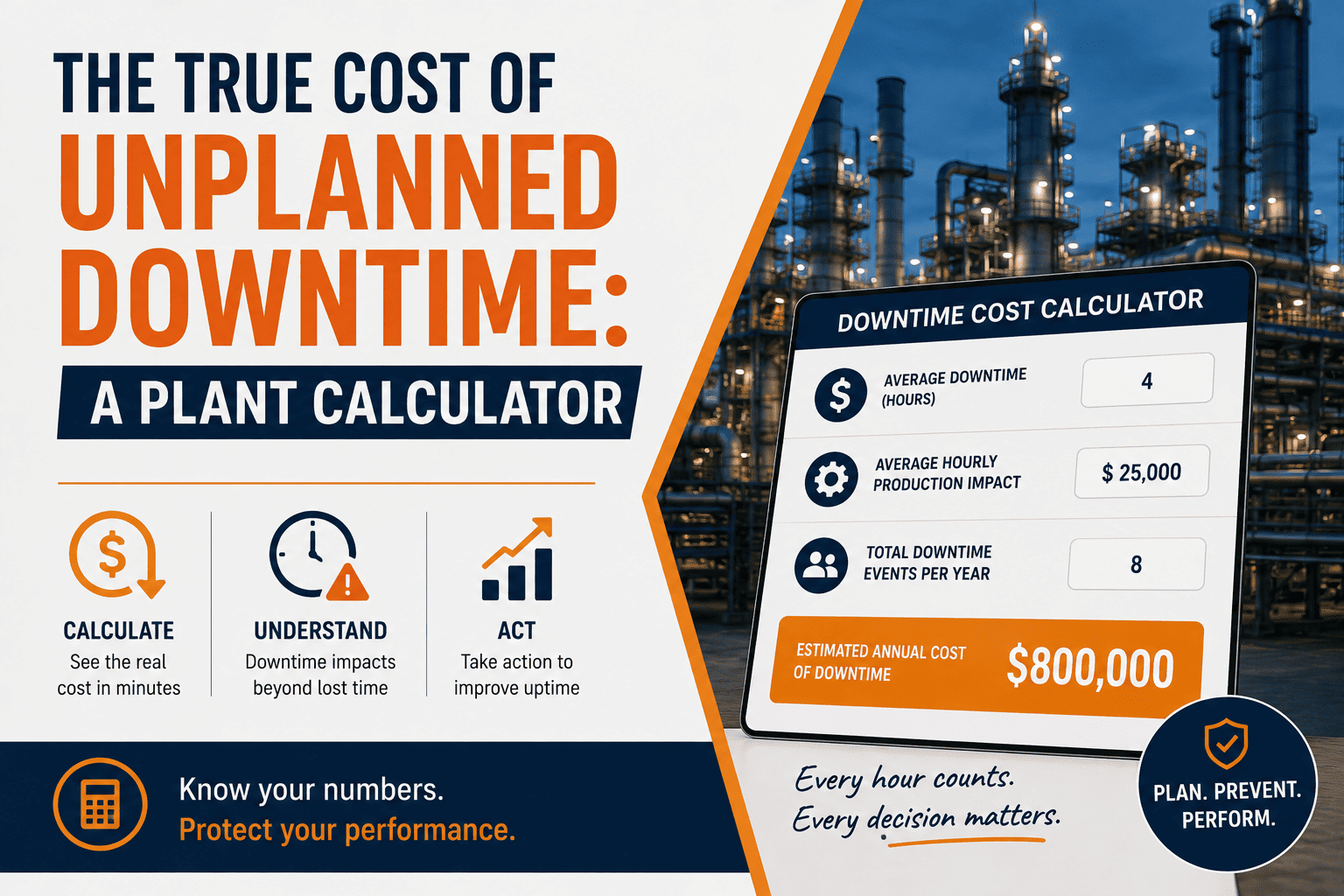
Calculate Your Annual Downtime Cost
Annual Downtime Hours  ×  Gross Margin Per Hour  =  Downtime Cost

Use gross margin per hour, not revenue. A plant producing $10M annually running 8,000 hrs with 40% margin loses $500/hr in true margin — not just sticker revenue. Then multiply by your annual unplanned downtime hours (industry average: 323).

Step 2
Quantify Current Maintenance Spend Waste
Annual Maintenance Cost  ×  40%  =  Reactive Waste Estimate

Studies consistently show reactive maintenance costs 4–5× more per repair than planned intervention. If your plant spends $500K/year on maintenance, roughly $200K is emergency-driven overhead that predictive programs eliminate within 12–18 months.

Step 3
Estimate Recoverable Value
(Downtime Cost + Reactive Waste)  ×  40%  =  Conservative Recovery

40% is the conservative benchmark from AMT and IEEE RAMS data for Year 1 recovery. Mature programs (Year 2+) recover 60–75%. Use the conservative figure when presenting to finance — then let the actual results outperform the model.

Step 4
Calculate ROI and Payback Period
ROI = (Recovery − Investment) ÷ Investment  ×  100
Payback (months) = Investment ÷ (Annual Recovery ÷ 12)

For a $75K sensor + software investment recovering $400K in Year 1, ROI is 433% with a 2.3-month payback — numbers that are not unusual for plants with downtime costs above $50K/hr. A single prevented major failure commonly covers the entire program cost.

ROI Benchmarks by Manufacturing Sector

Downtime cost per hour varies dramatically by industry. Use these benchmarks to locate where your facility sits and what realistic returns look like in your specific sector.

Sector Avg Downtime Cost/Hour Maintenance Cost Reduction Downtime Reduction Typical ROI (12–18 mo) Payback Period
Automotive $2.0M–$2.3M 25–30% 45–60% 20–30× 3–6 months
General Manufacturing $125K–$260K 25–30% 30–45% 10–30× 6–14 months
Food & Beverage $50K–$100K 20–25% 30–40% 8–15× 9–18 months
Heavy Industry / Cement $200K+ 30–40% 40–55% Up to 57× 3–9 months
Pharmaceuticals $150K–$500K 18–25% 30–45% 12–25× 6–12 months
Oil & Gas / Process $400K–$1M+ 25–35% 35–50% 15–30× 3–9 months

Figures are industry benchmarks from U.S. DOE, McKinsey, Siemens TCOD 2024, and Phoenix Strategy Group research. Your actual results depend on asset criticality, current failure rate, and program maturity.

3-Year ROI Model: What a Mid-Size Plant Actually Looks Like

Based on a facility with 50–100 critical assets, $2M annual maintenance spend, and 18 unplanned downtime incidents per year at $125K/hour average cost.

Investment
Sensors (per asset) $200–$2,000
IoT Infrastructure $50K–$200K
Software / CMMS $10K–$100K/yr
Integration Services $25K–$150K
Year 1 Total Outlay ~$100K–$450K
Return by Year
Year 1
$250K–$400K saved
60–70% of projected savings realized in first quarter post-launch
Year 2
$400K–$550K saved
Mature baselines, AI anomaly detection accuracy improves to 85%+
Year 3
$500K–$650K saved
Asset lifespan extensions begin deferring CapEx replacement cycles
3-Year Cumulative Net Return: $900K–$1.7M on a $200K program investment
No Spreadsheet Required

Oxmaint Tracks Every Dollar Saved — Automatically

When a sensor alert turns into a work order and the repair is completed before failure, Oxmaint logs the avoided downtime against your cost-per-hour inputs. Your ROI dashboard updates in real time — no manual data entry, no end-of-quarter guessing.

5 Inputs That Make or Break Your ROI Calculation

Garbage in, garbage out. The accuracy of your predictive maintenance business case depends entirely on how well you define these five baseline numbers before the program starts.

01
Hourly Downtime Cost
Use gross margin per production hour, not revenue. Include idle labor, missed shipment penalties, and scrap generated during restarts. Most plants underestimate this by 30–40% before their first calculation.
02
Annual Unplanned Downtime Hours
Pull the last 12 months of CMMS data. If you do not have a CMMS, count emergency work orders and multiply average repair time by 1.8× to account for secondary effects and restart time.
03
Current Annual Maintenance Spend
Include labor, contractor costs, spare parts, emergency procurement premiums, and any lost production attributed to maintenance activities. Most mid-size plants land between 2% and 5% of asset replacement value.
04
Number of Critical Assets
Define criticality as assets where a single failure costs more than $10K in downtime or creates a safety/quality event. Start your ROI model on the top 10–20 assets — they typically drive 70–80% of total maintenance costs.
05
Current Mean Time Between Failures
MTBF by asset type tells you where your biggest gains will come from. Assets with MTBF below 500 hours are strong candidates for vibration and current monitoring. Those below 200 hours are urgent priorities.

Frequently Asked Questions

How do I calculate predictive maintenance ROI for a small manufacturing facility?
Start with your top 5–10 critical assets. Multiply your average downtime cost per hour by annual unplanned downtime hours to get your baseline loss figure. Then apply a conservative 30–40% recovery factor to estimate Year 1 savings, and compare that against sensor and software investment. For a facility with even $50K/hour downtime costs, Oxmaint's free account can be configured in days and the program typically pays for itself before the first quarter ends.
What is the average payback period for predictive maintenance programs?
Most manufacturers hit breakeven within 6–14 months of full deployment, with 27% achieving payback within 12 months. Plants in high-cost sectors like automotive or oil and gas regularly see payback in 3–6 months — one prevented major failure can cover an entire year of platform cost. Book a session to model the payback timeline against your specific asset failure history and downtime rates.
What ROI does the U.S. Department of Energy report for predictive maintenance?
The U.S. DOE reports that predictive maintenance delivers an average 10:1 ROI on program investment — equivalent to a 1,000% return — alongside 70–75% reduction in equipment breakdowns and 25–30% lower maintenance costs. These figures are consistent with McKinsey and Deloitte benchmarks across hundreds of manufacturing deployments. Conservative estimates from industry analysts place the range at 5–8:1 for first-year programs and 10–30:1 for mature implementations. Start free with Oxmaint to begin building toward those numbers with your own asset data.
How much does predictive maintenance reduce maintenance costs?
Consistent research from McKinsey, Deloitte, and the DOE places maintenance cost reduction at 18–40%, with the range depending on how reactive the baseline program was. A facility spending $1M annually on maintenance can realistically target $180K–$400K in savings within 18 months. Savings come from eliminating emergency repair premiums, reducing spare parts overstock by 20–30%, cutting unplanned overtime by 15–20%, and deferring early capital replacement. Schedule a demo to see how Oxmaint tracks each category as savings accumulate in real time.
Can predictive maintenance ROI be justified for assets that fail infrequently?
Yes — low-frequency but high-consequence failures often deliver the strongest ROI cases. A single transformer or compressor failure costing $500K in downtime justifies years of monitoring investment. The ROI framework shifts from frequency-based to consequence-based: if one failure event exceeds your total annual sensor cost, monitoring is justified regardless of how rarely failures occur. Oxmaint's asset criticality scoring helps you identify exactly which low-frequency, high-consequence assets should be prioritized first.
How do I build a predictive maintenance business case for CFO approval?
Frame the investment around three numbers your CFO already cares about: current annual downtime cost, current maintenance spend as a percentage of asset replacement value, and the payback period of the pilot program. Document your top 10 asset failures from the past 24 months and calculate the avoided cost if each had been predicted 7 days in advance. A phased pilot on 5–10 assets reduces approval risk and generates real ROI data faster. Book a planning demo and Oxmaint's engineering team will help you structure the business case document with your actual inputs.
Your Next Unplanned Failure Is Already Being Predicted Somewhere

Make Sure It Gets Predicted at Your Plant

Every day a critical asset runs without condition monitoring is a day your facility absorbs costs that predictive maintenance programs have already eliminated for your competitors. Oxmaint connects sensor alerts to prioritized work orders automatically — no data entry, no missed thresholds, no unplanned downtime from alerts nobody acted on. Start free and see your first avoided failure on the dashboard within 30 days.
Share This Story, Choose Your Platform!