Managing 50 buildings from one operations team is not a scale problem — it is an information problem. Tenant requests arrive across email, portal, phone, and text. Maintenance tickets stack up without priority logic. Energy consumption drifts across the portfolio with no normalised benchmark to flag which building is actually underperforming. Property managers running multi-site portfolios in 2026 are not short of data — they are short of AI that turns that data into decisions. OxMaint's AI property management platform handles tenant request triage, predictive maintenance scoring, and energy benchmarking across every building in your portfolio from a single dashboard — deployable on-prem or in the cloud.
Live · Facility & Ops AI · Multi-Site Property
Upcoming Oxmaint AI Live Webinar-AI for Multi-Site Property Management: Operations at Portfolio Scale
Tenant Request Triage · Predictive Maintenance Scoring · Energy Benchmarking · 50+ Buildings
MAY 12, 2026 · 5:30 PM EST · Orlando
OxMaint AI Live Webinar — Deploy AI Across Your Property Portfolio in One Session
94%
Tenant Request Triage Rate
12
High-Risk Assets Flagged
3
Buildings Above Energy Benchmark
Energy Score by Building Type
68%
Tenant requests auto-triaged without human routing
4.2×
Faster maintenance prioritisation vs manual scoring
23%
Average energy cost reduction across portfolio
50+
Buildings managed per ops team with AI augmentation
The 3 Operational Bottlenecks AI Eliminates at Portfolio Scale
Bottleneck 1
Tenant Request Routing Takes Hours, Not Seconds
A portfolio of 50 buildings generates 200–400 tenant requests per week. Manually reading, categorising, and routing each request to the right property team or contractor is a full-time job that adds 4–12 hours of delay before any work begins. AI triage classifies request type, urgency, and responsible party automatically — routing 68% of requests without any human involvement and escalating the 32% that require judgment.
Bottleneck 2
Maintenance Backlog Has No Risk-Based Priority Logic
Without AI scoring, every open maintenance ticket looks equally important until something fails. A 200-item backlog across 50 buildings is unmanageable by inspection. OxMaint's predictive maintenance scoring assigns each asset a failure probability score based on age, service history, MTBF trend, and maintenance frequency — surfacing the 12 assets most likely to fail in the next 30 days before they cause tenant disruption or emergency spend.
Bottleneck 3
Energy Benchmarking Across Buildings Is Inconsistent
A building consuming 30% above its peer group is invisible without normalised benchmarking. Raw energy bills are not comparable across buildings with different occupancy, floor area, and usage type. AI energy benchmarking normalises consumption by building type, weather-adjusted degree-days, and occupancy rate — making it instantly visible which buildings are underperforming and which maintenance actions will recover the most energy efficiency.
AI Capability Matrix — What Gets Automated at Each Portfolio Scale
| AI Capability |
1–10 Buildings |
10–50 Buildings |
50+ Buildings |
| Tenant request auto-triage |
Useful |
High impact |
Critical |
| Predictive maintenance scoring |
Reduces reactive work |
Prevents escalation |
Required — manual scoring impossible |
| Cross-portfolio energy benchmarking |
Low priority |
Moderate value |
Critical for OpEx control |
| Contractor performance analytics |
Optional |
Useful |
High impact on cost control |
| Lease expiry + maintenance cost correlation |
Low priority |
Strategic insight |
Asset management critical |
| Compliance & inspection scheduling AI |
Useful |
High impact |
Risk management essential |
How AI Tenant Request Triage Works
1
Request Received
Tenant submits via portal, email, or SMS. AI ingests full text — no form structure required.
→
2
Classification
NLP model classifies: HVAC · Plumbing · Electrical · Access · Safety · Cosmetic · Noise
→
3
Urgency Scoring
Priority assigned: Emergency (water/safety) · Urgent (habitability) · Standard · Low (cosmetic)
→
4
Auto-Route or Escalate
68% routed automatically. 32% flagged for human review with AI-drafted summary and suggested action.
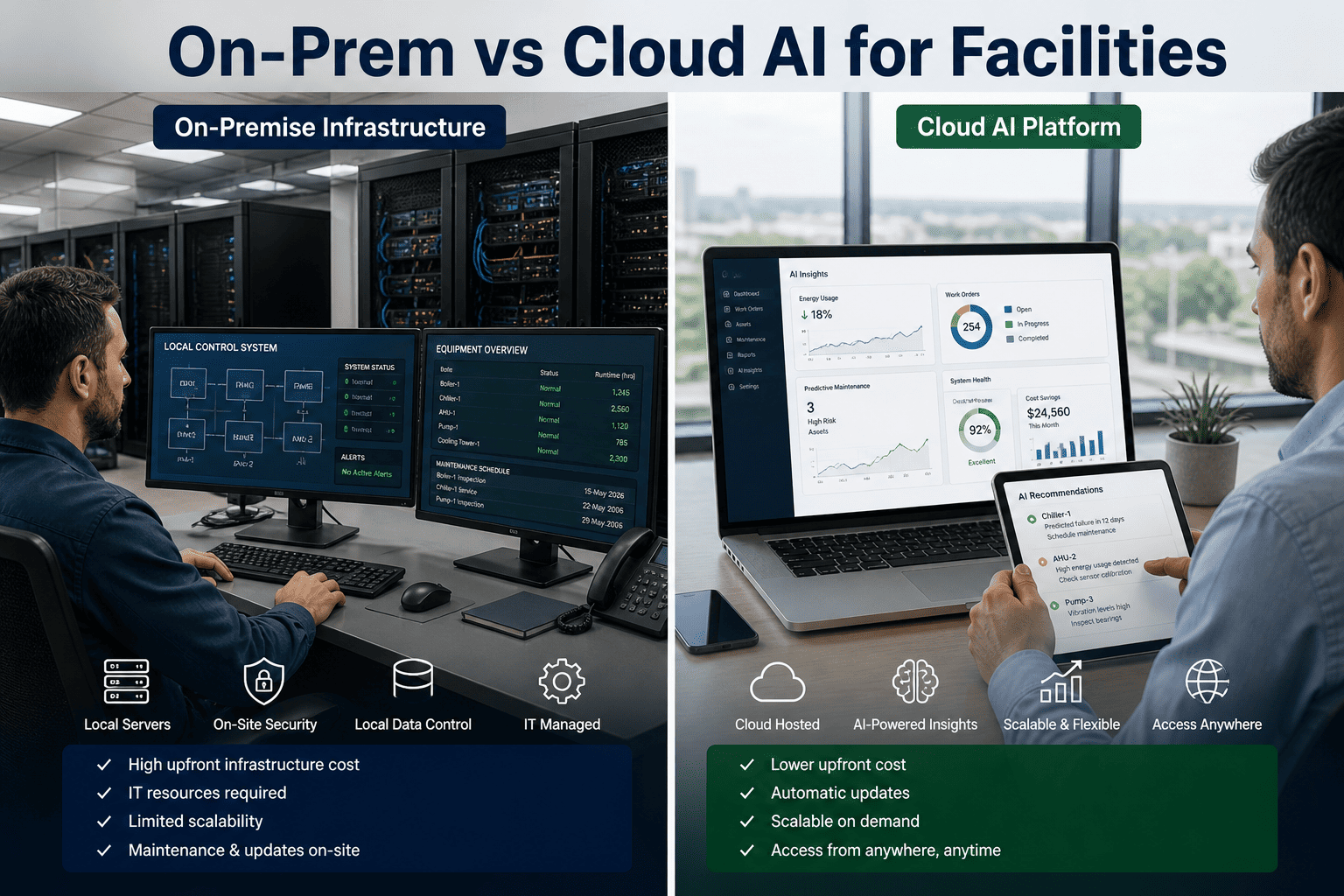
Deployment Architecture — On-Prem vs Cloud
On-Premises Deployment
Best for: Regulated · Government · Healthcare portfolios
AI models run on local servers — no tenant data leaves premises
Full compliance with data residency regulations (GDPR, local law)
Integrates with on-prem BMS, BACnet, and legacy property systems
Higher upfront hardware investment
Internal IT team required for model updates
Cloud Deployment
Best for: Commercial · Retail · Mixed-use portfolios
Deployed in days — no infrastructure procurement
Scales instantly as portfolio grows — no capacity planning
Model updates automatic — always current AI capabilities
Mobile-first access for on-site property managers
Data processed off-site — requires tenant data agreement review
"
The inflection point in multi-site property management is somewhere around 15 to 20 buildings. Below that threshold, an experienced property manager can hold enough mental context to triage requests, prioritise maintenance, and notice when a building is running hot on energy costs. Above 20 buildings, human cognitive capacity is the binding constraint — not team size, not budget, not technology. The managers I work with who have deployed AI triage and predictive maintenance scoring describe the same outcome: they stopped being reactive and started being deliberate. The AI handles the volume. The manager handles the judgment calls. That division of labour is what allows a team of four to effectively manage 60 properties with better tenant satisfaction scores than a team of eight managing 30 properties without AI augmentation.
Geraldine Moreau, CPM, MRICS
Senior Portfolio Operations Director · 22 Years Commercial and Mixed-Use Property Management · Certified Property Manager (IREM) · Member of the Royal Institution of Chartered Surveyors · Specialising in AI-augmented operations for large commercial property portfolios across Europe and North America
Energy Benchmarking — How AI Identifies Underperformers
Building A — Office · 12,000 sqm
Score: 91
Within benchmark — no action required
Building F — Retail · 8,400 sqm
Score: 64
18% above peer group — HVAC audit recommended
Building M — Residential · 240 units
Score: 83
Within benchmark — trending positive
Building R — Mixed-Use · 6,200 sqm
Score: 49
34% above benchmark — immediate investigation flagged
Frequently Asked Questions
How does OxMaint's AI handle tenant requests that don't fit standard maintenance categories?
OxMaint's NLP triage model uses a general-purpose classification layer trained on property management request data across residential, commercial, retail, and mixed-use categories. Requests that don't fit standard categories — noise complaints between tenants, lease clause queries, security concerns — are flagged for human review with an AI-generated summary of the request and a suggested response template. The human routing queue receives only the 30–35% of requests that require judgment; the rest are handled automatically. Over time, the model improves on your specific building portfolio's request vocabulary through supervised fine-tuning available in the OxMaint enterprise tier.
Start a free trial to see the triage interface with your request types.
Can OxMaint integrate with existing property management systems like Yardi, MRI, or AppFolio?
Yes. OxMaint connects to Yardi Voyager, MRI Software, AppFolio, Buildium, and RealPage via API or scheduled data sync. The integration typically requires read access to your work order, maintenance, and tenant records — OxMaint then layers AI scoring and analytics on top of your existing system without requiring migration. For portfolios with custom or legacy property systems, OxMaint supports CSV/JSON import pipelines for initial data ingestion while API integration is configured. Most integration projects complete within 2–3 weeks depending on the complexity of the source system's data model.
Book a demo to discuss your current property tech stack and integration path.
How accurate is the predictive maintenance scoring across diverse building types in the same portfolio?
OxMaint's predictive maintenance model is trained per asset class rather than per building type — so HVAC unit scoring uses HVAC-specific failure patterns regardless of whether the unit is in an office, retail, or residential building. This asset-class approach means scoring accuracy is not degraded by portfolio diversity. In pilot deployments across mixed portfolios, the model identifies 78–85% of assets that experience unplanned failure within 30 days of being flagged — measured against the control group of unflagged assets. Accuracy improves as historical work order data accumulates in OxMaint; most portfolios see meaningful scoring improvement after 90 days of data ingestion.
Explore OxMaint's predictive scoring with a free trial on your portfolio data.
OxMaint · AI Property Management
50 Buildings. One Operations Team. AI That Makes It Manageable.
OxMaint's AI property platform gives portfolio managers tenant request triage, predictive maintenance scoring, and energy benchmarking — across every building, from a single dashboard.