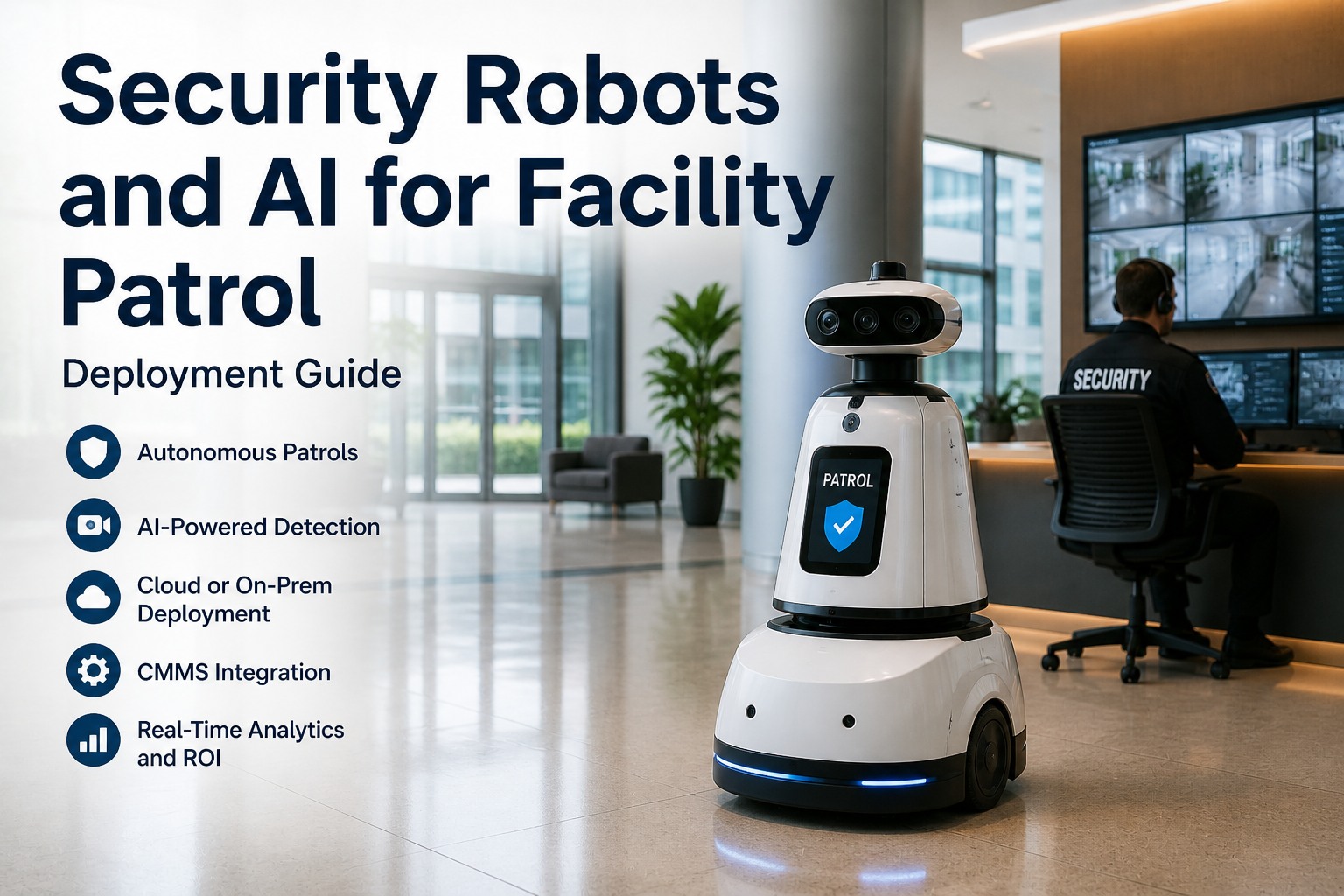
Security Robots and AI for Facility Patrol: Deployment Guide
By Riley Quinn on May 4, 2026
02:47 on a Sunday at a 4-acre logistics yard. Three trespassers cut the back fence. A K5-class autonomous patrol robot rolling its perimeter loop logs the movement at 02:48 — thermal signature, license plate of the parked vehicle, audio warning broadcast through the onboard horn. By 02:51, the local police are dispatched with timestamped video evidence already pushed to the dispatch system. The same incident under traditional patrol staffing takes 45-90 minutes to discover (between hourly walk-throughs) and produces zero usable evidence beyond what the trespassers leave behind. The math underneath this is brutal: a human guard costs $25-$45/hour. A robot patrol costs $7-$11/hour and never sleeps. Sign up free to see the security robot + CMMS workflow running on your facility footprint.
MAY 12, 2026 5:30 PM EST , Orlando
Upcoming OxMaint AI Live Webinar — Security Robots + CMMS: From Patrol Loop to Incident Work Order in 90 Seconds
Live session for facility security directors, physical security managers, CSOs, and operations leads. We'll architect a complete on-prem security robot deployment — patrol route optimization, edge video analytics, ONVIF + VMS integration, and the incident-to-work-order workflow that turns thermal detections into dispatched maintenance and security tickets in under two minutes. Includes the per-hour cost math that makes the CFO say yes.
The Hourly Cost Math — Where the Robot ROI Actually Lives
The CFO conversation about security robots starts and ends with one chart: cost per hour of coverage. Every other security argument flows from this number. A human security guard costs $25-$45/hour for unarmed coverage and $85/hour for armed off-duty law enforcement. An autonomous patrol robot covers the same perimeter at $7-$11/hour, with some subscription tiers running as low as $0.75/hour. The robot never sleeps, never calls in, never asks for overtime, and produces a timestamped video log of every patrol step. Here's what those numbers look like side by side.
Armed Off-Duty Officer
Hourly · sworn law enforcement
$85/hr
Unarmed Security Guard
Hourly · BLS & IBISWorld average
$25–$45/hr
Autonomous Security Robot
Hourly · 24/7 patrol coverage
$7–$11/hr
$79KForrester study annual savings — robot-as-a-service vs human guards over 12 months of 24/7 coverage
40%Overtime alone inflates labor cost by this much before recruitment, training, or turnover are added
3–5×Robot patrol cost-per-hour multiplier vs human guard at equivalent sites — the bigger the perimeter, the wider the gap
Three Robot Platforms — Match the Form Factor to the Facility
"Security robot" isn't one product — it's three distinct platforms with different terrain, different sensor packages, and different deployment patterns. Indoor wheeled robots dominate lobbies, malls, and large interior spaces. Quadruped robots (Spot-class with security payloads) handle stairs, gravel, and uneven terrain that wheels can't. Outdoor wheeled robots (SMP Argus, Knightscope K7) patrol large perimeters, parking structures, and open ground. The wrong form factor is the most common deployment failure in 2026 — here's how to match the platform to the site.
The robot itself is just the sensor platform. What turns a fleet of patrol robots into a security system is the workflow connecting detection to response. The OxMaint robot integration follows the same Detect → Document → Dispatch loop that ONVIF, VMS, and CMMS integration was built for — but compressed into seconds rather than the 5-15 minute lag that human-mediated alerts typically introduce. Book a demo to see the incident workflow running with live ONVIF feed.
02:48
Detect
Onboard NVIDIA Jetson runs YOLOv8 + thermal classifier. Identifies human figure 23m away in low-light, classifies confidence 91%, captures bounding-box video at 30fps.
02:49
Document
ONVIF stream pushes to on-prem VMS. License plate of parked vehicle logged, audio warning broadcast through onboard horn, time-stamped event tagged in incident timeline.
02:51
Dispatch
CMMS work order auto-created with full evidence package. On-call security supervisor paged. Local police dispatch notified with incident timeline. Total time: 3 minutes.
Loop closes in 3 minutes — vs 45-90 minutes typical human-only patrol
The Coverage Gap That Robots Actually Close
Human guards don't fail at security — they fail at coverage continuity. A typical 24-hour security shift covers patrol rounds in concentrated bursts (start-of-shift, mid-shift, end-of-shift) with significant gaps between. Robots eliminate the gaps because they never stop patrolling. The chart below shows what coverage continuity actually looks like across a 24-hour day. Sign up free to see your facility's coverage gap analysis modeled against autonomous patrol.
00:0006:0012:0018:0024:00
HUMAN GUARDS
Shift-based, hourly walk-throughs
Patrol
Patrol
Patrol
Patrol
Patrol
Patrol
Patrol
Patrol
~32%active coverage
ROBOT FLEET
Continuous, charging in sequence
Continuous patrol
Charge
Continuous patrol
Charge
Continuous patrol
~88%active coverage
Robot fleet coverage assumes 3-robot rotation with sequenced charging — a single robot achieves ~80% coverage solo.
Where the Insurance and Operations Numbers Land
Industry data on autonomous security robot deployments is now mature enough to anchor real ROI conversations — not just vendor pitches. The 2026 numbers from Forrester, Bureau of Labor Statistics, and the major insurance carriers show the financial case is no longer speculative. Book a demo to see these benchmarks modeled against your specific guard contract.
$9.33B
Commercial security robot market by 2031, up from $3.5B in 2025 (17.75% CAGR)
$79K
Annual savings vs human guards for 24/7 coverage — Forrester Trends Report
15–25%
Insurance premium discount range — Zurich Insurance for ISO 3691-4 compliant robotic guard sites
250K+
Automated security missions completed by Asylon DroneDog fleet to date
<1%
Hardware failure rate across missions — leading robotic security operators
100%
Patrol route consistency — robots execute programmed routes without fatigue or distraction
Pre-Configured · ONVIF-Ready · Ships in 6–12 Weeks
Order a Security Robot AI Stack That Connects to Your Robots Before They Roll
OxMaint's security robot AI server arrives pre-configured with the ONVIF video analytics fusion, fleet route optimization, edge AI integration with Knightscope/SMP/Asylon platforms, VMS integration, and CMMS work-order automation. Pre-configured, pre-tested, ready to plug into your robot fleet within days. No SaaS lock-in. Source code and modification rights included.
What an On-Prem Robot Integration Stack Actually Costs
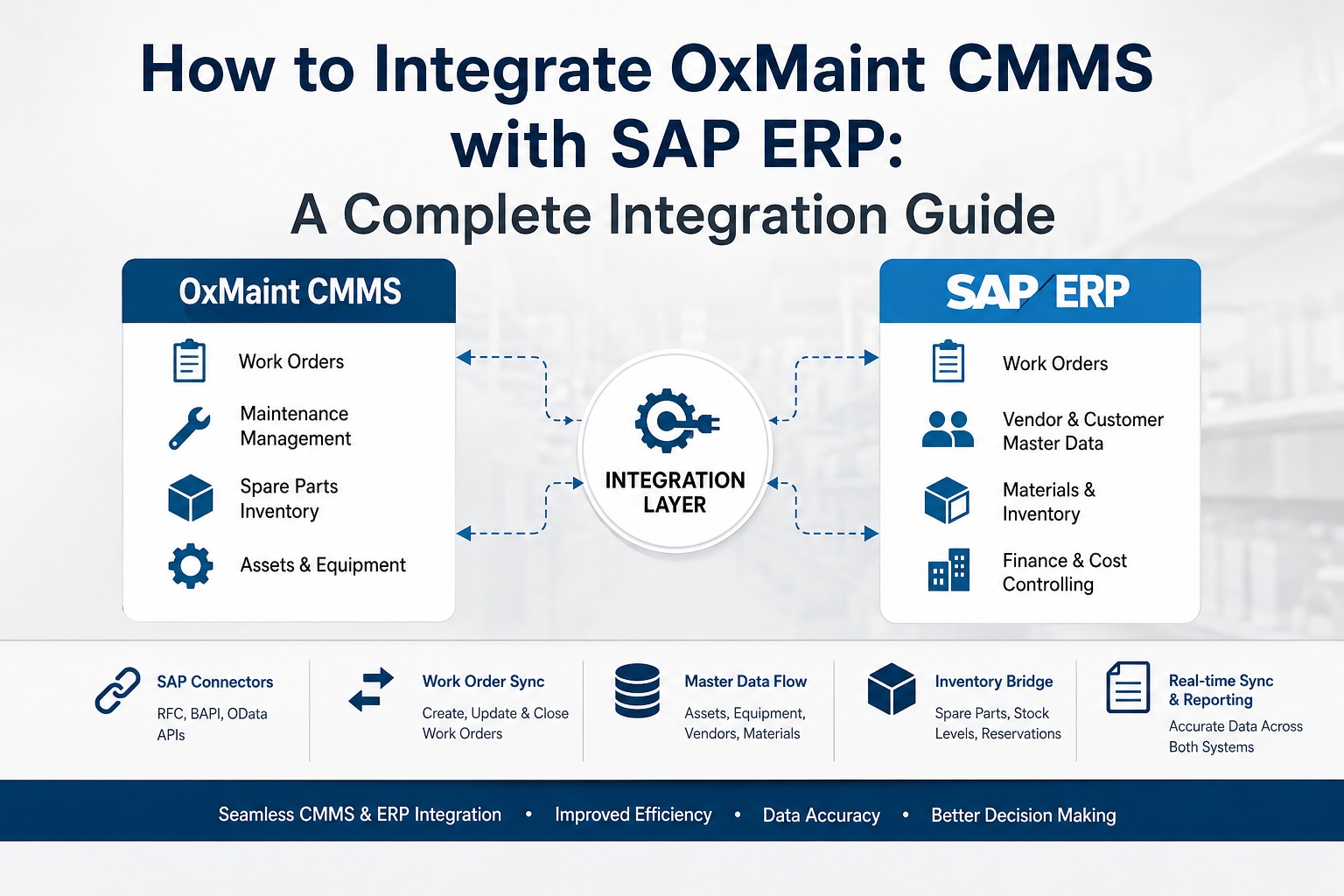
The robots themselves are sourced from your platform vendor of choice — Knightscope, SMP, Asylon, Boston Dynamics. The OxMaint stack is the AI integration layer that turns a fleet of robot platforms into a coordinated security system: video analytics, fleet management, ONVIF/VMS integration, CMMS workflow, and incident dispatch. Below is the platform layer cost — robot hardware is purchased separately from the platform vendor. Sign up free to see integration pricing tailored to your robot fleet size.
Swipe to see breakdown
Component
Unit Cost
Per Site (4 mo)
Notes
AI server (GPU + compute)
$19,000
$19,000
Video analytics + fleet coordination + edge inference
4-month delivery — platform layer, robot hardware separate
4-Site Portfolio Rollout
~$420,000–$520,000
Total programme
Parallel deployment across multiple sites
$84.5K
Avg per site
4 mo
Delivery
$0
Recurring fees
∞
Perpetual
Perpetual · Owned · ONVIF + Edge AI · Multi-Vendor Robot Support
Stop Paying Guard Wages for Routes a Robot Can Patrol on Repeat
A complete on-prem AI integration platform on enterprise-grade hardware in your facility. Multi-vendor robot fleet management, edge video analytics, ONVIF + VMS + CMMS integration, real-time incident dispatch — all pre-installed, all owned. Works with Knightscope, SMP Argus, Boston Dynamics + Asylon, and any ONVIF-compliant robot platform. No SaaS lock-in. No per-robot recurring fees.
Do we have to buy a specific brand of robot to use the OxMaint AI platform, or does it work with our existing fleet?
The OxMaint security robot AI platform is vendor-agnostic and supports any ONVIF-compliant robot platform — which covers the majority of commercial security robots in 2026. Specifically supported out of the box: Knightscope K5/K7 series, SMP Robotics Argus S5 series (S5.2, S5.3, S5.5), Boston Dynamics Spot with Asylon PupPack security payload, Cobalt Robotics, Ascent AeroSystems, and Oneway Robotics platforms. The OxMaint platform reads video and telemetry from your robot fleet through standard ONVIF and RTSP protocols, runs the analytics layer (object detection, license plate recognition, anomaly classification, fleet route optimization), then writes incident events back to your VMS and CMMS. If you're starting from zero robots, the OxMaint deployment includes platform recommendations matched to your facility type — wheeled indoor for office/healthcare, quadruped for data centers and stairs, outdoor wheeled for perimeter and yards.
How does this integrate with our existing VMS — Genetec, Milestone, Avigilon, Honeywell, others?
The OxMaint platform integrates with all major commercial VMS through standard protocols. ONVIF Profile S/T/G integration: Genetec Security Center, Milestone XProtect, Avigilon ACC, Honeywell MAXPRO, Hanwha Wisenet WAVE, Pelco VideoXpert, Bosch BVMS. Direct API integration: Genetec Mission Control plugin, Milestone Smart Client SDK, Avigilon Cloud Services. The platform reads live video and event data from your robot fleet, runs the AI analytics, and pushes time-stamped events back to your VMS as standard alarm events with attached video clips, license plate logs, and bounding-box overlays. Operators see robot-detected events in the same VMS console they already use for fixed cameras — no separate dashboard, no operator retraining. Typical VMS integration is 3-5 days from credentials handover to live event flow.
What happens when the robot detects a person — does it intervene physically, and what about privacy and use of force concerns?
Current commercial security robots in 2026 do not physically intervene in incidents. They are detection, documentation, and deterrence platforms. The standard response sequence is: (1) detect via on-board cameras and thermal imaging, (2) classify the event using edge AI, (3) broadcast a voice warning through the onboard horn ("you are entering a restricted area, security has been notified"), (4) push live video and event data to the dispatch system, (5) human operator decides on response. Some platforms offer optional non-lethal deterrents (high-intensity searchlight, dazzler, marker laser) but these require human-confirmed activation, not autonomous engagement. On privacy: the OxMaint platform supports privacy-zone masking (configurable areas where faces and bodies are auto-blurred), compliant audit logging, and on-prem-only data retention so no recordings leave your network unless you choose. Many jurisdictions require posted notification of robot patrol presence; the platform includes the signage templates and audit trail typically required for compliance.
What about false positives — won't the robot keep alarming on mail carriers, cleaning crews, and after-hours staff?
False positives are the most common reason security robot pilots fail. The OxMaint platform addresses them four ways. First, badge integration: access-control system feeds tell the AI which people are authorized to be in a zone at a given time, so an after-hours cleaning crew with badged entry doesn't trigger an alert. Second, scheduled exception zones: mail carrier routes, vendor delivery windows, and known patterns are configured as expected events — the system documents the visit but doesn't escalate. Third, multi-modal confirmation: an alert requires at least two confirming signals (camera detection + thermal signature + audio anomaly, or camera detection + perimeter sensor) before escalating to human dispatch. Fourth, learning feedback: every dismissed alert feeds the model, so within 4-6 weeks the false-positive rate drops substantially as the system learns your specific facility's normal patterns. Production deployments typically reach trustworthy alert rates (sub-5% false positive) by week 6-8.
How long from sign-up to live robot patrol operation?
Six to twelve weeks from sign-up to live operation is typical for the OxMaint integration platform. Robot platform delivery from your robot vendor (Knightscope, SMP, Asylon) runs in parallel — those typically ship in 8-16 weeks depending on platform and configuration. The compressed OxMaint timeline works because the integration server is configured, integrated, and pre-tested in the OxMaint factory before shipping — GPU, AI software, ONVIF/RTSP connectors, video analytics models (object detection, LPR, thermal classification), and VMS/CMMS integration are all installed and validated against synthetic robot fleet data before the unit ships. On-site work then collapses to: rack the server in your security operations center or IT room (1 day), connect to your VMS and access control systems (2-3 days), configure robot fleet endpoints and patrol route mapping (1 week), run the system in shadow mode against existing camera infrastructure (2-4 weeks), then enable live robot fleet integration as your robot platforms arrive on site. Most facilities deploy the platform first against existing fixed cameras (immediate analytics value), then layer in robot fleet integration as the platforms ship.