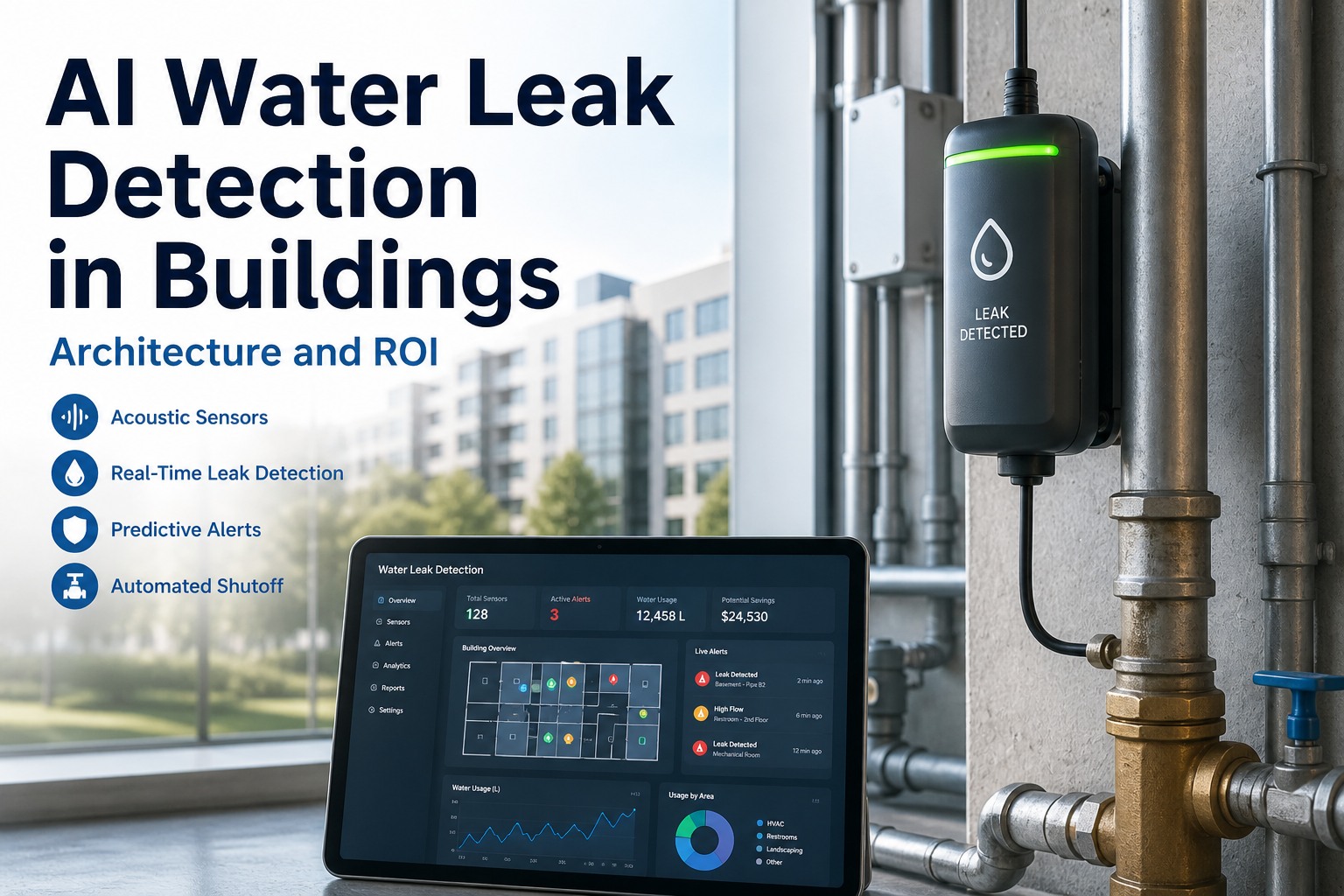
AI Water Leak Detection in Buildings: Architecture and ROI
By Riley Quinn on May 4, 2026
A pinhole leak under a 45th-floor sink at 02:14 on a Saturday. By 02:18, water has crossed three floors. By 06:00, when the morning crew arrives, eight floors are wet, three tenants are calling, and the insurance adjuster is on speaker. A flow-anomaly model on the same building's water meter flagged the unusual 02:15 baseline excursion — building-wide flow shouldn't be running at 4 AM. The shutoff valve closed at 02:17. Total damage: $4,800. Without the model, the same incident averages $500,000 in repairs, business interruption, and tenant claims. 70% of commercial water damage happens outside business hours — exactly when human inspection is gone. AI water leak detection isn't about better sensors. It's about closing the loop in 8 minutes instead of 4 hours. Sign up free to see the AI leak detection model running on your building's water meter.
MAY 12, 2026 5:30 PM EST , Orlando
Upcoming OxMaint AI Live Webinar — AI Water Leak Detection: From Pinhole to Auto-Shutoff in 8 Minutes
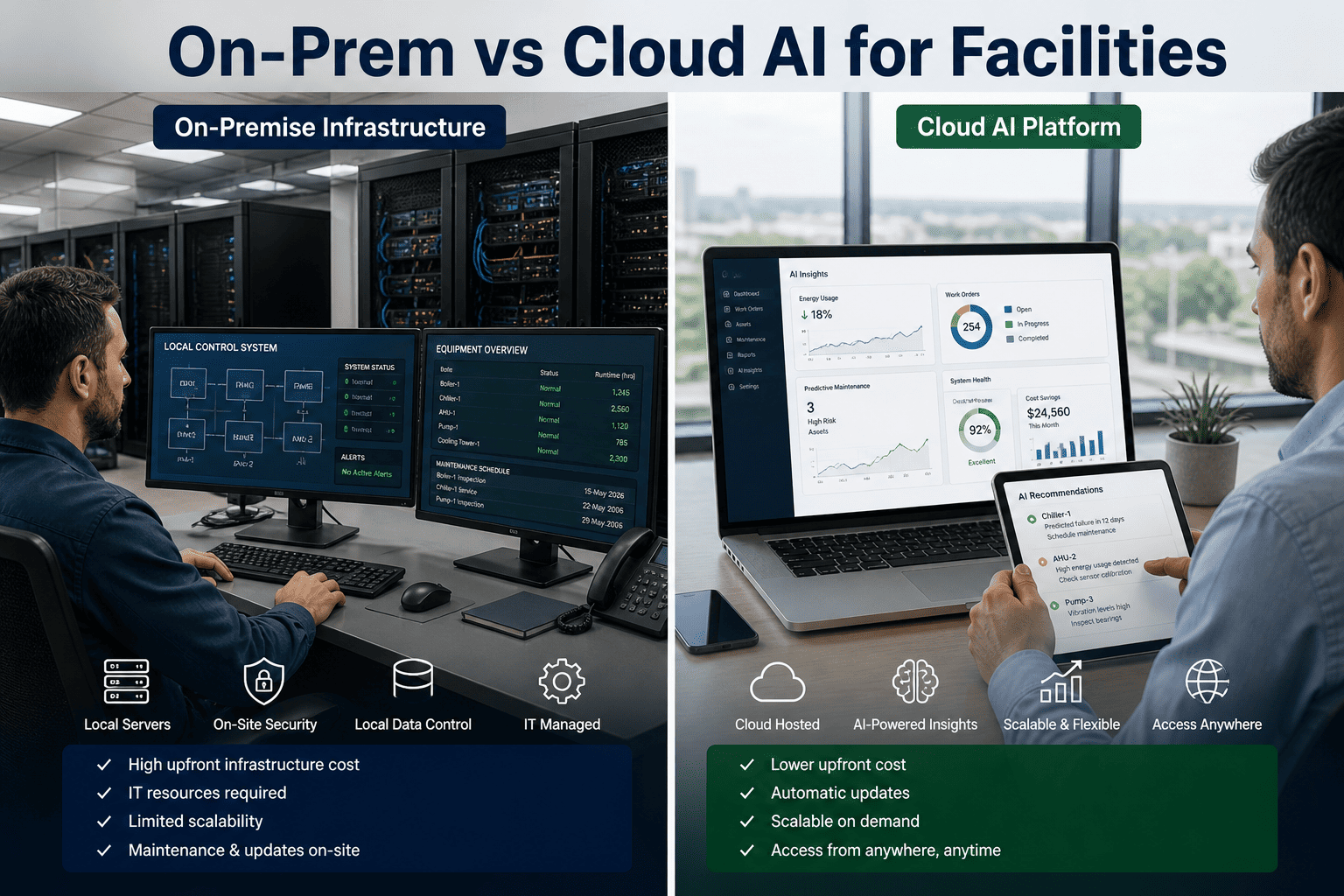
Live session for facility managers, property operators, risk managers, and insurance brokers. We'll architect a complete on-prem AI leak detection deployment — flow-anomaly models, acoustic mesh, smart shutoff integration, after-hours alert escalation, and the insurance-grade audit trail that earns 5-15% premium discounts. Includes the damage-cost curve every property owner should know.
The Damage Curve — Why Detection Time Is Everything
The single most consequential number in water leak detection is the time between leak start and detection. The cost of a water leak doesn't grow linearly — it explodes. A leak caught in the first hour costs $50 to fix. The same leak caught after three months costs $15,000. After four hours, costs cross $50,000. The mission of AI leak detection isn't to find leaks more accurately than a plumber would; it's to find them at the only point where the damage curve is still flat.
DAMAGE COST
$50–$5K
AI Detection Window
Continuous monitoring catches the flow excursion in minutes. Smart shutoff isolates before water spreads. Repair is the leak itself, not the building.
$5K–$50K
Human Discovery Window
Staff arrives, sees water, calls maintenance. Floor by floor damage. Insurance claim filed. Tenants displaced. Average commercial claim: $24,000.
$50K–$500K+
Catastrophic Discovery
Mold, structural damage, business interruption, tenant claims. Severe claims regularly exceed $500K; healthcare and data centers reach $1–2M.
The Five Detection Methods — What Each Catches, What Each Misses
Building leak detection isn't one technology — it's a stack of complementary sensors. Each catches a different leak type, covers a different area, and operates at a different cost. The buildings winning at leak prevention in 2026 don't pick one method; they layer flow-anomaly detection (whole-building) on top of acoustic mesh (pipe-level) on top of point sensors (high-risk zones), with smart shutoff valves as the closing action. Here's what each layer is for.
Best forMulti-tenant chargeback, ESG reporting, cost allocation
MissesReal-time event response — built for analytics, not alarms
The 70% After-Hours Problem — And the Auto-Shutoff Loop That Solves It
Insurance claims data reveals that roughly 70% of commercial water damage occurs outside business hours. The pinhole on Saturday at 02:14 isn't an outlier — it's the median. Without continuous AI monitoring, the leak runs from 02:14 to 06:00 before anyone is on-site. The OxMaint detect → shutoff loop closes that gap. Book a demo to see the auto-shutoff sequence running on a live test bench.
Flow excursion + acoustic spike correlation. Confidence 94%. Severity: high. Risk to building: 14 floors of cascade exposure.
02:17
Auto-shutoff fires
Motorized ball valve closes the riser feeding the affected floor. Building-wide supply remains live. Work order auto-created. On-call dispatched.
Loop closes in 3 minutes — total damage capped at the in-pipe leak
The ROI Math Insurance Carriers Actually Reward
Insurance is increasingly mandating leak detection, not optional. Farmers Insurance has begun requiring it for older properties and high-risk zones. Chubb offers an 8% discount for qualifying systems. Industry-wide premium discounts run 5-15% for buildings with continuous monitoring. The 2026 financial case isn't about avoiding one disaster — it's about the recurring annual savings stacking up alongside the avoided-claim probability. Sign up free to model the insurance ROI for your specific portfolio.
$24K
Average commercial water damage claim — Insurance Information Institute
$15B
Annual U.S. insurance payouts for water damage claims
70%
Of commercial water damage occurs outside business hours — when AI is the only watcher
5–15%
Premium discount range for buildings with continuous leak monitoring
93%
Damage severity reduction reported by buildings with detection systems
12–24 mo
Typical payback window from premium reductions alone — before any claim is avoided
Pre-Configured · BACnet-Ready · Ships in 6–12 Weeks
Order a Leak Detection AI Stack That Closes the Loop in Minutes
OxMaint's leak detection AI server arrives pre-configured with the flow-anomaly model, acoustic mesh integration, smart shutoff valve control, after-hours alert escalation, insurance-grade audit trail, and CMMS work-order automation. Pre-configured, pre-tested, ready to plug into your building's water infrastructure within days. No SaaS lock-in. Source code and modification rights included.
What an AI Leak Detection Deployment Actually Costs
Most leak detection vendors charge per-sensor SaaS, with separate fees for the analytics tier, the shutoff control module, and the insurance-export reports. The OxMaint leak detection stack is a one-time capital purchase: hardware, perpetual software license, AI models, and integration with your existing flow meters, acoustic sensors, and shutoff valves. No recurring license fees. Future costs are entirely optional and at your discretion. Sign up free to see leak detection pricing for your building footprint.
Swipe to see breakdown
Component
Unit Cost
Per Building (4 mo)
Notes
AI server (GPU + compute)
$19,000
$19,000
Flow anomaly + acoustic fusion + shutoff control
Edge sensor bridge unit
$4,000
$4,000
Flow meter + acoustic mesh + valve controller protocols
Network + install
$10,500–$14,500
~$12,500
Building VLAN, mechanical-room cabling, electrical
OxMaint AI software + integration
$35,000–$55,000
$45,000 avg
Perpetual license, AI models, BMS / shutoff integration, insurance export
Per-Building Total
$72,500–$94,500
~$84,500 avg
4-month delivery — single building or campus
4-Building Portfolio Rollout
~$420,000–$520,000
Total programme
Parallel deployment across portfolio
$84.5K
Avg per building
4 mo
Delivery
$0
Recurring fees
∞
Perpetual
Real Cases — Where the Math Showed Up
The leak detection ROI argument doesn't live in marketing decks — it lives in the documented case studies that property managers and insurance brokers pass around. Here are three that anchor the conversation in 2026. Book a demo to see how these patterns map to your specific risk profile.
01
High-Rise — $500K Saved on Floor 13
A leak in upper floors of a multi-floor commercial property was caught by AI flow analytics before water progressed below the 13th floor. Insurance provider's documented loss avoidance: $500,000 from one incident — equivalent to roughly six years of the building's leak detection investment.
02
Midtown 45-Story Tower — 87% Incident Reduction
After deploying a comprehensive AI leak detection system, a 45-story Midtown office tower documented an 87% reduction in water-related incidents in the first year and secured a 12% insurance premium reduction — compounding savings on a high-value commercial premium.
03
Historic Lower Manhattan — 6 Hidden Leaks Caught
A century-old commercial property installed non-invasive AI leak detection and identified 6 previously unknown small leaks in the first 90 days. Estimated avoided structural damage: $430,000. The building's insurer has since used the case as a template for older-property underwriting.
Stop Discovering Leaks at 6 AM When the Damage Is Already Done
A complete on-prem AI leak detection platform on enterprise-grade hardware in your building. Flow-anomaly model, acoustic mesh integration, smart shutoff valve control, after-hours escalation, insurance-grade audit trail, CMMS work-order automation — all pre-installed, all owned. No SaaS lock-in. No per-sensor recurring fees. Source code and modification rights included.
Do we need to install acoustic mesh sensors throughout the building, or can we start with flow-only monitoring?
Flow-only monitoring is genuinely effective as a starting point and produces meaningful ROI in the first year. A single ultrasonic flow meter at the building's main supply line — combined with the OxMaint flow-anomaly AI model — catches the majority of incidents that drive the largest claim values: hidden supply-line leaks, after-hours flow excursions, pipe bursts, and zone-wide pressure drops. The AI model learns your building's normal usage signature in 4-6 weeks (daily, weekly, and seasonal patterns) and then flags any deviation from baseline. Acoustic mesh becomes valuable as the second layer: it pinpoints where in the building the flow excursion is coming from, which speeds up response. Point sensors at high-risk zones (server rooms, mechanical rooms, near vault doors) are the third layer for incidents where any water exposure is unacceptable. Most buildings start with flow-only, see meaningful ROI inside 12 months, then add acoustic mesh and point sensors in a phased rollout.
How does the AI model distinguish a real leak from normal but unusual water usage — like a fire system test or a tenant move-in?
This is the classic false-positive problem and the OxMaint model addresses it three ways. First, multivariate context: the model considers time of day, day of week, ambient temperature, scheduled events (fire system tests on a calendar), and tenant move-in/move-out events from the property management system — so a 4 AM flow event during a scheduled fire pump test isn't flagged. Second, severity gradation: rather than binary alarm/no-alarm, the system produces a graduated severity (info / amber / red) where info-level events log for documentation but don't escalate. Red-level events (which trigger auto-shutoff and on-call escalation) require multiple confirming signals — flow excursion AND acoustic spike, or flow AND duration above threshold. Third, learning from feedback: every time a facility manager confirms or rejects an alert, the model updates. False positives drop substantially in the first 8-12 weeks as the model adapts to your specific building's quirks (the cooling tower top-up at 03:00, the kitchen pre-rinse at 05:30, the maintenance flush every other Tuesday).
How does this integrate with our existing BMS and flow meters — Honeywell, Belimo, JCI, ABB, others?
The OxMaint leak detection AI platform connects to all major BMS vendors and flow meter manufacturers through standard building protocols. BACnet/IP integration: Honeywell Niagara, JCI Metasys, Schneider EcoStruxure, Siemens Desigo. Modbus TCP: ABB flow meters, Endress+Hauser, Krohne, Belimo, Siemens MAG. MQTT: modern IoT-native flow sensors and acoustic meshes (Alert Labs Flowie, Phyn, Moen Flo, Watchdog ALERT). Direct API: Niagara, BACnet over Web Services. Smart shutoff valve control: motorized ball valves from Belimo, Siemens, Spence, Watts, and most major manufacturers via standard 24V or BACnet/Modbus control. The platform reads flow and acoustic data from your existing sensors, runs the leak-detection AI fusion and prediction models, and writes shutoff commands back to the BMS or directly to the valve controller through the same protocols. Typical BMS integration is 3-5 days from credentials handover to live closed-loop operation.
What's the realistic insurance discount we should expect?
Industry-wide, insurers offer 5-15% premium discounts for buildings with continuous water leak monitoring. The exact discount depends on your carrier, your building type, and how comprehensively the system is documented in your underwriting application. Specific named programs as of 2026: Chubb offers an 8% discount for qualifying installations. Farmers Insurance has begun mandating leak detection for older properties and high-risk zones — making detection a coverage requirement, not just a discount opportunity. Other major commercial carriers (Travelers, Liberty Mutual, AIG) typically negotiate 5-10% discounts on a case-by-case basis with documented system specifications. For a building paying $50,000 annual property premium, an 8-10% discount is $4,000-$5,000 per year — roughly 30-40% of typical leak detection ongoing operating cost, before any claim is avoided. The OxMaint platform produces an insurance-broker-ready specification document that includes sensor placement, coverage area, response-time documentation, and audit trail — exactly the format underwriters need to issue the discount.
How long from sign-up to live leak detection operation?
Six to twelve weeks from sign-up to live operation is typical. The compressed timeline works because the server is configured, integrated, and pre-tested in the OxMaint factory before shipping — GPU, AI software, flow-anomaly model, acoustic processing, BACnet/Modbus connectors, shutoff valve control logic, and CMMS integration are all installed and validated against synthetic building water data before the unit ships. On-site work then collapses to: rack the server in your building's IT room or BMS closet (1 day), connect to your flow meters and acoustic sensors (2-3 days), configure shutoff valve control circuits (1 week, plumbing-licensed work), run the system in shadow mode against current operations (2-4 weeks for the AI to learn your building's baseline), validate insurance audit-trail format with your broker (concurrent), then enable closed-loop auto-shutoff. Most buildings deploy detection-only first (alerts to facility manager phone, no auto-shutoff), then enable closed-loop auto-shutoff once operator confidence in the model is built — typically week 6-8.