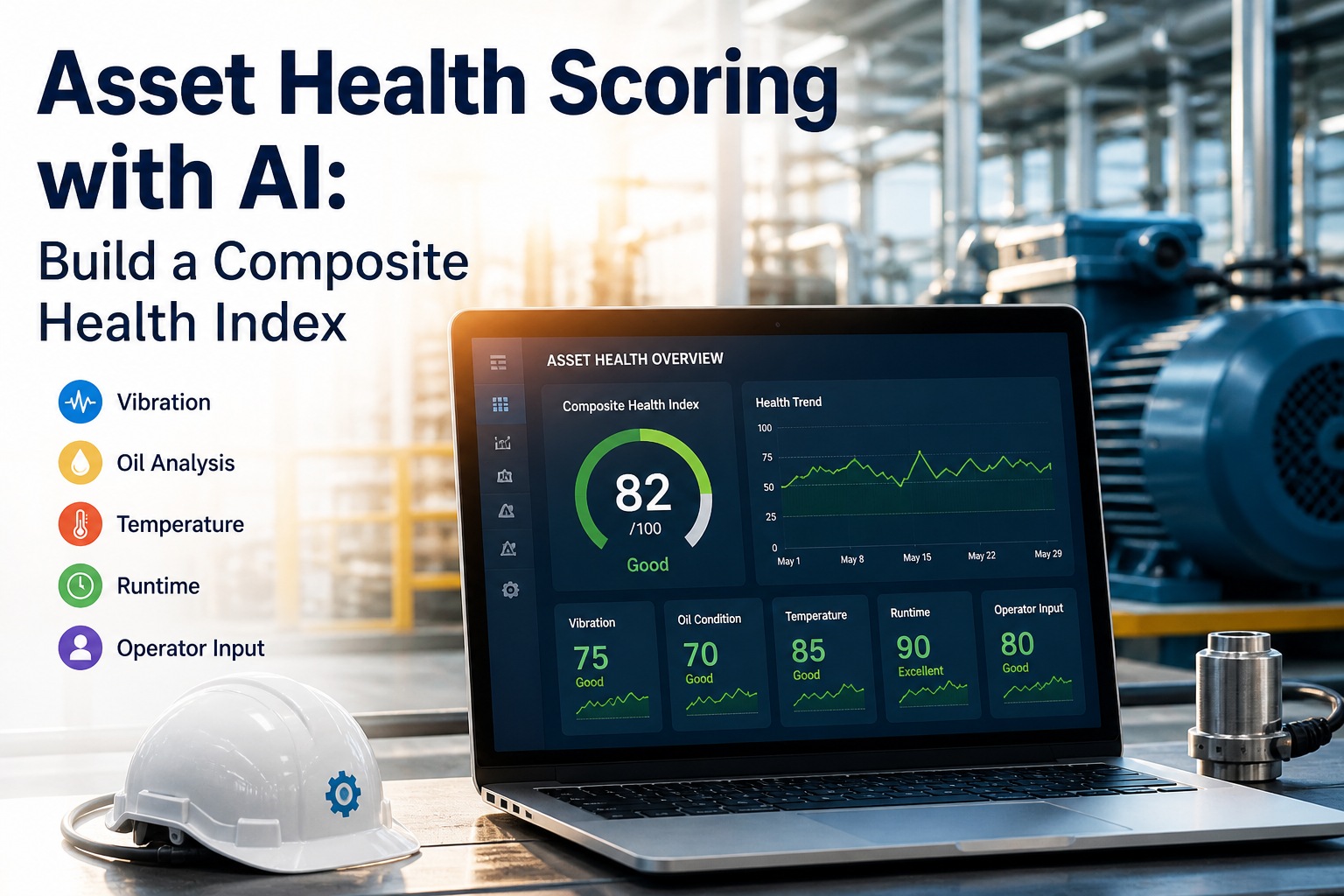
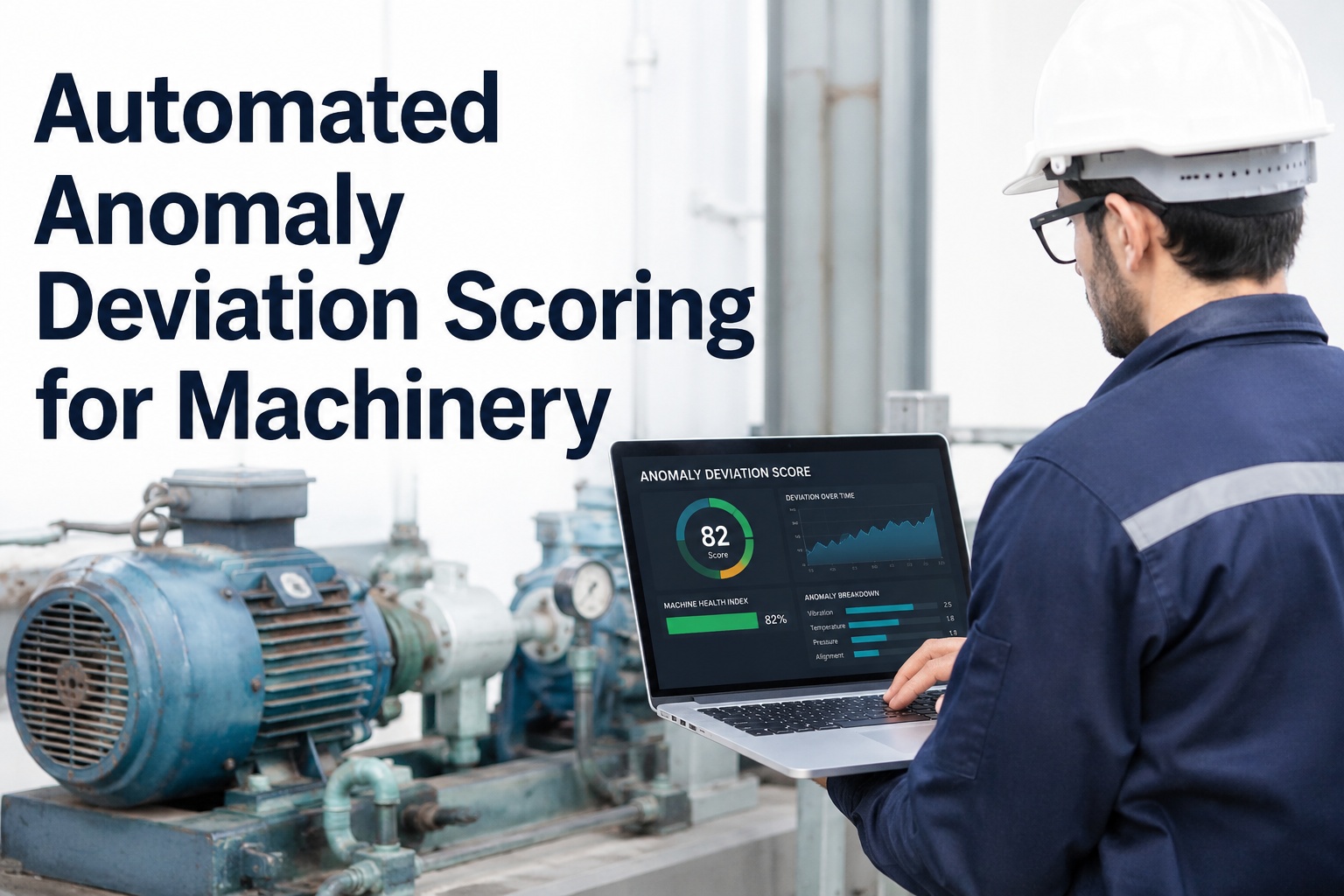
Asset Health Scoring with AI: Build a Composite Health Index
By Riley Quinn on May 4, 2026
A maintenance lead opens the dashboard at 06:30 on a Monday. Twelve hundred assets across the plant. Each one has a single number next to its name: a score from 0 to 100. Pump P-244 is at 87 — green, no action. Compressor C-12 is at 64 — amber, schedule a service window. Mill drive M-08 is at 38 — red, dispatch now. That's the entire morning triage, done in four minutes. The math underneath each number is brutal: vibration FFT features, oil particle count (ISO 4406), motor current signature, thermal trends, runtime hours, and the technician's last work-order note — six independent signals, weighted by asset class, fused into one composite health index. Single-sensor monitoring gets to 35% false positives. Composite scoring lands under 8%. Sign up free to see the composite health scoring model running on your asset list.
MAY 12, 2026 5:30 PM EST , Orlando
Upcoming OxMaint AI Live Webinar — Asset Health Scoring: From Six Sensor Signals to One 0–100 Index
Live session for reliability engineers, maintenance managers, plant CIOs, and asset performance leads. We'll architect a complete composite asset health scoring deployment — multi-sensor fusion (vibration, oil, temperature, current, runtime, operator input), per-asset-class weighting, severity zones, RUL estimation, and the CMMS work-order integration that turns scores into scheduled maintenance. Includes the false-positive math that takes alarm fatigue from 35% to under 8%.
The 0–100 Score — Anatomy of a Composite Health Index
An asset health score is one number that means everything. 92 = healthy, 64 = degrading, 38 = critical. But the number is only useful if a technician can trust it — and trust comes from understanding how it's constructed. The score isn't a single sensor reading. It's a weighted fusion of six independent signals, each contributing a portion of the 100 points based on what that signal reveals about asset condition. Here's the live anatomy of a sample compressor health score, broken down by contribution.
Compressor C-12 · Reciprocating · Class A Critical
64
DEGRADING — Plan service
Vibration · 18/30
Oil · 12/20
Temp · 10/15
Current · 9/15
Runtime · 8/10
Op · 7/10
050100
0–49
Critical
Failure imminent. Auto-dispatch. Stop or run-to-fail decision. Parts pre-staged.
50–74
Degrading
Schedule service in next planned window. Order parts. Increase monitoring cadence.
75–100
Healthy
Normal operation. Standard PM cadence. No action required.
The Six Signals — What Each Input Reveals and How It's Weighted
The score's weighting isn't arbitrary. Each input contributes a percentage of the total based on what that signal actually tells you about asset condition for that asset class. A reciprocating compressor weights vibration heavily because rod-to-piston dynamics surface there first. A gearbox weights oil analysis higher because metal particle count predicts gear tooth wear. The OxMaint platform ships with pre-calibrated weight templates per asset class — and the weights tune to your specific failure history over the first 90 days. Book a demo to see the weighting calibration on your asset library.
30%
Vibration
FFT features → bearing wear, imbalance, misalignment, looseness
Detects 4–8 weeks pre-failure
20%
Oil Analysis
ISO 4406 particle count, wear metals (ferrography), TAN/TBN, viscosity
The single most expensive failure mode of single-sensor predictive maintenance is alarm fatigue. A vibration-only system fires on every transient — load swings, ambient changes, sensor noise — and the maintenance team learns to ignore the alerts. Composite health scoring solves this because the score only drops when multiple signals confirm the trend. A vibration spike alone won't move a healthy 92 score. A vibration spike plus rising oil particle count plus increasing current draw moves the score to 64 and triggers action. Sign up free to see the alarm-rate comparison run on your historical sensor data.
SINGLE-SENSOR
Threshold alarms on individual signals
False positive rate35%
Alarm cadence10–25 alerts per asset per week
Operator responseAlarms get muted within 4–6 weeks
Detection accuracy72% at 1–2 weeks pre-failure
COMPOSITE SCORE
Multi-signal fusion, weighted by asset class
False positive rate<8%
Alarm cadence1–3 actionable alerts per asset per month
Operator responseTrust grows — alerts treated as actionable
Detection accuracy94% at 3–5 weeks pre-failure
4×Lower false positive rate vs single-sensor
2.5×Earlier detection — 3-5 weeks vs 1-2 weeks
25%Maintenance cost per asset reduction (POSCO 180-asset deployment)
The Numbers Asset Health Programs Actually Run On
Industry benchmarks from POSCO, ArcelorMittal, and the major reliability software vendors show what mature composite health scoring delivers in production. These aren't pilots — they're 2024-2026 production deployments with documented outcomes.
94%
Detection accuracy with composite scoring at 3–5 weeks pre-failure
35% → <8%
False positive rate drop with composite scoring vs single-sensor threshold
60–80%
False alarm reduction from multi-sensor fusion (peer-reviewed industrial deployments)
25%
Maintenance cost per asset reduction — POSCO 180-asset rolling mill deployment
70%
Unplanned downtime reduction reported by mature composite-scoring deployments
15–60 sec
Score refresh interval per asset — real-time enough for line-speed decisions
Pre-Configured · Sensor-Agnostic · Ships in 6–12 Weeks
Order a Health Scoring AI Stack That Knows Your Assets Before It Arrives
OxMaint's asset health scoring AI server arrives pre-configured with the six-signal fusion model, asset-class weighting templates (rotating equipment, gearboxes, motors, compressors, pumps, fans, conveyors), severity classification engine, RUL estimation, and CMMS work-order integration. Pre-trained on synthetic industrial data; fine-tunes on your healthy operation in the first 90 days. Pre-configured, pre-tested, ready to plug into your SCADA/historian within days.
How the Weights Shift by Asset Class — Three Live Examples
The same six signals don't tell you the same story for every asset. A reciprocating compressor's failure signature dominates in vibration. A gearbox's failure signature dominates in oil. A motor's failure signature dominates in current draw. The OxMaint platform ships with pre-calibrated weight templates per asset class — and reliability teams can override them at the asset level. Here's how the weighting actually shifts across three common asset classes. Book a demo to see the asset-class weighting templates run against your equipment library.
Reciprocating Compressor
Rod-to-piston dynamics surface in vibration first
Vib30%
Oil20%
Temp15%
Curr15%
Run10%
Op10%
Industrial Gearbox
Metal particle count predicts gear tooth wear earliest
Vib22%
Oil32%
Temp14%
Curr10%
Run12%
Op10%
3-Phase Induction Motor
MCSA reveals rotor bar and electrical faults before mechanical signs
Vib24%
Oil10%
Temp16%
Curr30%
Run10%
Op10%
What an On-Prem Asset Health Scoring Deployment Actually Costs
The OxMaint asset health scoring stack is a one-time capital purchase: hardware, perpetual software license, AI models, asset-class weighting library, and CMMS workflow integration. Sensor hardware is sourced from your existing OT vendors (or recommended fits at deployment). No recurring license fees. Future costs are entirely optional and at your discretion. Sign up free to see health scoring pricing tailored to your asset count.
Stop Drowning in Single-Sensor Alarms — Run on One Number Per Asset
A complete on-prem asset health scoring platform on enterprise-grade hardware in your plant. Six-signal fusion, asset-class weighting, severity classification, RUL estimation, CMMS work-order integration — all pre-installed, all owned. No SaaS lock-in. No per-asset recurring fees. Source code and modification rights included. The 0–100 number every reliability team has been asking for.
How is the asset-class weighting calibrated — and can we override it?
The OxMaint platform ships with pre-calibrated weight templates for the major industrial asset classes: rotating equipment (motors, fans, blowers), reciprocating equipment (compressors, engines), gearboxes (helical, planetary, worm), pumps (centrifugal, positive-displacement, slurry), conveyors, hydraulic systems, and electrical equipment. Each template encodes the relative diagnostic value of each input signal for that class — for example, a reciprocating compressor weights vibration heavily (rod-to-piston dynamics surface there first), while a gearbox weights oil analysis higher (metal particle count predicts gear tooth wear). Yes, you can override every weight at the asset level, the asset-class level, and the plant level. Most deployments run with stock weights for the first 60-90 days, then fine-tune based on the failure history that accumulates in your CMMS — the platform exposes a calibration interface that lets reliability engineers shift weights and replay historical scores against known failures to validate the change. Custom weight schemes are first-class citizens, not an exception path.
What if we don't have all six input signals on every asset?
Most plants don't — and the platform handles partial sensor coverage gracefully. Each asset gets scored on whatever signals are available, and the missing inputs are either substituted (proxy signals) or excluded from the score with the remaining weights renormalized. For example, if you have vibration + temperature + runtime but no oil analysis or current sensors, the score is calculated from those three with weights renormalized to 100% across the available inputs. The score still produces actionable values; the confidence interval just gets wider. The platform also surfaces "data quality" alongside the score — so a 64 score with three of six inputs displayed shows lower confidence than a 64 score with all six. Most facilities phase in additional sensors over 12-24 months, with the score tightening as coverage improves. The minimum viable signal set for useful scoring is two — typically vibration plus one of (temperature, current, oil) — though three or more is strongly recommended for assets that drive plant-critical lines.
How does this integrate with our existing CMMS / EAM — Maximo, SAP PM, Infor EAM, etc.?
The OxMaint platform integrates with all major CMMS and EAM systems through standard protocols and APIs. SAP S/4HANA Plant Maintenance: AI-generated work orders flow into PM module via standard BAPIs with full asset hierarchy mapping. IBM Maximo: REST API integration for work-order creation, asset-master sync, and notification linkage. Infor EAM: WebMethods integration with mapped equipment IDs and failure codes. Oracle EAM: REST + database integration. Microsoft Dynamics, Hexagon EAM, Bentley AssetWise, IFS Cloud — all supported through standard protocols. The integration pattern is the same across all systems: when an asset's score crosses a configured threshold (e.g., drops below 65 for the first time, or drops 10+ points in a 24-hour window), the platform creates a work order in your CMMS with the score, the contributing signals, the recommended action, parts list, and severity classification attached. Typical CMMS integration is 3-5 days from credentials handover to live work-order flow. The platform sits as an intelligence layer above your existing CMMS — it doesn't replace it.
How long before the model produces trustworthy scores for our specific assets?
The platform produces working scores on day one because it ships with synthetic-data pre-trained models for each asset class. Trust builds in three phases. Phase 1 (weeks 1-4): scores are produced using the pre-trained model with stock asset-class weights — useful for triage but with wider confidence intervals. Phase 2 (weeks 4-12): the model fine-tunes against your specific assets' healthy operation, learning each asset's normal vibration signature, oil baseline, temperature pattern, and runtime profile. Confidence intervals narrow significantly. Phase 3 (months 3-6): as work orders close and known failures get documented in CMMS, the model learns from your specific failure history — false positives drop to the <8% range, and asset-class weights tune to your equipment population. Most reliability teams run the system in advisory mode (scores logged, no automatic CMMS action) for the first 6-8 weeks, then enable automatic work-order creation once operator confidence is built. POSCO's 180-asset rolling mill deployment hit production-grade trust at month 4 and reported 25% maintenance cost reduction at month 9.
How long from sign-up to live asset health scoring?
Six to twelve weeks from sign-up to live operation is typical. The compressed timeline works because the server is configured, integrated, and pre-tested in the OxMaint factory before shipping — GPU, AI software, six-signal fusion model, asset-class weighting library, RUL estimator, severity classification engine, and CMMS connectors are all installed and validated against synthetic asset data before the unit ships. On-site work then collapses to: rack the server in your plant IT room (1 day), connect to your SCADA/historian/oil-lab data feeds (2-3 days), connect to your CMMS (3-5 days), import asset list and assign asset classes (1 week), pre-train models on existing healthy-operation data (2-4 weeks running in parallel), validate scores in shadow mode against current operations (2-4 weeks), then enable production scoring with automatic CMMS work-order creation. Most plants start with 50-100 critical assets in the first phase, see ROI in months 3-6, then expand coverage to the full asset library in phase two.