Indoor Air Quality AI: Real-Time Monitoring and Compliance
By Riley Quinn on May 4, 2026
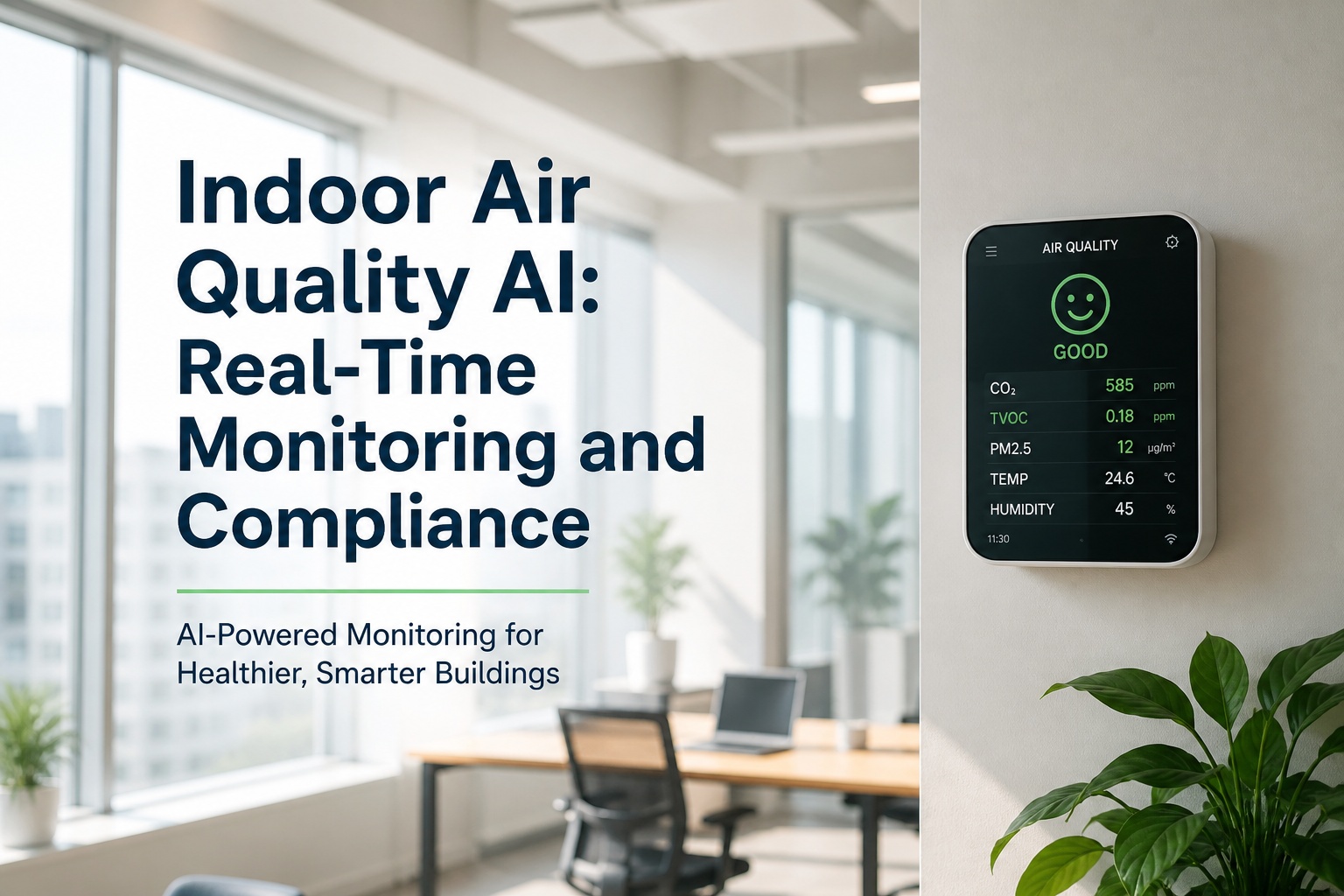
It's 14:32 on a Tuesday in a 240-person open office. CO2 just crossed 1,180 ppm in the east zone. PM2.5 is at 16 µg/m³ — above the WELL v2 threshold. The conference-room VOC sensor spiked after this morning's furniture install. Single-metric monitoring (just CO2, just temperature) misses three out of six problems. ASHRAE 62.1-2025 now expects ventilation to adjust dynamically to real-time occupancy and pollutant levels, EPA documentation failures carry fines starting at $10,000, and tenants pursuing WELL or LEED demand continuous IAQ data they can audit. The facility teams shipping IAQ AI in 2026 stop monitoring six numbers in six dashboards and start running one closed-loop AI system that senses, predicts, and adjusts the HVAC. Sign up free to see the multi-parameter IAQ dashboard running on your building.
MAY 12, 2026 5:30 PM EST , Orlando
Upcoming OxMaint AI Live Webinar — Indoor Air Quality AI: From Six Pollutants to One HVAC Action
Live session for facility managers, sustainability officers, building engineers, and WELL / LEED program leads. We'll architect a complete on-prem IAQ AI deployment — six-pollutant sensor fusion, occupancy-based predictive ventilation, threshold-triggered work orders against the right AHU or filter, and the ASHRAE 62.1-2025, WELL v2, LEED v4.1 documentation export that satisfies audits in one click.
The Six-Pollutant IAQ Dashboard — Live Thresholds That Trigger Action
"Indoor air quality" is six metrics, not one. Each pollutant has a distinct source, a distinct health consequence, and a distinct regulatory threshold. Single-metric monitoring (just CO2, just temperature) misses three out of six problems. Continuous multi-parameter sensing is the 2026 baseline — here's what gets measured, what triggers action, and which compliance frameworks each metric satisfies.
CO2
ppm
800 WELL
1200 alert
1,180 ppm
Source: occupancy + ventilation lag
→ Increase OA% in zone
PM2.5
µg/m³
12 WELL
25 alert
16 µg/m³
Source: outdoor infiltration / construction
→ Filter change · MERV 13 check
VOC / TVOC
ppb
500 alert
740 ppb
Source: furniture · cleaning · carpet off-gas
→ Boost ventilation 90 min
Humidity
% RH
30 min
60 max
47 % RH
Source: HVAC humidification setpoint
→ Within ASHRAE comfort band
Temperature
°F / °C
68
76
72 °F
Source: HVAC setpoint + zone load
→ Comfort band — no action
PM10 · NOx
µg/m³
50 alert
42 µg/m³
Source: traffic infiltration · combustion
→ Monitor — no action yet
The Sense → Predict → Act Loop — Where AI Replaces Static Setpoints
The 2026 distinction in IAQ isn't sensor density — most modern buildings already have CO2 sensors. The distinction is what happens after the sensor reads. Static-setpoint HVAC reacts to threshold breaches that have already happened. AI-driven Demand-Controlled Ventilation (DCV) predicts the breach before it occurs and pre-adjusts the AHU to prevent it. Book a demo to see the closed-loop control running against live building data.
01 SENSE
Multi-parameter sensing
CO2, PM2.5, VOC, humidity, temperature, occupancy (PIR + Wi-Fi). Per zone, per AHU, every 30–60 seconds. Edge agents normalize the streams.
02 PREDICT
Activity-aware forecasting
Bi-directional feedback fusion: occupancy schedule + outside-air conditions + zone history → predicts CO2 and PM2.5 trajectories 60–180 minutes ahead.
03 ACT
HVAC + work order
VAV damper position, AHU outside-air %, fan speed adjusted via BACnet. Threshold breaches that need physical action (filter change, sensor cal) auto-create CMMS work orders.
Closed loop — re-sense, refine model, repeat
The Compliance Matrix — One Sensor Network, Four Frameworks
The reason continuous IAQ AI pays back fast in 2026 isn't operational — it's regulatory. ASHRAE 62.1-2025 now requires dynamic ventilation. WELL v2 awards points for continuous monitoring at specific thresholds. LEED v4.1 has IAQ monitoring credits. RESET certification audits real-time data. One sensor network, four documentation requirements. Here's the matrix that earns the points. Sign up free to see the one-click compliance export across all four frameworks.
Pollutant / Metric
ASHRAE 62.1
WELL v2
LEED v4.1
RESET
CO2 < 800 ppm
✓
✓
✓
✓
PM2.5 < 12 µg/m³
—
✓
✓
✓
VOC / TVOC threshold
✓
✓
✓
✓
MERV 13+ filtration
✓
✓
✓
—
Demand-controlled ventilation
✓
✓
✓
—
Continuous data audit trail
✓
✓
✓
✓
✓ Required or awarded credit— Not required by this framework
The Numbers IAQ Programs Actually Run On
"Better air quality" is too soft a phrase to drive a capital procurement. Here are the 2026 benchmarks from peer-reviewed research and field deployments — energy savings, cognitive performance, fine exposure, and the cost of getting IAQ wrong.
2–5×
Indoor air more polluted than outdoor across commercial buildings (EPA estimates)
30–50%
Energy savings from demand-controlled ventilation vs constant high ventilation
20–35%
HVAC energy savings from AI setpoint optimization (HVAC is ~40% of building energy)
$10K+
EPA documentation failure starting fine — continuous data is the audit defense
80%
Of time spent indoors — IAQ is where occupant exposure actually happens
MERV 13
Minimum filter rating commercial post-pandemic — required by WELL A07 for outside air
Pre-Configured · Six-Pollutant Ready · Ships in 6–12 Weeks
Order an IAQ AI Stack That's Connected Before It Arrives
OxMaint's IAQ AI server arrives pre-configured with the six-pollutant fusion model, occupancy-based DCV control, BACnet integration with your AHUs and VAV boxes, ASHRAE / WELL / LEED / RESET compliance scaffolding, and CMMS work-order automation for filter changes and sensor calibrations. Pre-configured, pre-tested, ready to plug into your BMS within days.
Most IAQ AI vendors quote per-sensor SaaS, with separate per-zone fees for the dashboard, separate fees for the analytics tier, and separate fees for the compliance export module. The OxMaint IAQ stack is a one-time capital purchase: hardware, perpetual software license, AI models, and integration with your BMS. No recurring license fees. Future costs are entirely optional and at your discretion. Sign up free to see IAQ pricing tailored to your building footprint and zone count.
Facility teams in 2026 don't have appetite for "AI projects" — they have appetite for IAQ workflows that ship payback inside six months. Here are the five workflows that consistently land first across IAQ AI deployments and what each one is replacing or augmenting in your existing BMS stack. Book a demo to see these workflows running on real building data.
DCV
Demand-controlled ventilation per zone
CO2 + occupancy → AHU outside-air % adjusted in 5-minute windows. Replaces fixed-percentage outside air. Energy savings 30-50% during low-occupancy periods.
FILTER
Filter change scheduling against actual loading
PM2.5 trend + filter pressure-drop data → CMMS work order when filter loading hits replacement threshold. Replaces calendar-based scheduling that misses real loading.
VOC
Off-gas event detection
VOC spike + maintenance log correlation flags carpet install, paint, cleaning chemicals. AHU runs purge cycle for 60-90 min after the event. Auto-logged for tenant disclosure.
CALIB
Sensor calibration tracking
CO2 sensor ABC drift detection → calibration PM scheduled before drift compromises the audit trail. Required for ASHRAE 62.1 documentation defense.
EXPORT
One-click compliance export
Single export covers WELL v2 audit, LEED v4.1 IAQ credit verification, ASHRAE 62.1 ventilation log, RESET continuous data, and tenant lease IAQ disclosure.
A complete on-prem IAQ AI platform on enterprise-grade hardware in your building. Six-pollutant sensor fusion, occupancy-based DCV control, threshold-triggered work orders, and one-click WELL / LEED / ASHRAE / RESET compliance export — all pre-installed, all owned. No SaaS lock-in. No per-sensor recurring fees. Source code and modification rights included.
Do we need to replace our existing IAQ sensors to use the OxMaint AI platform?
No. The OxMaint IAQ AI platform is sensor-agnostic and connects to whatever IAQ sensors you already have via standard building protocols — BACnet for sensors integrated through your BMS, Modbus for industrial-grade meters, MQTT for modern IoT sensors, and direct API integrations for popular IAQ sensor brands (Awair, Senseware, Kaiterra, AirThings, AirGradient, Aeroqual, Honeywell, Veris). The platform reads from your existing sensor network and adds the AI layer on top — sensor fusion, predictive forecasting, threshold-triggered work orders, and compliance export. If you're starting from zero sensors, the OxMaint deployment includes optional sensor recommendations sized for your building's zone count and ASHRAE 62.1 ventilation calculation requirements.
How does this integrate with our existing BMS — Honeywell, JCI, Schneider, Siemens, or others?
The OxMaint IAQ AI platform connects to all major BMS vendors through standard building protocols. BACnet/IP integration: Honeywell Niagara/Tridium, JCI Metasys, Schneider EcoStruxure, Siemens Desigo, Distech Controls, Trane Tracer. Modbus TCP: legacy controllers and edge equipment. MQTT: modern IoT-native BMS. Direct API: Niagara, BACnet over Web Services. The platform reads sensor and occupancy data from the BMS, runs the IAQ AI fusion and prediction models, then writes setpoint and damper-position commands back to the BMS through the same protocols. AHU outside-air % adjustments, VAV damper positions, fan speed commands all flow through your existing BMS — the OxMaint platform sits as an intelligence layer above it, not a replacement. Typical BMS integration is 3-5 days from credentials handover to live closed-loop control.
How long before the AI model produces reliable predictions for our building?
The OxMaint IAQ AI platform ships with synthetic-data pre-training that produces working predictions on day one. Building-specific fine-tuning improves accuracy progressively as data accumulates: 2-3 weeks of building data produces zone-level CO2 forecasting with sufficient accuracy for DCV control; 6-8 weeks of data captures weekly occupancy patterns and seasonal trends; 12-16 weeks of data captures the full annual cycle including HVAC seasonal modes and outdoor-air infiltration patterns. Most buildings see meaningful predictions in week 1, trustworthy DCV closed-loop control by week 4-6, and full-confidence forecasting by week 12. Compliance export and threshold-triggered work orders work from day one — they don't depend on model maturation.
What's the difference between this and the IAQ dashboard our BMS already has?
Most BMS-embedded IAQ dashboards display current sensor readings against fixed thresholds — they're visualization, not intelligence. The OxMaint IAQ AI platform adds three things the BMS dashboard doesn't have. First, multi-pollutant fusion: the model considers CO2, PM2.5, VOC, humidity, temperature, and occupancy together rather than alarming on each sensor independently — which is what produces lower false-positive rates. Second, predictive forecasting: instead of reacting to threshold breaches that already happened, the model predicts CO2 and PM2.5 trajectories 60-180 minutes ahead and adjusts ventilation pre-emptively. Third, automated workflow output: threshold breaches that need physical action (filter change, sensor calibration, off-gas purge) auto-create CMMS work orders against the specific AHU or VAV box that triggered the breach — closing the loop from sensor reading to scheduled maintenance without facility-team manual triage. You keep your BMS dashboard for what it does well; you add the OxMaint layer for the intelligence that the BMS dashboard structurally can't provide.
How long from sign-up to live IAQ AI operation?
Six to twelve weeks from sign-up to live operation is typical. The compressed timeline works because the server is configured, integrated, and pre-tested in the OxMaint factory before shipping — GPU, AI software, sensor fusion model, BACnet/Modbus/MQTT connectors, ASHRAE/WELL/LEED/RESET compliance scaffolding, and CMMS work-order integration are all installed and validated against synthetic IAQ data before the unit ships. On-site work then collapses to: rack the server in your building's IT room or BMS closet (1 day), connect to your BMS network and IAQ sensor feeds (2-3 days), run the system in shadow mode against current operations (1-2 weeks), validate compliance export against your specific WELL/LEED program documentation (1 week, runs in parallel), then enable closed-loop DCV control and automatic CMMS work-order creation. Most buildings deploy compliance export and work-order automation first (immediate documentation value), then enable closed-loop DCV control once operator confidence is built.