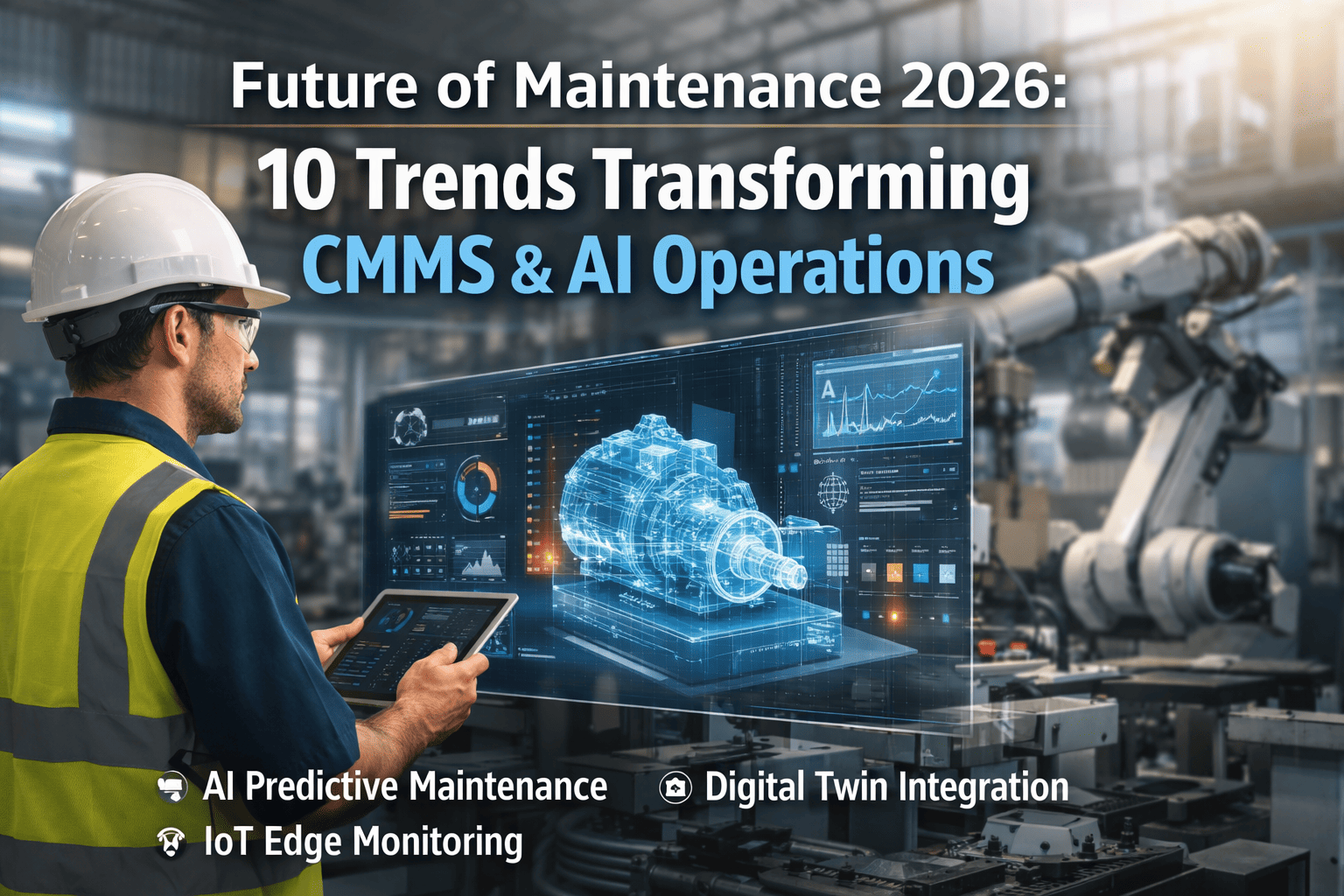
Themaintenance profession is entering the most transformative decade in its history. AI systems are detecting bearing failures four weeks before any human inspector could observe a symptom. Digital twins are running failure simulations on equipment that has never yet failed. Technicians in remote plants are receiving real-time expert guidance overlaid on their field of vision through augmented reality headsets. None of this is speculative — it is operational today in leading industrial facilities. The CMMS market that hit $1.38 billion in 2024 is racing toward $3.55 billion by 2034, driven not by incremental software improvements but by a fundamental redefinition of what maintenance data can do, where it can go, and how fast it can act. What follows are the ten forces reshaping maintenance practice for 2026 and the decade beyond — with the data, the adoption timelines, and the specific CMMS implications every maintenance leader needs to understand right now. Start your free OxMaint trial and position your maintenance programme for the future from day one.
Trends Shaping the Future of Maintenance
AI-Driven Failure Prediction: From Pattern Recognition to Pre-Emptive Action
Machine learning models trained on vibration, temperature, current draw, and acoustic signatures are outperforming scheduled PM by a factor of 3–5× on rotating equipment. The models are not predicting failure — they are detecting the early-stage process deviations that precede failure weeks before any threshold alarm would trigger. Plants with condition monitoring connected to CMMS are seeing 40–60% reductions in unplanned bearing and gearbox failures within the first 12 months of deployment.
AI models will self-calibrate per asset — learning each machine's unique operational baseline rather than comparing against fleet averages. Failure prediction windows will extend to 8–12 weeks on well-instrumented critical assets, giving planning teams enough lead time to schedule repairs during planned production downtime rather than emergency windows.
Digital Twins: Running the Future in Parallel with the Present
A digital twin is a real-time virtual replica of a physical asset, fed by live sensor data and updated continuously as the physical asset operates. Maintenance teams use digital twins to simulate failure scenarios, test PM interval changes, and model the impact of operating parameter adjustments — without touching the physical equipment. Early industrial adopters report 20–30% reductions in unplanned downtime and 15–25% improvements in asset lifespan for twinned assets.
Digital twin platforms will connect directly to CMMS work order systems — so every maintenance action taken on the physical asset automatically updates its digital counterpart. Failure simulations will incorporate actual maintenance history, parts quality data, and operating condition trends to generate plant-specific (not generic) remaining useful life estimates for every critical component.
Industrial IoT and Edge Computing: Intelligence Closer to the Machine
Industrial IoT sensor costs have dropped 80% since 2018, making condition monitoring economically viable for assets that could not previously justify instrumentation. Edge computing — processing sensor data locally on a device near the asset rather than in a central server — eliminates latency and allows real-time alert generation even in facilities with poor network coverage. Vibration, temperature, current, and ultrasonic sensors now deploy wirelessly in hours, not weeks.
Edge AI — full machine learning inference running on the sensor device itself — will enable sub-second failure detection without any cloud connectivity. Entire maintenance decision chains will complete at the edge: sensor detects anomaly, local AI classifies failure mode, work order generated in CMMS, technician notified — all in under three seconds, with zero cloud dependency.
Sensor integration, open API, mobile-first, and automated work order generation — already in OxMaint today.
Mobile-First Maintenance: The Death of the Desktop Work Order
Technicians who navigate to a desktop terminal to log a work order are a legacy pattern that the most productive plants have already eliminated. Native mobile CMMS apps with offline capability, QR code asset identification, photo and video work order documentation, and voice-to-text notes are the baseline expectation for any new maintenance technology deployment in 2026. Plants still running desktop-only CMMS see 23–31% lower adoption rates from field technicians — directly reducing the quality of maintenance data and the effectiveness of every data-dependent strategy above.
Wearable CMMS integration — smartwatch notifications, hands-free voice command work order logging, and real-time inventory scanning via wearable barcode readers — will reduce technician documentation time to near zero. AI-assisted field notes will automatically classify failure mode and root cause from technician verbal descriptions, populating structured CMMS fields without manual selection.
Maintenance as the Engine of Decarbonisation
Poorly maintained equipment consumes 15–30% more energy than well-maintained equivalents. As carbon pricing, EU ETS, and scope 3 emissions reporting obligations expand through 2026 and beyond, maintenance teams are being asked to track and optimise energy performance at the asset level — not just manage repairs. CMMS platforms are evolving to track energy consumption per asset, link consumption anomalies to maintenance condition, and generate energy-triggered work orders when an asset's energy draw signals declining efficiency.
CMMS platforms will integrate with sustainability reporting systems — feeding ISO 50001 energy management, GHG Protocol Scope 1/2/3 tracking, and regulatory compliance dashboards with real-time asset condition and energy consumption data. Maintenance KPIs will expand to include carbon intensity per unit of production alongside traditional reliability metrics.
AR-Assisted Maintenance: Expert Knowledge Projected at the Point of Work
Augmented reality headsets — Microsoft HoloLens, RealWear, Vuzix — overlay step-by-step repair instructions, exploded component diagrams, and real-time expert video guidance directly onto a technician's field of view while both hands remain free for the task. Early industrial adopters report first-time fix rate improvements of 25–40% and repair time reductions of 20–34% for complex multi-component tasks, particularly in environments where documentation is traditionally paper-based and procedures are complex.
AR systems will connect directly to CMMS asset records — so when a technician scans an asset's QR code, the AR interface automatically surfaces the open work order, maintenance history, parts required, and step-by-step repair procedure for the current task. Completed steps will auto-populate CMMS work order fields, eliminating the documentation step that currently adds 15–25 minutes to every repair.
Cloud-Native CMMS: The Shift from On-Premise to Always-On
Cloud-native CMMS eliminates server infrastructure, reduces IT maintenance burden, enables real-time multi-site synchronisation, and provides automatic feature updates without planned downtime for system upgrades. The cost advantages over on-premise have become decisive for most organisations: no server capex, no DBA resource, no disaster recovery infrastructure, and a subscription model that scales linearly with usage rather than requiring upfront capacity over-investment. The final holdouts are typically regulated industries with strict data sovereignty requirements — and cloud vendors are now meeting those requirements with regional data residency options.
Federated cloud CMMS — where data sovereignty regulations require local data storage but cross-site analytics operate on aggregated, anonymised datasets — will become the architectural standard for multi-national industrial operators. Maintenance benchmarking across organisations (with permission) will emerge as a new capability: your MTBF on a specific compressor type compared against thousands of similar assets across the industry fleet.
Always-on availability, automatic updates, real-time multi-site sync, and zero server infrastructure — out of the box.
The Maintenance Skills Crisis: Knowledge Capture Before the Grey Wave Retires
The average age of an experienced industrial maintenance technician in North America and Europe is 52. Within the next decade, a generation of institutional maintenance knowledge — failure pattern recognition, equipment-specific diagnostic intuition, plant-specific configuration memory — will walk out the door. Plants that have not captured this knowledge in structured CMMS records, digital work instructions, and documented failure histories will experience sharp performance degradation as experienced staff retire and are replaced by technicians who have no access to that institutional memory.
AI-powered knowledge extraction will interview experienced technicians — through structured CMMS prompts and voice capture — and convert their tacit knowledge into structured maintenance procedures, failure mode libraries, and diagnostic decision trees that persist in the CMMS after they leave. The CMMS becomes the institutional memory that survives workforce transitions.
OT Cybersecurity: Maintenance Systems as Critical Infrastructure Targets
CMMS platforms that connect to plant networks, IoT sensors, and ERP systems are OT attack surfaces. The Colonial Pipeline attack, Oldsmar water treatment breach, and multiple manufacturing ransomware events since 2022 demonstrated that maintenance and operational technology systems are high-value targets — because disabling them stops production immediately. Security posture for CMMS selection has moved from a procurement checklist item to a board-level risk evaluation criterion.
Zero-trust architecture will become the mandatory standard for industrial CMMS deployments — every user, device, and API connection verified independently regardless of network location. CMMS vendors who cannot demonstrate SOC 2 Type II certification, penetration testing results, and OT-specific security frameworks will be excluded from enterprise procurement processes by risk governance requirements.
Autonomous Maintenance Operations: When the CMMS Acts Without Being Asked
The logical endpoint of every trend above is a maintenance system that does not wait for human instruction. Sensor detects anomaly → AI classifies failure mode and predicts remaining useful life → CMMS automatically schedules repair work order for the next production window → inventory check confirms parts availability or triggers procurement → technician receives pre-packaged work order with procedure, parts, and tools listed. The human role shifts entirely from reactive coordinator to strategic supervisor. Pilot programmes in aerospace, automotive, and process manufacturing are demonstrating 50–70% reductions in planning labour and near-zero emergency procurement events.
Fully closed-loop autonomous maintenance — where the CMMS not only generates and schedules work orders but also adjusts operating parameters, orders parts, books contractor resources, and updates maintenance strategies based on outcome data — will be operational in leading facilities. The maintenance manager role transforms from scheduler and dispatcher to reliability architect and exception handler.
OxMaint Is the Foundation Every Trend in This Guide Builds On
AI prediction, IoT integration, mobile-first workflows, cloud-native architecture, knowledge capture, and autonomous work order generation — OxMaint is designed for where maintenance is heading, not just where it is today. Start with your current state and scale to every trend above without changing platforms.
Frequently Asked Questions
Which of these 10 trends should we prioritise first for maximum near-term ROI?
For most industrial operations that are not yet at Tier 2 CMMS maturity, the answer is Trends 4 and 8 — mobile-first maintenance and knowledge capture. These deliver immediate ROI through faster work order closure, better data quality, and institutional knowledge preservation before retirement waves hit. Trends 1 and 3 (AI prediction and IoT) require 12–18 months of quality CMMS data before they deliver reliable value. Build the data foundation first; the advanced analytical trends become more powerful as a result.
How much does deploying AI predictive maintenance typically cost versus its benefit?
Documented ROI studies show 10:1 returns on AI-driven condition monitoring investment in heavy industrial applications. A typical deployment — vibration and temperature sensors on 20–30 critical assets, AI analysis platform, CMMS integration — costs $80,000–$250,000 including installation and first-year software. A single avoided major failure event (bearing seizure, gearbox failure, motor burnout) on a critical production asset typically recovers $120,000–$600,000 in avoided downtime and emergency repair costs. Plants that avoid 2–3 major events per year typically achieve payback within 6–12 months.
How long does it take for an organisation to move from reactive maintenance to predictive maintenance capability?
The realistic timeline for most industrial organisations is 18–36 months from reactive baseline to operational predictive maintenance capability. The critical path is: Month 1–6 CMMS deployment and data quality establishment, Month 6–12 preventive maintenance programme achieving 80%+ compliance, Month 12–18 first IoT sensor deployments on critical assets, Month 18–30 AI model training on accumulated sensor and failure data, Month 24–36 predictive work order generation operational on priority asset class. Organisations that try to shortcut this sequence by deploying AI before CMMS data quality is established consistently fail to achieve reliable prediction and often abandon the investment.
What role does the CMMS play as maintenance becomes more autonomous?
The CMMS becomes more important — not less — as autonomy increases. It is the central orchestration layer that receives signals from AI and sensor platforms, generates and schedules work orders, manages parts procurement triggers, coordinates technician assignments, and records the outcome data that improves the next cycle. Autonomous maintenance does not bypass the CMMS — it automates the human inputs to it. The platform that cannot accept automated inputs, process them at volume, and generate structured outputs will be unable to participate in the autonomous maintenance ecosystem, regardless of how advanced the surrounding technology becomes.
Is digital twin technology accessible for mid-size industrial operations or only for large enterprises?
Digital twin costs have declined significantly since 2020 and component-level twins — for a single kiln, a single compressor, or a single production line rather than an entire facility — are now accessible to mid-size operations at $50,000–$200,000 for implementation. The barrier is no longer cost — it is data readiness. A digital twin requires rich historical maintenance data, real-time sensor feeds, and accurate asset specifications to generate reliable simulations. Organisations with 3+ years of structured CMMS data and IoT sensor coverage on the target asset can begin digital twin deployment at mid-market scale with realistic ROI expectations.
How do we capture knowledge from experienced technicians who are retiring soon?
The most effective knowledge capture programme pairs structured CMMS work order requirements with direct documentation sessions. Have each senior technician work through the top 10–15 failure scenarios they have personally encountered for each critical asset — describing symptoms, diagnostic steps, and repair procedures in a structured CMMS template format. Supplement this with a requirement that all work orders above a defined complexity threshold include a detailed repair narrative, not just a category selection. Voice-to-text capture tools, now integrated into modern CMMS mobile apps, reduce documentation friction for technicians who are uncomfortable typing. Target capturing 80% of knowledge for your top 20 highest-criticality assets before each senior technician's retirement date.
What should we look for in a CMMS to ensure it is future-proof for these trends?
Evaluate five capability dimensions: (1) Open API architecture — can it receive sensor data and AI alerts automatically and generate work orders without human intervention? (2) Mobile-native application — offline capability, photo/video capture, QR code scanning on iOS and Android? (3) Cloud-native deployment — automatic updates, 99.9%+ uptime SLA, no self-hosted infrastructure? (4) Data portability — can you export your complete dataset in standard formats at any time, enabling future AI model training or migration? (5) Integration ecosystem — does the vendor have documented integrations with leading IoT, AI, ERP, and AR platforms? A CMMS that scores well on all five dimensions will participate in every trend in this guide as those trends mature through 2030 and beyond.
The Future of Maintenance Is Being Built on Today's CMMS Data
Every work order your team closes, every failure mode they document, every condition reading they log — this is the data that will power AI prediction, digital twins, and autonomous maintenance in 2029 and beyond. The organisations leading maintenance in 2030 are building their data foundation today.