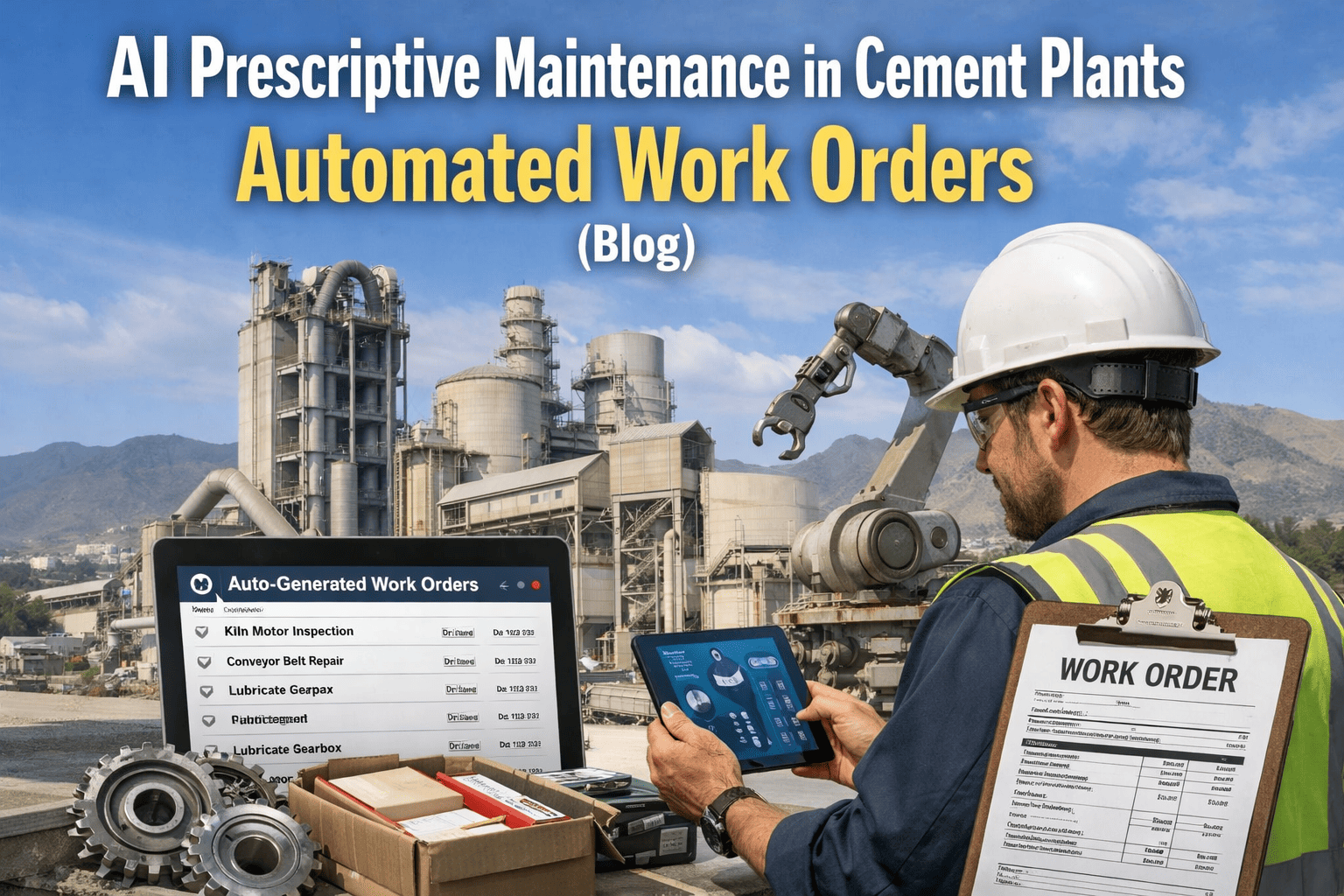
Cement plants operate in one of the most demanding industrial environments on earth — continuous 24/7 production cycles, extreme heat, abrasive dust, and critical rotating equipment that cannot afford unplanned stoppage. Yet in 2025, over 60% of cement manufacturers still rely on paper-based or spreadsheet-driven work order systems that were designed for a slower era. The result: reactive firefighting instead of planned maintenance, vanishing institutional knowledge, compliance gaps, and maintenance costs consuming 25–35% of total production operating expenses. Digital work order management through a purpose-built CMMS is no longer a competitive advantage — it is an operational necessity. Start your free Oxmaint account and replace paper chaos with a structured, digital maintenance command center built specifically for the complexity of cement plant operations. Ready to see it live? Book a 30-minute demo and watch real work orders route, prioritize, and close in real time.
Why Paper Work Orders Are Costing Your Plant More Than You Realize
Every paper clipboard your technicians carry represents a system designed to fail. Here is what the data shows about the true cost of analog maintenance workflows in cement operations.
Lost Work Orders
Paper forms get buried under dust, soaked in lubricant, or simply lost. Research shows cement plants lose 12–18% of paper work orders before completion — meaning maintenance tasks simply vanish.
Zero Traceability
When a kiln bearing fails and you need to trace the last 5 maintenance actions, paper logs offer incomplete, illegible records — preventing true root cause analysis and repeat-failure prevention.
Scheduling Blindness
Maintenance supervisors managing kiln, raw mill, cement mill, and packaging lines simultaneously have no consolidated view of pending work — creating dangerous overlap and resource conflicts.
Compliance Exposure
OSHA, ISO 45001, and environmental regulations require documented maintenance evidence. Paper-based systems fail audits when records are incomplete, illegible, or time-stamped incorrectly.
Knowledge Drain
When a 20-year veteran retires, decades of equipment knowledge leaves with them. Paper systems capture no institutional memory — digital CMMS locks it in permanently, accessible by every technician.
Reactive Cost Spiral
Without prioritized, data-driven work order queues, maintenance teams default to the loudest alarm — not the highest risk. This reactive pattern costs cement plants 2–4x more per repair than planned maintenance.
The Digital Work Order Lifecycle in a Cement Plant
A properly configured CMMS transforms work orders from static paper forms into dynamic, data-rich workflows that connect every stakeholder from the field technician to the plant manager. Sign up free and configure your first digital work order in under 15 minutes.
Triggered via QR scan, sensor alert, planned schedule, or manual request. Asset details, location, priority, and failure mode auto-populate from the equipment register — zero re-keying.
CMMS assigns priority using asset criticality weighting, safety risk flags, production impact score, and compliance urgency. Kiln failures score P1-Emergency. Lighting faults score P4-Routine. No supervisor guessing required.
Work orders route to technicians based on certification level, current workload, shift schedule, and location proximity. No more shouting across the floor or relying on radio guesswork during production runs.
Technician receives push notification with asset history, last 5 repairs, parts location in stores, torque specs, and safety LOTO procedure. Photo documentation and GPS stamp on completion — all from one device.
Work order closes with time stamp, labor hours, parts consumed, failure code, and root cause tag. Integrated LOTO check prevents closure while energy isolation is still active — eliminating premature re-energization incidents.
Every closed work order feeds the reliability database. MTBF trends surface. Repeat failure codes trigger preventive maintenance interval adjustments. The system gets smarter with every repair — building the institutional memory paper can never capture.
Stop Losing Maintenance Data to Paper Clipboards
Oxmaint's digital work order system is purpose-configured for the complex equipment landscape of cement plants — kilns, mills, crushers, conveyors, baghouses, and packaging lines. Every work order becomes a data point. Every repair builds knowledge. Every closure updates your asset history automatically.
Work Order Priority Matrix: How Cement Plants Should Classify Every Task
Not all maintenance tasks are equal. The most effective cement plant maintenance teams use a four-tier priority classification system that aligns response time with production risk, safety impact, and regulatory requirements.
Paper vs. Digital Work Orders: A Side-by-Side Reality Check
The comparison below reflects documented operational differences from cement plants before and after CMMS implementation — not theoretical projections.
Paper-Based System
Oxmaint Digital Work Orders
Work Order Analytics: What the Data Tells You
Digital work orders generate a continuous stream of maintenance intelligence that paper systems permanently destroy. Understanding these analytics is the key to shifting your cement plant from reactive to predictive maintenance. Access your analytics dashboard free from day one of your Oxmaint trial.
MTTR Tracking
Target: <4 hrs for P2Mean Time to Repair by asset category, crew, and shift exposes where the bottlenecks actually are — parts delay, skill gaps, or diagnostic time. Cement plants using CMMS-tracked MTTR reduce average repair time by 22–28% within 12 months.
Backlog Age Analysis
Target: <14 days avg ageAn aging work order backlog is a leading indicator of reliability risk. When P3 and P4 work orders age beyond 30 days, they frequently escalate to emergency P1 events — the classic deferred-maintenance trap that costs cement plants millions annually.
PM Compliance Rate
Target: >90% on-schedulePreventive maintenance compliance directly predicts future equipment availability. Every percentage point below 90% PM completion correlates with measurable increases in emergency work order volume. Digital scheduling makes PM compliance visible, manageable, and improvable. Track how this connects to your asset lifecycle management strategy.
Repeat Failure Index
Target: <5% repeat failuresDigital work orders tag every repair with a failure mode code. When the same failure code appears on the same asset more than twice within 90 days, the CMMS flags it as a repeat failure — triggering root cause investigation rather than another temporary fix. Repeat failures represent 30–40% of total maintenance spend in plants without structured failure tracking.
Your Cement Plant Deserves a Maintenance System That Learns
Every work order you close in Oxmaint makes your next repair faster, safer, and more cost-effective. Connect your kiln, mills, crushers, and conveyors to a digital maintenance backbone that builds institutional knowledge automatically — no consultant required.
- Work order creation in under 90 seconds from any mobile device
- Automated PM scheduling for all cement plant asset classes
- Compliance documentation auto-generated on every closure
- Live MTBF, MTTR, and backlog dashboards from day one
- LOTO integration that prevents unsafe work order closure
Bring your asset list. We will configure your first 10 work order templates live during the demo.
Digital Work Order Implementation Roadmap for Cement Plants
The most common reason cement plants fail to achieve digital work order ROI is attempting to change everything at once. This phased approach — proven across heavy industrial deployments — delivers results within 90 days while respecting the cultural realities of experienced maintenance teams. Start your implementation today with Oxmaint's free tier — no upfront investment required.
Foundation: Asset Register and Work Order Templates
Weeks 1–3Momentum: Mobile Adoption and PM Program Migration
Weeks 4–7Optimization: Analytics, Integration, and Predictive Triggers
Weeks 8–12Frequently Asked Questions: Digital Work Order Management in Cement Plants
How long does it take to see ROI from digital work order management in a cement plant?
Most cement plants begin seeing measurable ROI within 60–90 days of full digital work order adoption. The earliest gains are typically in administrative time savings (2–3 hours per supervisor per day), parts-hunting reduction, and elimination of lost work orders. Deeper ROI from reduced unplanned downtime and improved MTBF typically materializes at 6–12 months as the system accumulates enough historical data to surface predictive insights. Plants that achieve 80%+ technician adoption within the first 30 days consistently report the fastest payback periods — typically 6–9 months from implementation.
Can digital work orders handle the LOTO (Lockout/Tagout) requirements specific to cement plant safety?
Yes — and this is one of the most critical safety advantages of cement-specific CMMS platforms. Oxmaint's LOTO integration prevents any work order from being marked complete while energy isolation is still active. This hard system block eliminates the most common source of serious injury in cement plants: premature re-energization of equipment that a technician is still working on. The system maintains a digital lock registry with worker-specific assignments, shift handover verification, and full audit trail for every isolation event. For cement plants under OSHA 29 CFR 1910.147 and ISO 45001 compliance requirements, this digital LOTO documentation is immediately exportable for audit purposes.
How should we prioritize work orders across multiple cement plant production lines simultaneously?
Multi-line cement plants require a criticality-weighted priority scoring system rather than simple first-in, first-out queues. The most effective approach assigns each asset a Criticality Ranking (CR) from 1–5 based on its impact on production continuity, safety risk, and cost of failure. This CR multiplied by failure probability (updated via sensor data or maintenance history) produces a dynamic risk score that continuously re-ranks the work order backlog. In practice, this means a P2 work order on the kiln motor will automatically rank above a P2 work order on a packaging conveyor — because the kiln carries a higher CR. Oxmaint's priority engine performs this calculation automatically as new data arrives.
What is a realistic technician adoption target for digital work orders, and how do we achieve it?
World-class cement plant digital transformation programs target 80%+ technician adoption within 30–45 days. The single most effective strategy for reaching this target is deploying mobile inspections as the first use case — not desktop CMMS entry. When technicians experience completing a kiln inspection 40% faster than their paper clipboard routine, they become internal champions driving peer adoption faster than any management mandate. Plants that start with complex desktop workflows consistently plateau at 15–25% adoption regardless of training investment. Keep the first work order template simple: asset scan, fault code selection, one photo, submit. Complexity can be added after habit is formed.
How does a digital CMMS handle emergency work orders differently from planned maintenance?
Emergency work orders in a cement plant CMMS trigger a fundamentally different workflow chain than planned maintenance requests. On P1 emergency creation, the system simultaneously: pushes notifications to the shift supervisor and plant manager, checks for active LOTO permits on the affected asset, reserves any pre-designated critical spare parts from inventory, generates a compliance documentation shell (pre-populated with asset data and timestamp), and initiates an automatic escalation timer that re-alerts management if the work order is not acknowledged within 15 minutes. This multi-parallel response is impossible with paper or radio-based systems, where each of these actions requires separate manual steps — typically consuming 20–40 minutes at the moment when speed matters most.
Can work order data integrate with our existing DCS, ERP, or historian systems at the cement plant?
Modern cement-focused CMMS platforms including Oxmaint offer API integration with the most common industrial systems: SAP and Oracle ERP for materials management and cost allocation, DCS/SCADA systems (ABB, Siemens, Rockwell) for sensor-triggered work order auto-creation, historian platforms (OSIsoft PI, AVEVA) for real-time condition monitoring links, and EHS management systems for compliance documentation flows. The most impactful integration for cement plants is DCS-to-CMMS: when a process variable (kiln shell temperature, bearing vibration, pressure differential) exceeds a threshold, the CMMS automatically generates a prioritized work order with the sensor reading attached — eliminating the human observation-to-reporting delay that allows minor deviations to become major failures.
What work order analytics should a cement plant maintenance manager review weekly?
A cement plant maintenance manager's weekly analytics review should cover five critical views: (1) PM compliance rate versus target (flag any asset class below 85%); (2) Work order backlog by age bracket — alert on any P2 work orders older than 72 hours; (3) Emergency-to-planned ratio trending over 4-week rolling window — increasing emergency ratio signals PM program degradation; (4) Repeat failure index by asset — identify top 3 chronic failure assets for root cause investigation; (5) MTTR by technician and shift — surface training needs and resource allocation gaps. These five views, available live in a properly configured CMMS dashboard, replace the end-of-month spreadsheet review that historically provided data weeks after decisions could still have been influenced.