Cement Rotary Kiln Maintenance: Complete Guide to Preventing Failures
By Samuel Jones on March 5, 2026
A rotary kiln operating at 1,450°C processes up to 6,000 tonnes of clinker per day — and when it fails, every hour of unplanned downtime costs a mid-size cement plant between $20,000 and $85,000 in lost production, emergency labour, and thermal energy wasted on the restart cycle alone. Kiln failures are not random events. They are the predictable result of deferred inspections, misread early warning signs, and maintenance programmes that react to failures rather than prevent them. The global cement industry loses an estimated 3–5% of total annual clinker production capacity to kiln-related downtime — a figure that has remained stubbornly unchanged in plants running paper-based maintenance systems. In plants running digital CMMS with structured kiln inspection programmes, that number drops below 1%. This guide covers every major kiln failure mode, every inspection interval, every alignment parameter, and every CMMS workflow that converts reactive kiln firefighting into precision predictive reliability. Start your free OxMaint trial and deploy your kiln maintenance programme digitally from day one.
Cement Rotary Kiln Maintenance: Complete Guide to Preventing Failures
Inspection schedules, failure mode diagnostics, alignment parameters, refractory monitoring, and CMMS workflows — everything your team needs to protect kiln uptime and eliminate preventable shutdowns.
$20K–$85KCost per hour of unplanned kiln downtime
3–5%Annual clinker production lost to kiln downtime (reactive plants)
<1%Downtime loss in CMMS-managed kiln programmes
72 hrsAverage restart time after major refractory failure
The Rotary Kiln System: Critical Components Every Maintenance Team Must Know
Kiln maintenance failures almost always trace back to a gap in component understanding — technicians who know how to replace a part but cannot read the early warning signs that part sends before it fails. Before building any inspection programme, your team needs a complete mental map of the kiln system and what each component is communicating at all times.
Axial floatNormal: ±25mm. Alarm: >±40mm continuous movement
Primary monitorContinuous axial position sensor + daily float reversal verification
Float without reversal = immediate investigation required
Refractory Lining
FunctionInsulate shell from 1,450°C process heat. Brick or castable, 180–250mm thick
Service lifeBurning zone: 9–18 months. Transition zone: 12–24 months
Key failureSpalling, ring build-up, brick fall (red kiln trigger)
Primary monitorShell scanner + manual inspection at every shutdown
Brick fall behind = hot spot within 2–6 hours
The 8 Kiln Failure Modes That Stop Production — and How to Catch Each One Early
Every major kiln failure leaves evidence weeks before it causes a shutdown. The problem is not that the signs are subtle — it is that most teams lack a structured system to collect, trend, and escalate that evidence before the threshold is crossed. Book a demo to see how OxMaint's kiln inspection workflows surface these signals automatically from technician field data.
Auto-alert when scanner reading exceeds 280°C. Escalation to shift manager in 60 seconds. Work order auto-created with pre-loaded inspection checklist.
CRITICAL
Support Roller Bearing Failure
Avg cost: $180K–$600K per event
Early Warning Signs
Bearing temp >70°C rising trendOil sample metal particle increaseVibration frequency changeVisual journal surface scoring
Detection Window
3–21 days from first elevated temperature to seizure
CMMS Prevention Action
Temperature trend logged hourly. Automatic work order at 70°C. Oil sampling task triggered at first anomaly. Bearing replacement scheduled within detection window.
Monthly vibration analysis logged. Backlash recorded and trended. Spray lubrication coverage photo-documented at each PM. Gear flip scheduled before 50% tooth wear threshold.
HIGH
Kiln Misalignment (Crank)
Avg cost: $120K–$400K per event
Early Warning Signs
Shell ovality exceeding 0.5% of diameterUneven tyre contact across roller faceBrick cracking at tyre cross-sectionRoller skewing required more frequently
Detection Window
6–24 weeks from first ovality increase to refractory damage
CMMS Prevention Action
Quarterly axis survey scheduled. Ovality measurement recorded per tyre. OxMaint trends data across surveys — flags progressive worsening before physical symptom threshold.
MEDIUM
Tyre Migration / Creep Excess
Avg cost: $40K–$150K if left unaddressed
Early Warning Signs
Migration >20mm/rev measuredTyre pad wear accelerationShell behind tyre visible flexTyre surface heat marks
Weekly migration reading logged by technician on mobile. OxMaint plots trend — alerts supervisor when 3 consecutive readings show increase. Tyre pad inspection triggered.
Your kiln is sending signals right now. OxMaint captures every inspection reading, trends every parameter, and escalates every threshold breach — automatically.
Kiln Inspection Master Schedule: Frequency, Parameters, and Pass/Fail Criteria
The difference between a world-class kiln maintenance programme and a reactive one is not the quality of technicians — it is the consistency and structure of the inspection programme. Every parameter below must be recorded, not just observed. Data that exists only in a technician's memory cannot be trended, cannot trigger alerts, and cannot prevent failures. Sign up for OxMaint to load these inspection templates directly onto your technicians' mobile devices today.
Daily
Operational Monitoring — Every Shift
14 parameters
Shell scanner — full rotation scan
Normal: <300°C
Alarm: >380°C
Stop kiln if >380°C
All support roller bearing temperatures
Normal: 40–65°C
Alarm: >80°C
Investigate and increase oil flow
Axial kiln float — direction and distance
Normal: ±25mm, reversal daily
Alarm: No reversal in 8 hrs
Adjust thrust roller angle
Main drive motor current (amps)
Normal: ±10% of baseline
Alarm: >15% sustained rise
Inspect for ring build-up or drag
Kiln inlet/outlet seal temperature
Normal: <120°C
Alarm: >160°C
Check seal cooling water flow
Girth gear spray lubrication — active/flow
Continuous operation confirmed
Alarm: Any interruption >30 min
Manual lube immediately, find fault
Weekly
Physical Inspection Round
9 parameters
Tyre migration measurement (all tyres)
Normal: 4–12mm/rev
Alarm: >20mm/rev
Inspect tyre pads; heat tyre if needed
Roller surface condition — visual
Smooth, uniform contact band
Alarm: Spalling, edge loading, cracks
Schedule roller grinding at next stop
Girth gear tooth visual — backlash check
Backlash: 0.15–0.35% of module
Alarm: Pitting, wear >10% tooth height
Increase inspection frequency; plan flip
Inlet/outlet seal wear inspection
Seal plates within wear limit
Alarm: Air infiltration visible
Replace seal segments at next stop
Monthly
Engineering Inspection & Measurement
7 parameters
Roller skewing — contact pattern assessment
Roller angle within ±0.05° of design
Alarm: Edge contact >20% of face width
Adjust roller skew at next opportunity
Vibration analysis — drive train
Baseline amplitude ±15%
Alarm: >25% increase from trend
Identify frequency source; plan inspection
Oil analysis — all roller bearings
Particle count within grade limits
Alarm: Metal particles above 50 ppm
Flush, resample within 72 hrs
Quarterly
Geometric Survey & Alignment Check
5 parameters
Kiln axis survey (laser alignment)
Deviation <2mm per 10m kiln length
Alarm: >3mm/10m deviation
Schedule realignment at next shutdown
Shell ovality measurement (per tyre)
Ovality <0.3% of shell diameter
Alarm: >0.5% ovality
Inspect refractory behind tyre, plan repair
Tyre & roller surface profile measurement
Crown/concavity within 0.5mm/m
Alarm: >1mm/m irregular profile
Schedule grinding at annual shutdown
Kiln Alignment and Ovality: The Hidden Killer of Refractory Life
Why Alignment Matters More Than Most Teams Realise
A kiln that is 5mm out of axis alignment exerts cyclic bending stress on the shell at every rotation. At 1–4 rpm, that means 1,440–5,760 stress cycles per day. Over weeks, this stress cracks refractory bricks, accelerates tyre migration, and causes the irregular roller contact patterns that lead to surface spalling. The kiln's apparent external condition can look normal right up to the point of brick collapse.
Axis deviation (tolerable)
<2mm per 10m
Axis deviation (action required)
2–3mm per 10m
Axis deviation (shutdown at next opportunity)
>3mm per 10m
Ovality — acceptable
<0.3% of diameter
Ovality — inspect refractory
0.3–0.5% of diameter
Ovality — brick life reduction
>0.5% = 40–60% shorter lining life
Alignment Survey Schedule
Quarterly — Laser axis survey under operating temperature. Record pier elevation and roller contact pattern. Log all readings in OxMaint.
After every shutdown — Full cold alignment check before kiln restart. Compare to last hot survey. Adjust roller positions before heat soak begins.
After foundation movement — Any ground settling event, seismic activity, or civil repair near a pier requires immediate axis check. Never assume foundation stability after external events.
Trigger check — Any sudden increase in roller bearing temperature, tyre migration rate, or drive current requires axis survey within 5 working days, regardless of last scheduled survey date.
Refractory Management: Maximising Lining Life and Preventing Catastrophic Failures
Refractory replacement is the single largest planned maintenance expenditure in any cement plant — typically $300,000–$900,000 per full kiln reline including material, labour, and lost production during the 7–14 day shutdown. The goal of a CMMS-driven refractory programme is not to extend lining life beyond its safe limit, but to predict remaining life accurately enough to reline on schedule rather than in emergency. Sign up for OxMaint to track your refractory thickness data, shell scan trends, and remaining life estimates in a single asset record.
Kiln Zones: Expected Refractory Service Life & Maintenance Frequency
Burning Zone
1,350–1,450°C
Lining Life
9–18 months
Magnesia-spinel or magnesia-chrome brick
Shell scan: Daily
Thickness check: At every shutdown
Replace trigger: <60% original thickness
Transition Zone (Upper)
1,100–1,350°C
Lining Life
12–20 months
High-alumina or dolomite brick
Shell scan: Daily
Thickness check: At every shutdown
Replace trigger: <55% original thickness
Safety Zone (Clinkering)
900–1,100°C
Lining Life
18–30 months
Spinel or fireclay brick with coating
Shell scan: Daily
Thickness check: Annual shutdown
Replace trigger: <50% original thickness
Inlet & Preheating Zone
200–900°C
Lining Life
24–48 months
Fireclay or insulating castable
Shell scan: Weekly minimum
Thickness check: Annual shutdown
Replace trigger: <45% original thickness
Red Kiln Protocol: The 6-Step Emergency Response Every Plant Must Have Documented
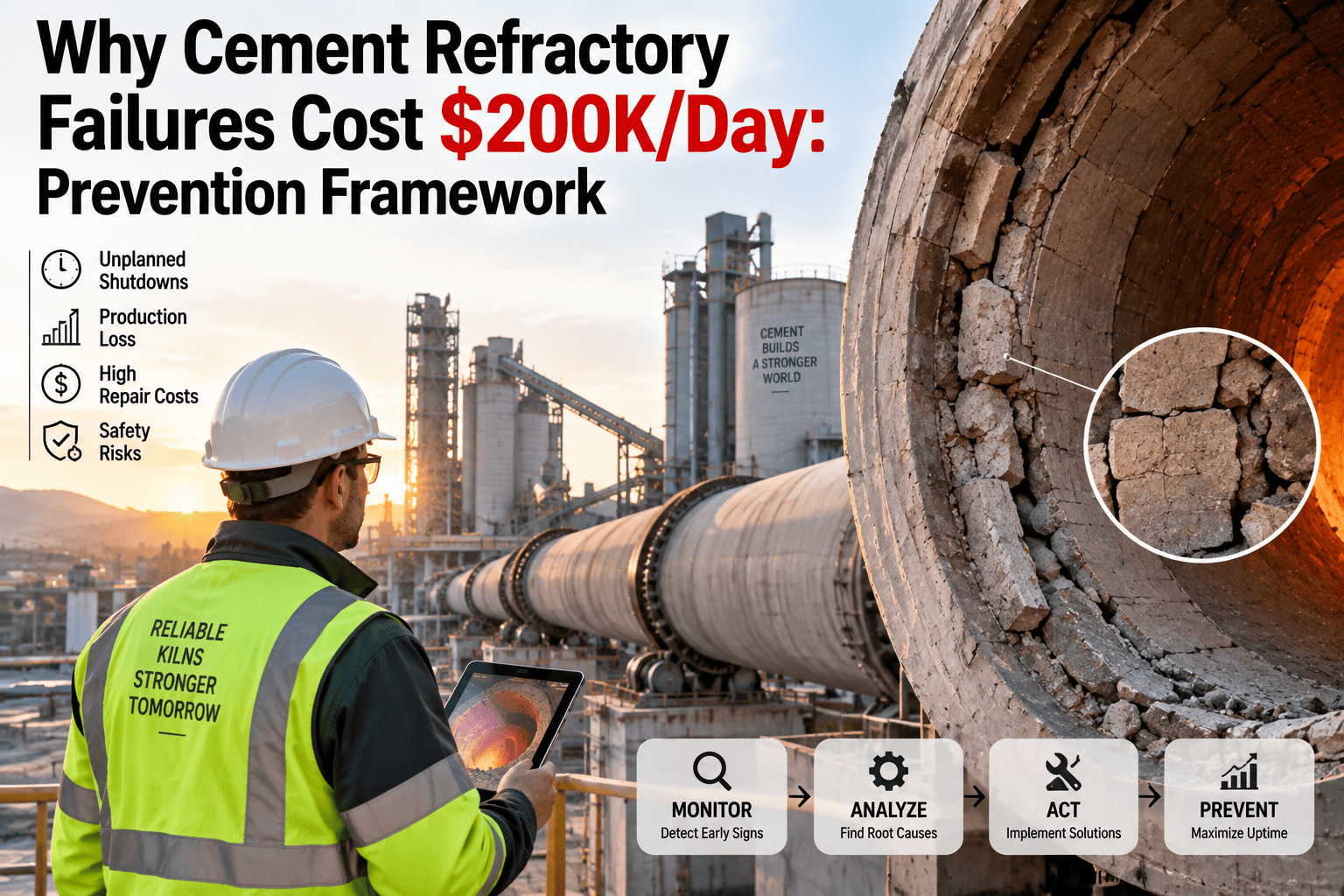
A red kiln — visible shell glowing red/orange — means refractory has failed and the steel shell is in direct contact with 1,450°C process gases. From first red spot to shell burn-through is typically 15–45 minutes. Every second of response time counts.
1
STOP KILN ROTATION IMMEDIATELY
Cut kiln drive power. Engage kiln turning gear immediately to prevent shell sag from thermal deformation. Hot zone must be rotated away from 6 o'clock position within 60 seconds.
2
CUT FUEL TO KILN BURNER
Shut off main burner fuel supply. Keep ID fan running at reduced speed to begin controlled cooldown. Do not kill the fan — thermal shock from zero airflow worsens refractory damage.
3
MARK AND MONITOR HOT SPOT LOCATION
Lock turning gear to hold red zone at 10–11 o'clock position. Continue shell scanner monitoring every 15 minutes. Document exact location by shell section number and degree position for repair team.
4
ALERT MAINTENANCE AND MANAGEMENT
OxMaint auto-escalates red kiln alert to maintenance manager, plant director, and refractory contractor. Emergency work order created with hot zone coordinates pre-populated. Spare refractory brick inventory checked automatically.
5
CONTROLLED COOLDOWN — MINIMUM 48 HOURS
Slow cooling at maximum 50°C/hour. Continue turning gear slow rotation. Monitor shell deformation with laser measurement at 12, 24, 36, and 48 hours. Never rush cooldown — thermal shock creates secondary shell cracking.
6
INSPECTION, REPAIR SCOPE, AND RESTART PLAN
Full internal brick survey by certified refractory specialist. Shell plate deformation measurement — determine if patch repair or section replacement required. OxMaint generates repair work order with material BOM from inspection findings. Target restart within 5–14 days depending on damage extent.
How OxMaint CMMS Structures Kiln Maintenance: 4 Core Workflows
WF1
Continuous Monitoring — Auto Work Order Generation
Shell scanner, bearing temperature, and axial position sensor data feed directly into OxMaint via API. When any parameter crosses a defined threshold — shell >300°C, bearing >70°C, float >35mm — the platform auto-generates a work order, assigns it to the on-shift supervisor, and sets a response deadline. No manual intervention required between detection and notification.
Sensor IntegrationAuto Work OrdersThreshold Alerts
WF2
Structured Inspection Rounds — Mobile Checklists
All 14 daily, 9 weekly, 7 monthly, and 5 quarterly inspection parameters are loaded as mobile checklists in OxMaint. Technicians complete rounds on-device, entering readings with photo documentation. Submissions auto-populate the kiln asset record. Trend charts update in real time — shift supervisors see parameter history without requesting reports.
Mobile ChecklistsPhoto EvidenceAuto Trending
WF3
Shutdown Planning — Kiln Work Order Package
Planned annual shutdown work orders are created in OxMaint 12 weeks ahead. All kiln repair tasks — refractory reline scope, roller grinding, bearing replacements, gear inspection — are included as sub-tasks with resource, parts, and contractor requirements. OxMaint generates the parts BOM automatically and triggers procurement. No last-minute emergency orders during the shutdown window.
Refractory Life Tracking — Zone-by-Zone Asset Record
Each kiln zone is a separate asset record in OxMaint. Thickness measurements, shell scan readings, and replacement history are logged per zone. Remaining life estimates update automatically based on consumption rate trends. When any zone approaches its replacement threshold, OxMaint schedules the reline work order with a lead time that ensures material procurement, contractor booking, and shutdown planning happen before the zone reaches critical status.
Zone-Level TrackingLife PredictionAuto Scheduling
Purpose-Built for Cement Plant Kilns
Give Your Kiln the Maintenance Programme It Deserves
OxMaint pre-loads kiln inspection templates, threshold alerts, and refractory zone tracking so your team goes from paper-based guesswork to data-driven precision in days — not months.
Every parameter in this guide needs to be recorded, trended, and acted on — not observed and forgotten. OxMaint puts that system in your team's hands in days.
How often should a rotary kiln axis survey be conducted?
Quarterly under hot operating conditions is the industry standard for active cement kilns. Additionally, a cold alignment check should be completed after every planned shutdown before restart, and a triggered check must occur within 5 working days whenever any indicator parameter — roller bearing temperature, drive current, tyre migration rate — shows a sudden unexplained change. OxMaint schedules all routine surveys automatically and generates triggered surveys from threshold breach events.
Q
What is the acceptable shell temperature range for a cement kiln under normal operation?
Normal kiln shell external surface temperature ranges from 180°C to 300°C depending on refractory type, zone, and operating load. Temperatures above 300°C in the burning zone warrant immediate investigation. Temperatures above 380°C at any point are an emergency stop condition. Modern infrared shell scanners provide continuous 360° coverage — OxMaint integrates with these scanners to log temperature data and trigger alerts automatically without relying on manual observation.
Q
How long does a cement kiln refractory reline typically take?
A full burning zone reline for a mid-size cement kiln (60–80m length, 4–5m diameter) typically requires 7–14 days including cooldown, brick removal, new brick installation, and heat soak before return to production. A partial zone patch repair can be completed in 3–5 days. The critical path is usually material availability — plants that pre-order refractory brick based on OxMaint's remaining life predictions complete relining in the minimum timeframe rather than adding 5–10 days for emergency material procurement.
Q
What causes a girth gear to fail prematurely and how can CMMS prevent it?
The primary causes of premature girth gear failure are inadequate spray lubrication coverage, improper backlash setting allowing metal-to-metal contact, misalignment-induced cyclic bending loads, and water or cement dust contamination of the lubricant. CMMS prevents premature failure through: daily lubrication coverage photo-documentation, monthly backlash measurement trending, quarterly vibration analysis, and auto-triggered inspection work orders when any parameter deviates from baseline. A girth gear that fails unplanned typically costs $800K–$2M and 3 weeks of downtime — a CMMS programme to prevent it costs a fraction of a single failure event.
Q
What is tyre migration and why does it matter?
Tyre migration (also called tyre slip or creep) is the relative rotational movement between the riding tyre and the kiln shell. A small amount of migration — 4–12mm per revolution — is normal and helps distribute heat. Excess migration above 20mm/rev indicates that the tyre pads that fill the gap between shell and tyre are worn, allowing the tyre to float on the shell. This causes shell ovality deformation under the tyre, accelerates refractory cracking, and eventually causes shell fatigue cracking. Weekly migration measurement logged in OxMaint catches excessive creep rates before they reach the damage threshold.
Q
How does OxMaint integrate with existing kiln monitoring systems like shell scanners?
OxMaint integrates with shell scanner systems, process historians, and sensor data platforms via REST API and standard industrial protocols. Scanner temperature readings can be pulled into OxMaint at configurable intervals, logged against the kiln asset record, and used to trigger alert thresholds and maintenance work orders automatically. Integration setup typically takes 1–2 days for plants with accessible data APIs. For plants without scanner integration, OxMaint provides a manual temperature entry module with photo documentation as an interim solution.
Q
What is the most cost-effective kiln maintenance strategy for a plant running on a tight budget?
Focus first on the three parameters with the highest cost-of-failure: shell temperature monitoring (red kiln prevention), support roller bearing temperature (bearing seizure prevention), and tyre migration (ovality control). These three, tracked consistently with structured inspection rounds and documented in a CMMS, prevent the majority of catastrophic kiln failures. The total technician time investment is approximately 2 hours per day — but the cost of a single prevented red kiln event typically exceeds the annual cost of the entire CMMS programme by a factor of 5–10×.
Related Resources for Cement Plant Optimization
Deep technical guides written for cement plant maintenance and reliability engineering teams.