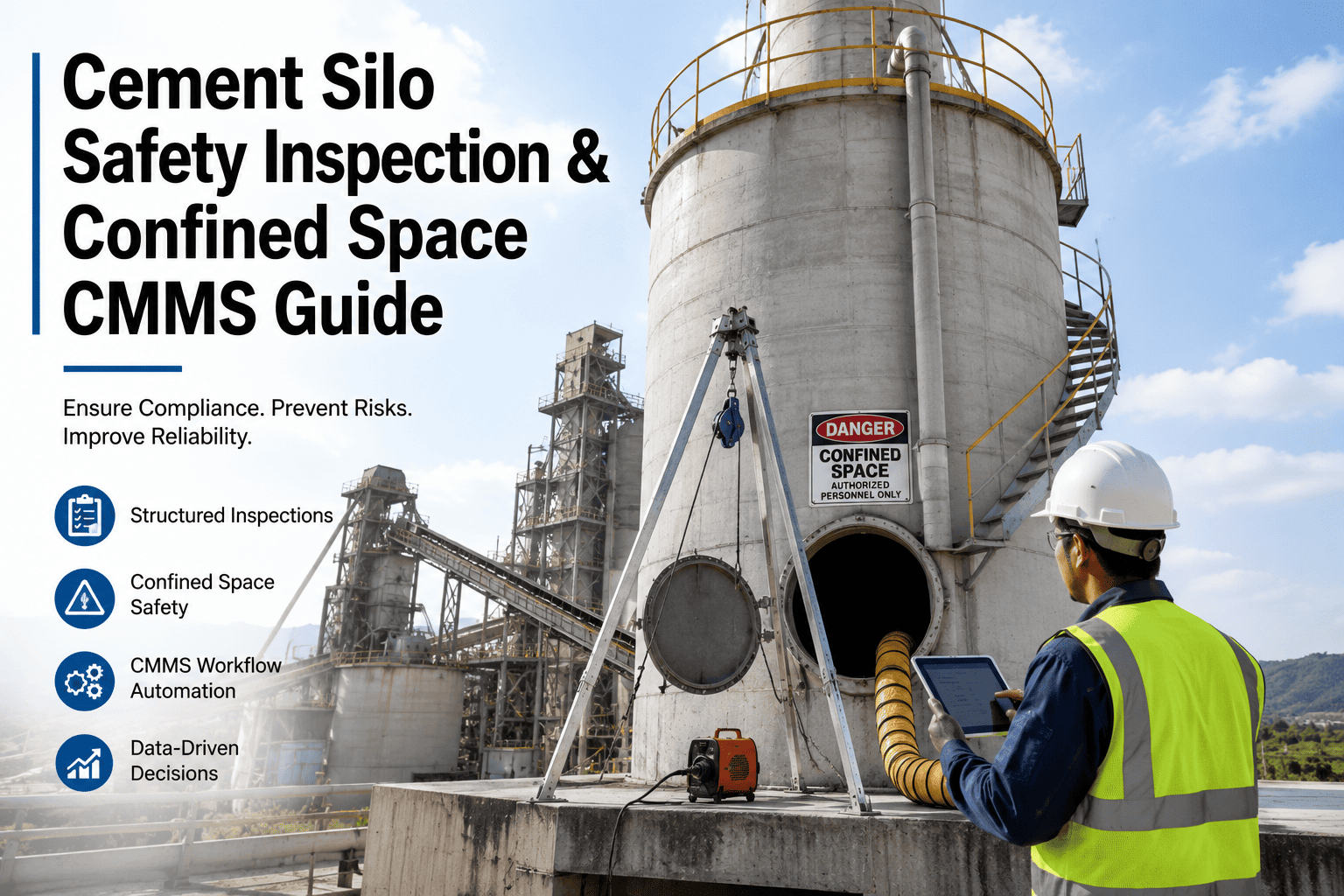
A cement silo that cannot accurately report its contents is an inventory liability. A silo that develops a rathole, bridging event, or structural crack without detection is a safety emergency. Yet across cement plants worldwide, silo maintenance is treated as a passive activity — inspected only when material flow problems are already disrupting production, and monitored by level sensors installed at commissioning that have never been recalibrated. Undetected material build-up reduces effective silo capacity by 20–40%, false level readings trigger unnecessary procurement orders worth $30,000–$150,000 per event, and structural defects discovered during emergency inspections cost 6–8x the price of a planned repair identified during routine condition assessment. Book a demo to see how Oxmaint structures silo inspection scheduling, level sensor asset management, and IoT monitoring integration across cement plant operations.
The Scale of Cement Silo Risk in Manufacturing Operations
Compliance Standards by Region: Silo Inspection and Storage Safety
Cement silo integrity, inspection frequency, and level monitoring obligations are governed by occupational safety, structural, and industrial storage regulations that vary by region. Oxmaint automates silo inspection scheduling, structural assessment documentation, sensor calibration records, and compliance audit trail generation — keeping every plant's silo programme current without manual calendar administration.
| Region | Key Frameworks | Oxmaint Coverage |
|---|---|---|
| USA | OSHA 29 CFR 1910.146 confined space, ACI 313 concrete silo design, NFPA 654 combustible dust | Confined space entry work orders, structural inspection scheduling, sensor calibration records, combustible dust inspection tracking |
| UAE | Civil Defence fire and storage codes, OSHAD-SF hazardous material storage, Emirates Authority for Standardisation guidelines | Structural inspection documentation, multi-site silo dashboards, level sensor maintenance records, digital audit trail exports |
| India | IS 4995 criteria for reinforced concrete silos, Factories Act confined space provisions, BIS storage standards | Inspection schedule management, structural assessment records, confined space entry permit tracking, compliance certificate management |
| Germany | DIN EN 1991-4 Eurocode silo loads, BetrSichV confined space, DGUV Regulation 113-004 silo safety | Mandatory structural inspection archiving, confined space access documentation, sensor certification tracking, TUV inspection records |
| UK | BS EN 1991-4 Eurocode loading, HSE Confined Spaces Regulations 1997, COSHH dust exposure, PSSR 2000 | Confined space permit work orders, structural inspection scheduling, digital PPE and air monitoring records, RIDDOR reporting support |
| Canada | CSA A23.3 concrete structures, Provincial OH&S confined space regulations, CCBFC National Building Code storage provisions | Multi-site silo compliance dashboards, inspection record management, confined space programme tracking, structural defect documentation |
Oxmaint delivers silo inspection scheduling, structural assessment documentation, level sensor calibration tracking, and confined space entry compliance records for cement plant silo programmes across every region above — accurate records available at every audit, without manual calendar management.
What Is Structured Cement Silo Maintenance and Level Monitoring?
Structured silo maintenance is the systematic approach to inspecting, tracking, and managing the full technical condition of every cement storage silo — covering the concrete or steel shell, aeration and fluidisation systems, material discharge mechanisms, level measurement instrumentation, and all structural connections — on a scheduled, documented, condition-informed basis. Level monitoring is the real-time or periodic measurement of stored material volume, integrated with CMMS asset records to ensure sensor calibration, data accuracy, and procurement decisions are built on verified inventory readings. Book a demo to see how Oxmaint manages silo assets and monitoring equipment in a live cement plant environment.
Structural Integrity Management
Systematic inspection of silo shell condition — concrete carbonation depth, crack width and progression, reinforcement corrosion indicators, cone angle integrity, and roof structure loading assessment. Defects logged against the silo asset record with repair urgency classification, and tracked through planned intervention cycles rather than discovered during structural failure events.
Level Monitoring and Sensor Management
Continuous or periodic measurement of stored cement, clinker, and raw material inventory using radar, ultrasonic, microwave, or load cell level sensors — registered as maintained assets with calibration schedules, drift history, and replacement life. Level data accuracy is only as reliable as the sensor maintenance programme behind it. Inventory decisions built on uncalibrated sensors carry full procurement risk.
Aeration and Flow Promotion Maintenance
Cement silos rely on continuous or on-demand aeration systems — air pads, aeration cannons, and fluidisation tiles — to maintain material flow and prevent bridging, ratholing, and compaction. Aeration system elements are wear components with defined service lives requiring scheduled inspection, replacement, and airflow verification. Blocked or failed aeration pads are the primary cause of silo discharge failures in cement plants globally.
Confined Space and Safety Programme
Internal silo access for cleaning, inspection, and repair falls under confined space regulations in every major jurisdiction — requiring work permits, atmospheric monitoring, standby personnel, and rescue equipment. A CMMS manages the full confined space entry workflow: permit generation, atmospheric test records, PPE issuance, entry duration limits, and post-entry sign-off — all documented against the silo asset record for audit readiness.
See Oxmaint Managing Cement Silo Assets and Monitoring Equipment
Our team will walk you through a live demo with silo asset hierarchies, inspection work orders, level sensor calibration schedules, and structural defect tracking built for cement manufacturing — in under 30 minutes.
Four Silo Management Failures Creating Production and Safety Risk in Cement Plants
These four operational failures account for the majority of silo-related production disruptions, procurement errors, and structural safety incidents found during plant audits and insurance assessments in cement manufacturing globally.
Level Sensors Uncalibrated for Years — Inventory Data Unreliable
The majority of cement plants operate level sensors installed at commissioning that have never been recalibrated against actual material volume. Radar and ultrasonic sensors develop measurement drift of 8–15% over 3–5 years of continuous operation in high-dust cement environments — translating directly into inventory errors of 40–120 tonnes per silo per reading cycle. Procurement decisions, production scheduling, and dispatch planning built on these readings carry systematic error that accumulates into overstock or stockout events with real financial consequence.
Aeration System Failures Causing Bridging and Ratholing
Cement bridging — where compacted material spans the silo cone and blocks discharge — stops clinker and cement dispatch entirely and requires either aeration cannon intervention or confined space cleaning entry to resolve. The primary cause is failed or blocked aeration pads never placed on a maintenance programme. A single bridging event in a finished cement silo costs $15,000–$60,000 in lost dispatch capacity, overtime labour, and contractor cleaning fees. Plants with active aeration pad replacement schedules eliminate 85–90% of bridging events entirely.
Structural Defects Escalating Without Detection
Concrete silo shells develop carbonation-driven reinforcement corrosion, crack propagation, and cone angle deterioration silently between inspections. A hairline crack in a cone transition zone identified during routine inspection requires a $12,000–$40,000 repair. The same crack discovered after two years of unchecked water ingress and freeze-thaw cycling escalates into structural remediation costing $200,000–$800,000 — or triggers a mandatory out-of-service notice from a structural engineer, eliminating silo capacity from the production plan without warning.
No Digital Record of Confined Space Entries or Inspections
Cement silo internal cleaning and inspection entries are confined space activities requiring documented permits, atmospheric monitoring records, and post-entry condition reports in every major jurisdiction. Most cement plants maintain paper-based confined space records — filed locally, lost during personnel changes, and unavailable for remote audit. When a regulatory inspection requests the last five years of silo confined space entries, the absence of organised digital records is treated as a programme failure regardless of whether entries were conducted safely.
How Oxmaint Structures Cement Silo Maintenance and Level Monitoring
Oxmaint connects silo structural inspection scheduling, level sensor asset management, aeration system PM, and confined space entry compliance into a single platform — giving cement plants the systematic structure to manage silo assets as the critical production and storage infrastructure they represent. Book a demo to walk through the full silo management framework with your plant's storage capacity and asset profile.
Ready to Bring Your Silo Programme Under Full Digital Control?
Oxmaint deploys across a cement plant's silo asset register and monitoring infrastructure in 60–90 days. Start with the silo hierarchy, activate inspection scheduling, and build the sensor calibration records that make inventory data defensible. Book a personalised 30-minute demo — your silo data, our platform, zero obligation.
Oxmaint Platform: Purpose-Built for Cement Silo Asset and Monitoring Management
Each module addresses a specific failure point in cement silo management — from structural integrity to inventory accuracy. Together they form a closed operational loop where every inspection feeds the structural condition record, every sensor calibration builds inventory data confidence, and every confined space entry is documented against the silo asset for full compliance readiness. Book a demo to walk through each module with live cement silo asset data.
Reactive Silo Management vs. Oxmaint: The Operational and Compliance Gap
| Factor | With Oxmaint | Manual Management |
|---|---|---|
| Level Sensor Accuracy | Calibration verified biannually against actual volume. Drift history tracked per sensor. Inventory data accuracy within 2–3% across all silos. | Commissioning calibration used indefinitely. Drift accumulates to 8–15% measurement error. Procurement decisions carry systematic inventory risk. |
| Aeration System Condition | Quarterly airflow verification work orders per silo zone. Blocked pads replaced on schedule. Bridging events reduced by 85–90% within 12 months. | Aeration pads inspected only after bridging event occurs. Cleaning callouts cost $15,000–$60,000 per event. Root cause never systematically addressed. |
| Structural Inspection Currency | Annual external and 3–5 year internal inspection cycles scheduled. Defects classified and tracked through repair. Structural condition history always current. | Inspection triggered by visible damage or insurance renewal. Early-stage defects missed for years. Reactive repairs cost 6–8x planned intervention. |
| Confined Space Entry Records | Every entry documented with permit, atmospheric test, PPE records, and post-entry findings in digital asset record. Audit export in under 5 minutes. | Paper permits filed locally. Records lost during personnel changes. Regulatory audit requires days of manual assembly — gaps always identified. |
| Inventory Decision Confidence | Level data accuracy verified against sensor calibration records. Finance and procurement teams have confidence in inventory figures driving decisions. | Inventory figures accepted from uncalibrated sensors without verification. Overstock and stockout events traced to sensor drift discovered retrospectively. |
| Regulatory Inspection Outcome | Inspection records, confined space programme, and structural assessment documentation all current. Inspections closed compliant with zero remediation notices. | Multiple non-conformances typical — outdated structural records, absent confined space permits, no sensor calibration evidence. Enforcement risk significant. |
Cement Silo Maintenance Programme Performance Benchmarks
These performance improvements represent average outcomes from cement plants that transitioned from reactive silo management to structured Oxmaint-driven programmes within 18 months of deployment.
Your Silo Programme Compliance and Accuracy Starts Here
Oxmaint delivers measurable silo management improvements within 60–90 days of deployment. Book a 30-minute demo to map your current silo asset register and monitoring programme against best practice — and build a deployment roadmap for your operations team.
Cement Silo Asset Profiles: Maintenance and Monitoring by Silo Type
Maintenance requirements and level monitoring technology selection differ across silo types in a cement plant. Understanding the structural characteristics, material properties, and CMMS tracking approach for each silo class is the foundation of an effective silo management programme. Book a demo to see how Oxmaint tracks inspection schedules, sensor calibration, and aeration maintenance across your plant's full silo inventory.
Finished Cement Storage Silos
Dispatch readiness directly dependent on silo condition and level accuracy. Aeration pad zones tracked by quadrant with individual airflow verification records. Radar sensor calibration verified against truck load-out weighbridge data biannually — drift above 3% triggers immediate recalibration work order. Cone discharge gate condition inspected monthly, wear ring replacement scheduled before impact on material flow rate.
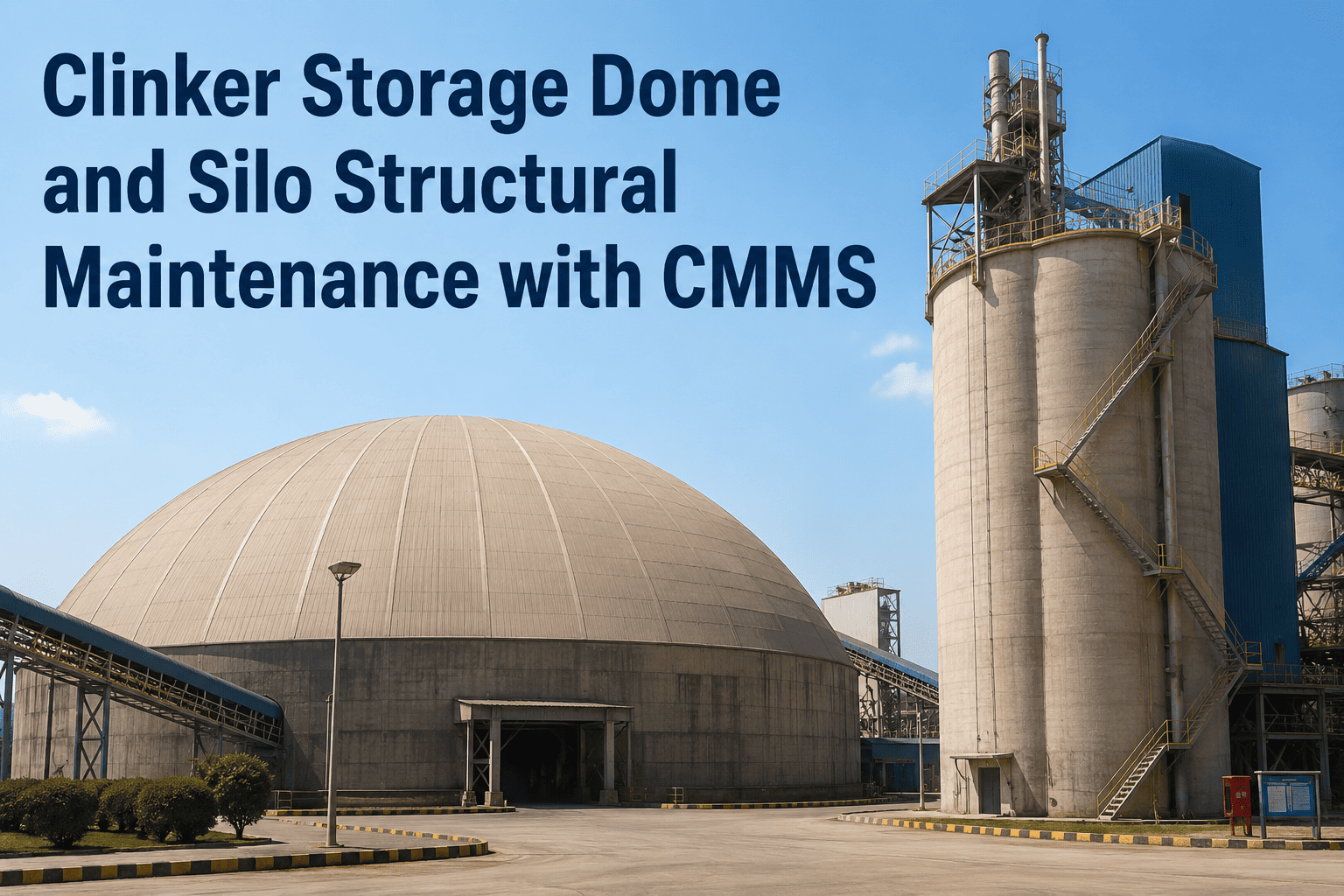
Clinker Storage Silos and Domes
Clinker temperature at discharge tracked alongside level data — hot material recirculation events logged as asset condition incidents. Dome shell crack mapping updated at each annual inspection with photographic evidence stored against the structure record. Sensor calibration cross-checked against belt weigher totals — discrepancy above 4% generates automatic investigation work order.
Raw Meal Homogenisation Silos
Aeration sector sequencing verified monthly — uneven sector wear causes raw meal homogenisation failure and kiln feed chemistry deviation with direct impact on clinker quality. Blending air compressor PM linked to silo aeration dependency — compressor failure immediately generates elevated-priority silo impact alert. Raw meal level accuracy critical for kiln feed rate control — sensor drift above 2% logged as a process impact event requiring root cause investigation.
Additives and Bulk Materials Silos
Gypsum silos flagged as elevated bridging risk — aeration verification frequency doubled versus standard cement silos. Fly ash silo moisture ingress inspection included in quarterly external walkdown checklist. Vibrating fork level sensor verification monthly — fork fouling by sticky material is the primary cause of false high-level readings triggering unnecessary delivery rejections. Material-specific bridging event history tracked per silo to identify seasonal moisture patterns requiring aeration schedule adjustment.
ROI From Structured Cement Silo Maintenance and Level Monitoring
Frequently Asked Questions: Cement Silo Maintenance and Level Monitoring
QHow often should cement silos be formally inspected for structural condition?
QWhat causes cement silos to bridge and how is it prevented?
QWhich level monitoring technology is best suited for cement storage silos?
QWhat regulations govern confined space entry into cement silos globally?
QHow long does Oxmaint take to deploy a cement silo maintenance management programme?
QCan IoT level sensor data be integrated directly into Oxmaint for automated work order triggering?
Continue Reading: Cement Plant Quality and Production Resources
Explore these in-depth guides to build a complete picture of quality management, process control, inventory management, and production optimisation across cement manufacturing operations.
Start Digitalising Your Cement Silo Management Programme Today
Oxmaint deploys across your cement plant's silo asset register and monitoring infrastructure in 60–90 days — no heavy implementation fees and no long onboarding. Start with the silo hierarchy, activate inspection scheduling, and build the sensor calibration records that make inventory data defensible and structural assessments audit-ready. Book a 30-minute demo — your silo data, our platform, zero obligation.