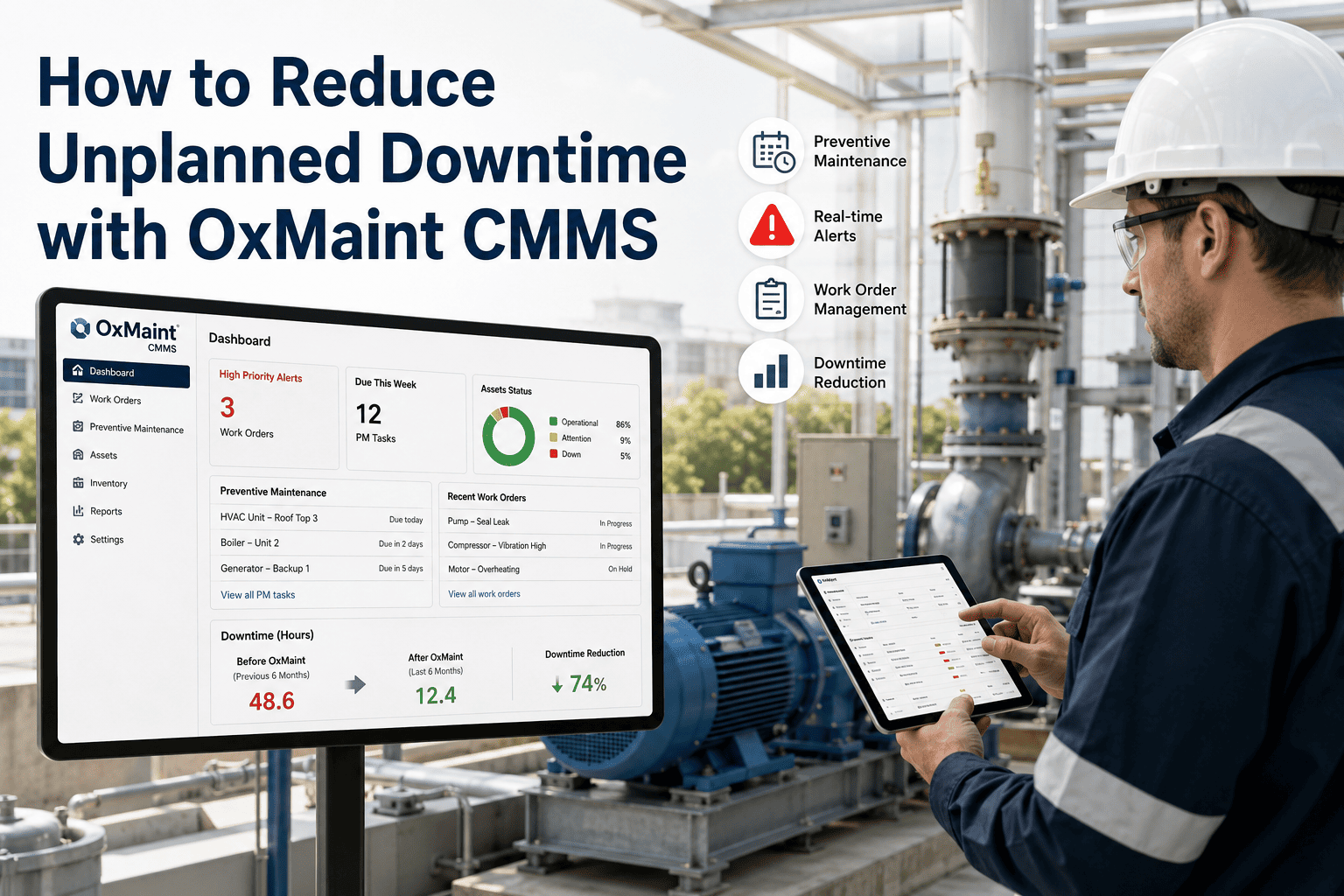
How to Reduce Equipment Downtime: A Data-Driven Approach
Right now, somewhere in your facility, a machine is degrading. A bearing temperature is climbing 0.3°C per shift. A vibration signature is drifting outside its baseline envelope. A filter is approaching saturation. None of it has triggered an alarm yet — but it will. And when it does, the repair that costs $800 in parts will arrive attached to $47,000 in production loss, $12,000 in emergency labour, and a week of root-cause meetings. Unplanned equipment downtime is not an operations problem. It is a data problem. Plants that have solved it did not buy better machines — they built better data pipelines from their existing machines into maintenance decisions. This guide is the blueprint. Start your free OxMaint trial and connect your first asset to a structured data pipeline today.
Industrial Maintenance Intelligence Report · 2026
How to Reduce Equipment Downtime: A Data-Driven Approach
The framework, the data, and the exact CMMS workflows that separate plants running at 94% availability from those stuck in reactive firefighting at 76%.
OEE OptimisationMTTR ReductionPredictive MaintenanceRoot Cause AnalysisCMMS Workflows
Unplanned downtime costs your industry
$260,000
per hour on average
Lost production revenue52%
Emergency labour & contractors23%
Wasted raw materials & energy15%
Quality losses & rework10%
82% of companies experience an unplanned outage every single month
·
45% downtime reduction when plants shift from reactive to preventive maintenance
·
70% of equipment failures are age-unrelated — calendar PM alone cannot prevent them
·
10:1 ROI on condition monitoring investment across critical assets
Why Your Downtime Is Not Random — The Root Cause Pareto
Every plant blames different equipment, different shifts, different operators. But when downtime data is aggregated across industries, the same five root cause categories appear in the same proportions — every time. Understanding where your downtime actually comes from is the prerequisite to every strategy in this guide. Book a demo to see how OxMaint's root cause tagging system builds this Pareto automatically from your work order data within 90 days.
Where Industrial Downtime Actually Comes From
Inadequate preventive maintenance
38%
Fix: Structured PM programme with CMMS enforcement
Chronic repeat failures (unresolved root cause)
24%
Fix: Mandatory root cause field on every reactive work order
Parts unavailability extending repair time
18%
Fix: Asset-linked spare parts with reorder automation
Delayed technician response and diagnostic time
12%
Fix: Mobile work orders with pre-attached repair procedures
Operator-induced failure (improper use or startup)
8%
Fix: Digital operator checklists and startup procedure enforcement
The 80/20 rule applies sharply: the first two categories — inadequate PM and unresolved chronic failures — account for 62% of all downtime. These are also the two categories that a CMMS addresses most directly and most quickly.
The Data Your CMMS Must Capture to Drive Downtime Reduction
Most plants operate with data poverty at the maintenance layer. Work orders exist, but they lack the structured fields that make data useful. A work order that says "fixed motor" is forensically useless. A work order that captures failure mode, root cause category, time to first response, parts consumed, repair duration, and asset operating hours at failure — that is the raw material of a downtime reduction programme. Sign up for OxMaint and get every one of these fields pre-configured on your first day.
Data Field
Why It Matters
Analysis It Enables
Impact Without It
RequiredFailure mode category
Identifies whether failures are mechanical, electrical, lubrication, or operator-induced
Failure pattern analysis — reveals whether PM or root cause elimination is the right response
Cannot distinguish preventable from random failures. All treated identically.
RequiredTime-to-first-response
Time from work order creation to technician on-site. Reveals notification and escalation gaps.
MTTR decomposition — separates response delay from actual repair time
MTTR reduction initiatives target the wrong bottleneck — repair time vs. response delay
RequiredParts consumed per WO
Links inventory consumption to specific failure events and asset records
Parts unavailability analysis — identifies stockout patterns, drives reorder point optimisation
Inventory managed by instinct. Parts stockouts continue repeating invisibly.
RequiredRoot cause (5-Why)
The actual mechanism behind the failure — not the symptom that was repaired
Chronic failure elimination — identifies systemic issues, not just recurring symptoms
Same failure repeats every 6 weeks forever. Root cause never addressed.
ImportantAsset operating hours at failure
Enables runtime-based MTBF calculation — more accurate than calendar-based intervals
PM interval optimisation — replace OEM estimates with your actual consumption data
PM intervals remain fixed at OEM defaults — often 2–3× wrong for actual conditions
ImportantDowntime duration (production stopped)
Separates total repair time from actual production impact — not all repairs cause full stoppage
True downtime cost calculation — prioritises failures by financial impact, not frequency
Resources allocated to frequent low-impact failures while high-cost rare events ignored
All 6 fields. Pre-configured. Day 1.
OxMaint work order templates include every data field this framework requires — out of the box, on every work order, on every device.
Every plant sits at one of four maturity stages. Each stage has a specific set of data capabilities, maintenance outcomes, and bottlenecks. The strategies in the next section are mapped to these stages — because the right action depends entirely on where you are starting from, not where you want to eventually be.
Stage 1
Reactive
Maintenance is driven entirely by equipment failure. No structured PM programme. Work orders created after breakdown. Parts ordered after stockout.
Diagnostic Indicators
>60% reactive work orders
No CMMS or paper-only system
MTBF unknown or not measured
PM completion rate below 40%
OEE: typically 45–60%
First move: Deploy CMMS + asset register
Stage 2
Preventive
Calendar-based PM programme in place. Work orders managed in CMMS. Technicians using mobile. Parts stocking improved but still reactive on critical items.
Diagnostic Indicators
30–60% reactive work orders
PM completion rate 60–80%
MTBF measured, not yet trending
Root cause rarely documented
OEE: typically 60–72%
Next move: Root cause programme + data enrichment
Stage 3
Predictive
Condition monitoring on critical assets. Failure data drives PM interval decisions. Chronic failures systematically eliminated. MTBF trending upward.
Diagnostic Indicators
10–30% reactive work orders
PM completion rate 80–92%
Sensor alerts auto-generate WOs
Root cause documented 70%+ of WOs
OEE: typically 72–85%
Next move: AI anomaly detection + interval optimisation
Stage 4
Reliability-Centred
Maintenance strategy matched to each failure mode individually. FMEA-driven PM design. AI-assisted anomaly detection. Continuous improvement embedded in governance.
Diagnostic Indicators
<10% reactive work orders
PM completion rate above 92%
MTBF improving quarter-over-quarter
RCM applied to all critical assets
OEE: typically 85–95%+
Focus: Sustain and benchmark against world-class
Stage-by-Stage Action Playbook: What to Do at Each Maturity Level
Stage 1 → Stage 2 Actions
Timeline: 0–90 days
Target: PM completion above 70%, reactive ratio below 50%
Week 1–2: Deploy
1
Register every asset with criticality rating (Critical / Important / Standard) — no specs needed yet, just the hierarchy
2
Create work order templates with the 6 required data fields — failure mode, root cause, parts, response time, downtime, operating hours
3
Pre-stage 1 unit of every Class A critical spare part — eliminate parts-sourcing delay from your top 10 failure assets
Week 3–6: Build PM
4
Load OEM PM tasks for all critical assets into CMMS — activate auto-scheduling so work orders generate without manual intervention
5
Assign mobile devices and train technicians on work order closure — target 80% mobile closure rate by Day 45
6
Publish weekly PM compliance rate to all supervisors — visibility alone drives 15–20% improvement before process changes
Week 7–12: Optimise
7
Review first 8 weeks of CMMS data — identify top 10 assets by reactive work order count and cost, flag for Stage 2 root cause investigation
8
Audit PM task list — remove tasks with no failure prevention rationale, consolidate tasks that can be combined in a single inspection round
9
Establish baseline metrics: OEE, MTTR, MTBF per critical asset, and reactive ratio — these become your before/after comparison at Month 12
Run 90-day failure frequency report — identify chronic offenders (assets with 3+ reactive WOs in 90 days) — these are your highest-ROI targets
11
For each chronic offender: conduct structured 5-Why root cause analysis using CMMS failure history as evidence — not post-incident memory
12
Categorise root causes: design deficiency, incorrect PM interval, lubrication failure, contamination, operator error — each category has a different fix pathway
Month 5–6: Intervene
13
Implement design or process fixes for root causes identified — this is permanent elimination, not repeat repair of the same symptom
14
Adjust PM intervals based on actual MTBF data — assets showing zero failures at OEM interval extend by 20%; assets failing before interval shorten by 25%
15
Deploy vibration and temperature monitoring on top 5 critical assets — connect sensor threshold alerts directly to CMMS work order generation
Month 7–9: Scale
16
Expand condition monitoring to all critical assets — build threshold libraries from the first 90 days of sensor data from initial deployments
17
Implement monthly asset performance review — compare MTBF this quarter vs. last quarter per asset, update criticality ratings if performance has changed
18
Establish technician post-repair inspection protocol — work order closure triggers automatic 24hr and 7-day follow-up inspection WOs for all critical asset repairs
The Transformation in Numbers: Reactive Plant vs. Data-Driven Plant
Metric
Reactive Plant (Before)
Data-Driven CMMS Plant
Change
Overall Equipment Effectiveness (OEE)
54–62%
81–91%
+27–29 pts
Reactive work order ratio
55–75%
8–18%
−47–57 pts
Mean Time To Repair (MTTR)
8–16 hours
1.5–4 hours
−65–80%
PM completion rate
35–55%
88–96%
+40–60 pts
Emergency parts procurement events/month
12–22 events
0–3 events
−85–100%
Maintenance cost per unit of production
Baseline
−28–41% of baseline
−28–41%
Time to prepare compliance audit report
3–5 days manual
Under 2 hours
−94%
OxMaint — Start Where You Are
From Stage 1 Reactive to Stage 3 Predictive — OxMaint Scales Every Step
Deploy your asset register, activate PM scheduling, and capture the 6 critical data fields on Day 1 — with sensor integration and predictive workflows ready when your data maturity reaches Stage 3. No platform migration required at any stage.
unplanned downtime reduction — documented 12-month customer result
94%
PM completion rate achieved from a 41% reactive baseline
Frequently Asked Questions
01
How do we know which failure mode category to assign to each work order?
Use a standardised dropdown in your CMMS with 6–8 predefined failure mode categories: Mechanical wear, Electrical fault, Lubrication failure, Contamination, Operator error, Installation defect, Design deficiency, and Unknown. Train technicians to select the most accurate category at work order closure — not at creation when the cause is unknown. After 90 days, your failure mode distribution chart will reveal whether your PM programme (which prevents mechanical wear) is addressing your dominant failure type or whether other categories dominate and require different interventions.
02
What is the right target for MTTR in our facility?
Rather than an absolute target, focus on MTTR decomposition first. Break your current MTTR into four components: notification delay (time from failure to work order creation), response delay (time from WO creation to technician on-site), diagnostic time (time from arrival to identifying the fault), and repair time (actual hands-on fix time). In most reactive plants, notification and response delay account for 40–60% of total MTTR — and these are fixable without any capital investment. Once you have the breakdown, set targets per component rather than for MTTR as a whole. World-class plants target notification delay under 15 minutes, response delay under 30 minutes, and repair time optimised through procedure standardisation.
03
How long before our CMMS data is rich enough to make reliable PM interval decisions?
You need a minimum of 3 complete failure cycles per asset before statistical confidence in interval setting is meaningful. For assets that fail every 3 months, that is 9 months of data. For assets that fail every 18 months, that is 4.5 years. In the interim, use OEM intervals as a conservative starting point and apply a modification factor based on your operating environment — cement and chemical plants typically apply a 0.65–0.80 multiplier to OEM intervals to account for environmental severity. As MTBF data accumulates, tighten or extend intervals in 15–20% increments, never more than 25% in a single adjustment cycle.
04
Should we try to eliminate all reactive maintenance?
No — and trying to is a trap. Some equipment is appropriately managed on a run-to-fail basis: non-critical assets where failure consequence is low, failure mode is random with no detectable precursor, and replacement is fast and inexpensive. Forcing PM onto these assets wastes maintenance labour and budget without reducing downtime. The goal is not zero reactive maintenance — it is reactive maintenance only on assets where that strategy is deliberately chosen, not on critical production assets where it is happening by default due to programme gaps. A well-designed mature programme typically operates at 8–15% reactive, with that 8–15% being deliberate run-to-fail decisions on low-criticality equipment.
05
How do we justify the CMMS investment to senior management using downtime data?
Build the business case on three numbers: your current annual downtime cost, your projected downtime cost at the target OEE improvement, and the CMMS annual cost including implementation. Use this formula — Annual Downtime Cost = (Unplanned Downtime Hours/Year) × (Hourly Production Value + Emergency Repair Premium). Then model the improvement at a conservative 35% reduction (the low end of documented outcomes). For most industrial facilities with hourly downtime costs above $15,000, the first year payback is measured in months, not years. Critically, present the calculation before the CMMS investment — not as a post-hoc justification — so management's baseline expectation matches the framework.
06
What is the fastest single action we can take to reduce downtime this week?
Pre-stage critical spare parts for your top three highest-downtime assets. Identify the three assets that caused the most production downtime in the last 12 months. Identify the parts that were missing or delayed during those events. Ensure one unit of each is in your storeroom today, clearly labelled and accessible within 5 minutes. This single action — requiring no software, no budget approval, and no cross-functional coordination beyond stores access — typically reduces MTTR for repeat failures on those assets by 35–50% starting from the next event. It is the highest-leverage action available in the shortest timeframe.
07
How do condition monitoring and preventive maintenance work together — do we replace PM with sensors?
Condition monitoring supplements PM — it replaces it only for specific failure modes where a reliable sensor signal exists. For example, vibration monitoring can replace interval-based bearing inspection because bearing degradation produces a measurable vibration signature. But lubrication tasks, visual inspections for corrosion or seal integrity, and calibration checks cannot be replaced by sensors because the failure mechanism does not produce a sensor-detectable precursor. The mature programme uses condition monitoring to eliminate unnecessary PM tasks (those targeting failure modes that sensors now detect earlier) while retaining PM tasks that target failure modes without detectable precursors.
Your Downtime Reduction Programme Starts With One Work Order
Every shift your team closes work orders without structured data fields is a shift of failure intelligence lost permanently. OxMaint captures the data this framework requires from your very first work order — and turns it into downtime reduction within 90 days.