Every hour a loaded cement truck spends waiting at the dispatch gate is an hour of working capital locked in inventory, a customer relationship eroding, and a loading bay blocked from the next vehicle. Cement plants running manual dispatch systems average 45–90 minutes per truck turnaround — world-class operations with integrated weighbridge automation and digital scheduling achieve 18–25 minutes on the same asset base. The difference is not equipment — it is the absence of a system that connects stockpile inventory, packing plant throughput, loading bay scheduling, and weighbridge data into a single operational view. Book a demo to see how Oxmaint structures loading operations, dispatch scheduling, and supply chain tracking across cement plant operations.
The Hidden Cost of Unoptimised Cement Loading and Dispatch Operations
Compliance Standards by Region: Cement Loading, Weighbridge, and Dispatch Operations
Cement loading and dispatch operations intersect with commercial weighing regulations, vehicle overloading enforcement, occupational safety requirements, and product quality certification frameworks that vary significantly by region. Oxmaint delivers digital documentation, calibration scheduling, and compliance audit trails that keep every dispatch legally defensible — without building manual tracking systems.
| Region | Key Frameworks | Oxmaint Coverage |
|---|---|---|
| USA | NIST Handbook 44, FHWA axle load limits, DOT vehicle safety, OSHA 29 CFR 1910 | Weighbridge calibration scheduling, digital load records, dispatch safety inspection tracking |
| UAE | Emirates Authority for Standardisation, Ministry of Industry weights regulations, Civil Defence loading codes | Real-time dispatch records, calibration certificate management, multi-site loading compliance dashboards |
| India | Legal Metrology Act 2009, Bureau of Indian Standards IS 2386, Motor Vehicles Act axle load norms | Weighbridge calibration work order scheduling, statutory certificate tracking, load record archiving |
| Germany | Eichgesetz measuring accuracy law, DIN EN 45501, BetrSichV loading equipment safety, StVZO | Mandatory calibration documentation, test record archiving, loading equipment certification tracking |
| UK | Weights and Measures Act 1985, DVSA axle weight enforcement, HSE loading bay safety guidance | Digital weighbridge inspection records, statutory calibration scheduling, compliance audit exports |
| Brazil | INMETRO metrological regulations, ABNT NBR weighing standards, DNIT vehicle weight regulations | Multi-site dispatch compliance dashboards, weighbridge certification management, load record management |
Oxmaint delivers weighbridge calibration scheduling, dispatch documentation, and compliance audit trails for cement loading operations across every region above — accurate records at every dispatch, zero manual tracking overhead.
What Is Cement Bag and Bulk Loading Optimisation?
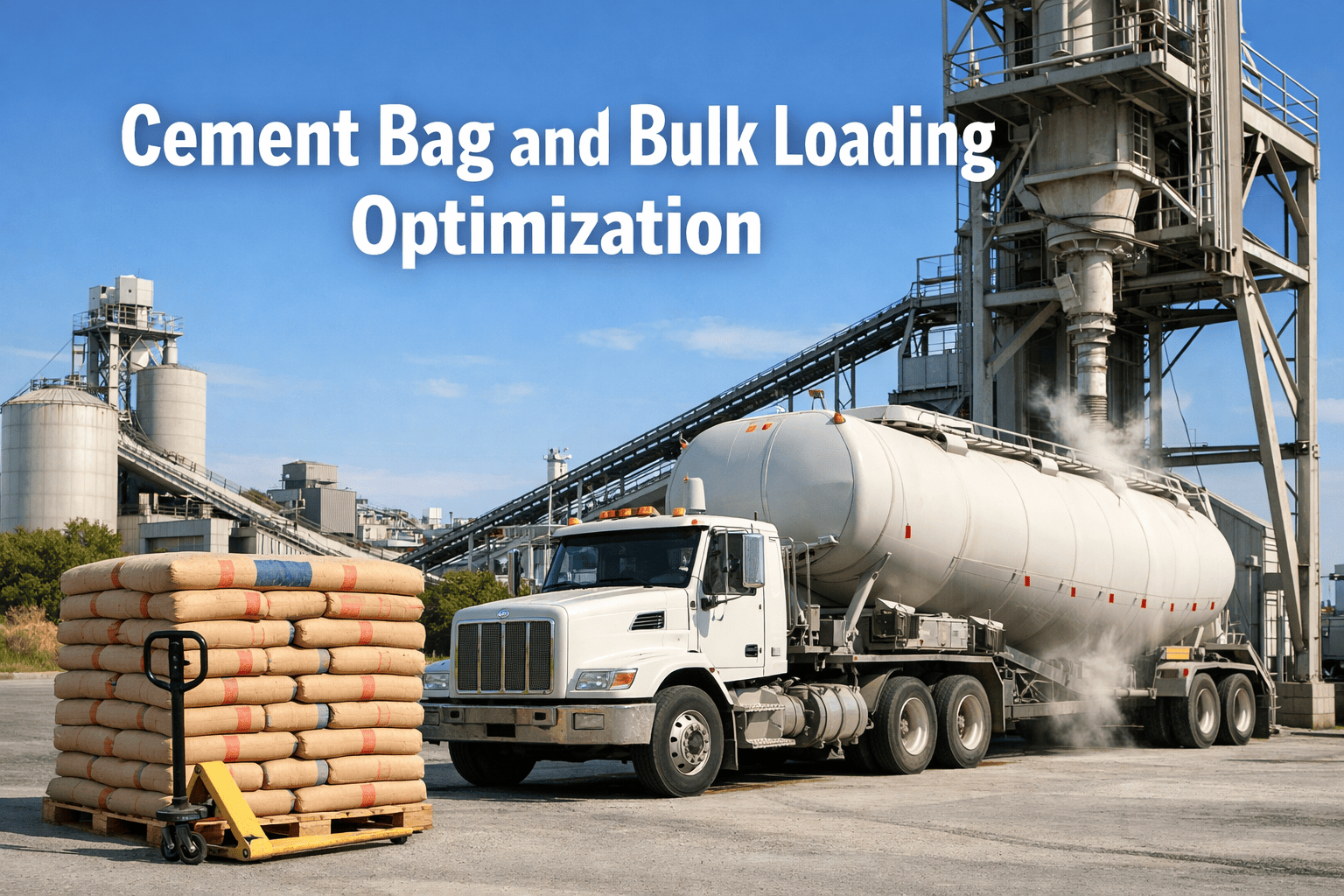
Cement loading optimisation is the structured approach to maximising dispatch throughput, minimising truck turnaround time, reducing weighbridge errors, and ensuring that loading operations run as a precision supply chain function — not as a congested, manually managed bottleneck between the packing plant and the customer. It covers both bagged cement dispatch through rotary packers and palletised loading lines, and bulk tanker loading through pressurised silo outlets and inline weighing systems. Book a demo to see how Oxmaint connects dispatch scheduling, packing plant throughput, and loading asset management in a live cement plant environment.
Dispatch Scheduling
Digital pre-booking of loading bay slots against packing plant throughput capacity and cement grade availability. Vehicle queue managed before trucks enter the plant — eliminating the gate congestion that wastes 15–25 minutes per truck in unscheduled dispatch operations and causes packing line stoppages waiting for loading bays to clear.
Weighbridge Integration
Automated weighing data captured at entry and exit — tare weight, gross weight, and net tonnage linked directly to delivery order records without manual transcription. Calibration schedules maintained in Oxmaint with automated alerts before statutory certification lapses. Every dispatch record legally defensible and instantly retrievable.
Loading Automation
Bulk loading systems with automatic cut-off at target weight, integrated with silo inventory to confirm grade availability before loading commences. Bag loading lines with conveyor sequencing linked to truck positioning confirmation — eliminating manual start signals that add 3–8 minutes per truck in manual coordination.
Loading Equipment Preventive Maintenance
Structured PM for weighbridges, bag loading conveyors, palletisers, stretch wrappers, bulk loading spouts, and silo outlet valves — all tracked against running hours and throughput cycles in Oxmaint. Equipment failures at the loading bay directly delay dispatch and cascade into customer delivery failures that are far more expensive than the maintenance they replace.
See Oxmaint Running on Live Cement Dispatch Operations
Our team will walk you through a live demo with cement dispatch scheduling, weighbridge calibration management, loading equipment PM schedules, and supply chain tracking dashboards — in under 30 minutes.
Four Loading and Dispatch Problems Reducing Cement Plant Revenue and Customer Reliability
The same operational failures repeat across cement plant dispatch operations regardless of plant capacity or geography. These four problems account for the majority of truck turnaround delays, weighbridge disputes, loading equipment downtime, and customer delivery failures in the industry.
Gate Congestion and Unscheduled Truck Arrivals
Without a pre-booking system, trucks arrive based on driver availability and dealer demand — not packing plant throughput capacity. Peak arrival clusters create gate queues of 8–20 vehicles waiting simultaneously, each idling for 45–75 minutes before loading commences. Fuel cost, driver time, and customer dissatisfaction compound daily. Packing line operators alternate between maximum throughput and complete stoppages waiting for bays to clear — destroying packing plant OEE in the process.
Weighbridge Inaccuracy, Manual Errors, and Calibration Gaps
A weighbridge running without its statutory calibration certificate is a legal liability on every dispatch. Manual transcription of tare and gross weights introduces 0.1–0.3% systematic errors that accumulate across thousands of dispatches — at current cement prices, a 0.2% under-dispatch on 500,000 tonnes per year represents $150,000–$400,000 in unrecovered product annually. Calibration intervals are tracked on spreadsheets or wall calendars in most plants, with lapses discovered only during external audit.
Loading Equipment Breakdowns During Peak Dispatch Windows
A bag loading conveyor belt failure, palletiser gripper jam, or bulk loading spout blockage during the morning dispatch peak creates a cascade — trucks already loaded in the queue cannot move, bays are blocked, and packing line production has nowhere to go. Loading equipment is typically maintained reactively in cement plants because it is not considered a primary production asset. The average cost of 4 hours of dispatch disruption from an avoidable loading equipment failure exceeds $12,000 in contract penalties, overtime, and additional truck mobilisation costs.
No Real-Time Inventory Link Between Silo Stock and Dispatch Commitments
Manual dispatch systems have no live connection between cement silo inventory levels by grade and the loading orders being fulfilled at the gate. Grade shortage discoveries happen at the loading bay — truck already loaded and waiting, driver already invoiced for a grade that is not available. Grade substitutions create customer complaints and commercial disputes. Over-dispatching a silo to zero stock causes the next truck in queue to wait for production to fill the silo — turning a 25-minute turnaround into a 3-hour wait.
How Oxmaint Structures Cement Loading and Dispatch Optimisation
Oxmaint connects dispatch scheduling, loading equipment maintenance, weighbridge management, and silo inventory tracking into a single operational platform — giving cement plants the visibility needed to run loading as a precision supply chain function. Book a demo to walk through the full dispatch management framework with your plant's loading infrastructure and throughput targets.
Ready to Cut Your Truck Turnaround Time by 50%?
Oxmaint deploys across cement dispatch operations in 60–90 days. Start with the loading asset register, activate weighbridge calibration scheduling, and begin building the dispatch data that drives daily throughput improvements. Book a personalised 30-minute demo — your loading infrastructure, our platform, zero obligation.
Oxmaint Platform: Purpose-Built for Cement Loading and Dispatch Operations
Each module addresses a specific operational failure point in cement plant loading and dispatch management. Together they form a closed loop where every work order feeds equipment condition data, every weighbridge transaction feeds dispatch analytics, and every asset record contributes to the supply chain capital plan. Book a demo to walk through each module with cement plant dispatch data from a live operation.
Manual Dispatch vs. Oxmaint: The Performance Gap in Cement Loading Operations
Cement Loading Optimisation Performance Benchmarks
These performance improvements represent average results from cement plants that transitioned from manual dispatch management to structured Oxmaint-driven programmes within 18 months of deployment. Results vary by plant dispatch volume, loading infrastructure age, and baseline truck turnaround time.
Your Dispatch Operation Baseline Starts Here
Oxmaint delivers measurable loading throughput improvements within 60–90 days of deployment. Book a 30-minute demo to map your current dispatch turnaround baseline against industry benchmarks and build a business case for your operations team.
Critical Asset Lifecycle Profiles: Cement Loading and Dispatch Equipment
Loading and dispatch equipment carries medium-to-high capital risk in cement operations — not because individual assets are as expensive as a kiln, but because their failure directly stops revenue-generating dispatch and damages customer relationships that took years to build. Book a demo to see how Oxmaint tracks loading equipment lifecycles and capital replacement forecasts for cement dispatch operations.
Electronic Weighbridge System
Calibration due dates tracked with 30-day advance work order generation. Certificate storage linked to asset record. Load cell performance trending from calibration error history — replacement triggered before accuracy drifts outside legal tolerance. Weighbridge surface cleaning and joint inspection scheduled quarterly.
Rotary Packer and Bag Loading Line
Bag spout and seal wear tracked by bags-per-spout cycle count — replacement work orders generated before seal failure causes burst bag rate above 0.1%. Conveyor belt condition monitored by running hours and tonne-kilometres. Packing line OEE tracked daily — target above 85% flagged for investigation when below threshold.
Bulk Loading Spout and Tanker Connection System
Spout liner wear tracked by total bulk tonnes dispatched through each outlet. Dust sock condition logged at monthly inspection with replacement triggered before dust emission limit exceedance. Outlet valve cycle count tracked for service interval management — minimising the stuck-valve events that block a bulk loading lane for an entire shift.
Palletiser and Stretch Wrapper
Gripper pad and actuator service tracked by pallet cycle count — replacement before pad hardening causes bag compression failures that split bags on the loading platform. Stretch wrapper pre-stretch mechanism serviced by film-roll consumption count. Palletiser stacking pattern verification logged quarterly against current bag dimension settings.
ROI From Structured Cement Loading and Dispatch Management
Frequently Asked Questions: Cement Bag and Bulk Loading Optimisation
QWhat is the single highest-impact change for reducing truck turnaround time in cement dispatch?
QHow frequently must cement plant weighbridges be calibrated to stay legally compliant?
QWhat is a realistic bag loading conveyor belt service life in a cement plant environment?
QHow does Oxmaint connect silo inventory data to the dispatch scheduling system?
QHow long does Oxmaint deployment take across cement loading and dispatch operations?
QWhat loading KPIs should cement plant dispatch managers track daily?
Continue Reading: Cement Plant Supply Chain and Operations Resources
Explore these in-depth guides to build a complete picture of supply chain management, dispatch operations, and raw material handling across cement manufacturing.
Start Optimising Your Cement Loading Operations Today
Oxmaint deploys across cement dispatch and loading operations in 60–90 days — no heavy implementation fees, no long onboarding programme. Start with your weighbridge and loading equipment asset register, activate PM scheduling, and begin building the dispatch data that drives daily throughput improvements. Book a 30-minute demo — your dispatch infrastructure, our platform, zero obligation.