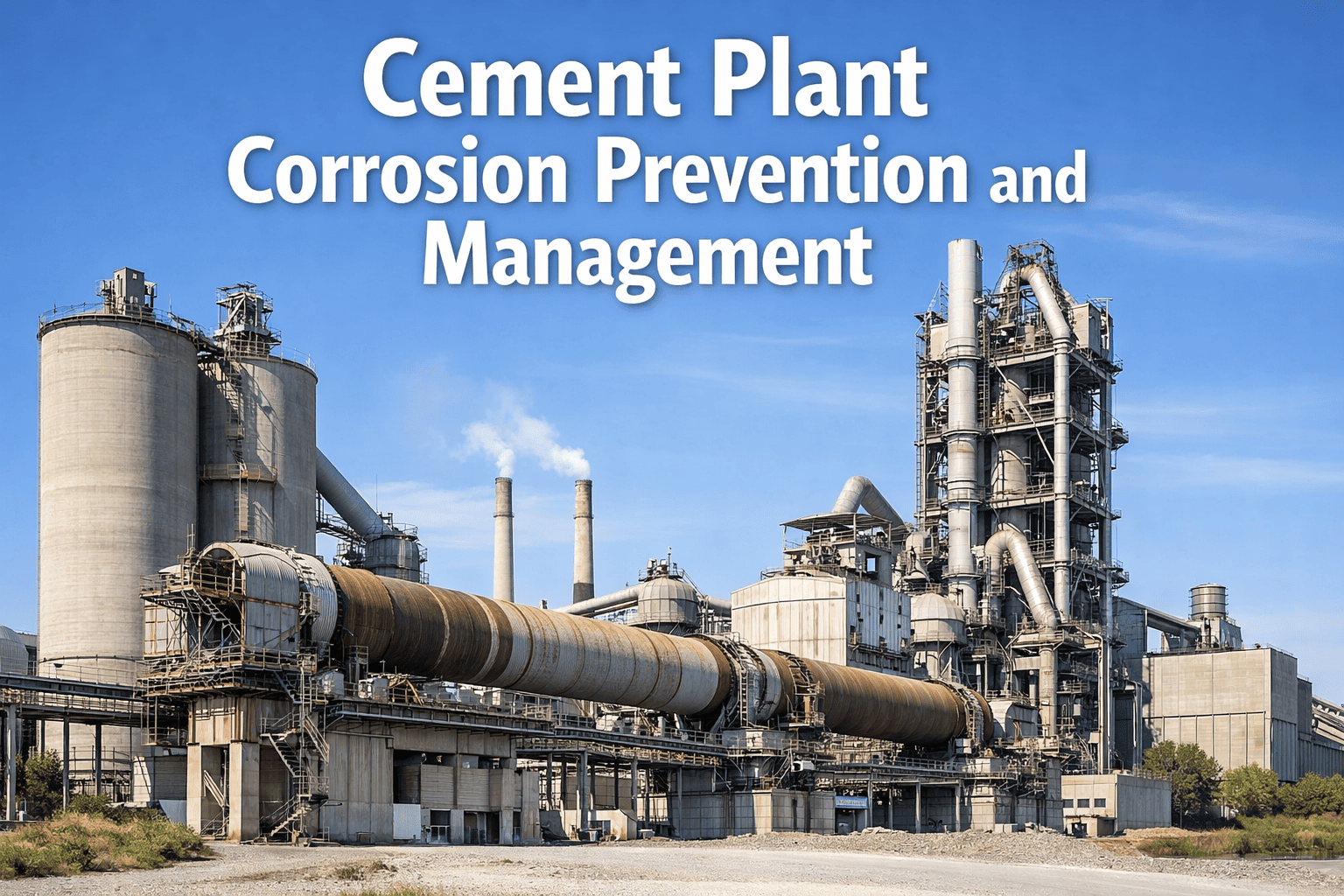
Corrosion is the single largest contributor to premature structural and equipment retirement in cement plants — costing the global cement industry an estimated 3–5% of total maintenance budget annually, and retiring assets at 60–75% of their rated service life in plants without a systematic corrosion management programme. The cement plant environment is uniquely aggressive: alkali dust settles on structural steel and reacts with condensed moisture to form corrosive electrolytes, sulfur dioxide from the kiln converts to sulfuric acid in preheater exhaust stacks, chlorides from alternative fuels accelerate electrochemical attack in bypass duct systems, and thermal cycling in cooler casings drives fatigue cracking that opens pathways for deep corrosion penetration. Every unmanaged corrosion zone is a capital clock running toward an unplanned replacement event. Book a demo to see how Oxmaint structures corrosion monitoring, protective coating maintenance, and inspection scheduling across cement plant infrastructure.
Compliance Standards by Region: Corrosion Management and Structural Inspection
Cement plant corrosion management intersects with structural safety inspections, pressure vessel integrity requirements, environmental protection obligations, and asset register maintenance regulations across all major operating regions. Oxmaint automates inspection scheduling, coating maintenance documentation, and compliance audit trail generation for all corrosion-managed assets.
| Region | Key Frameworks | Oxmaint Coverage |
|---|---|---|
| USA | OSHA 29 CFR 1910 general industry, NACE SP standards, API 570 piping inspection, EPA structural integrity | Inspection scheduling, NACE coating inspection records, corrosion monitoring programme documentation, compliance audit trails |
| UAE | Civil Defence structural safety codes, SASO coating standards, Ministry of Industry asset integrity, OSHAD-SF | Structural inspection scheduling, coating maintenance records, multi-site corrosion programme dashboards |
| India | Factories Act 1948 structural safety, IS 9172 protective coatings, CPCB emission structure integrity, BIS standards | Statutory inspection scheduling, coating specification records, structural asset register management |
| Germany | BetrSichV plant safety, DIN EN ISO 12944 corrosion protection coatings, TUV structural inspection, DGUV | TUV inspection scheduling, DIN-compliant coating records, corrosion monitoring documentation, certificate archiving |
| UK | HSE structural safety guidance, NACE/ISO 8501 surface preparation, COSHH coating chemicals, RIDDOR incidents | Structural inspection work orders, coating inspection records, COSHH chemical tracking, compliance exports |
| Canada | CSA S16 structural steel, SSPC coating standards, provincial OHS plant safety, NACE corrosion engineering | Multi-site inspection compliance dashboards, coating specification management, corrosion monitoring records |
Oxmaint delivers corrosion inspection scheduling, coating maintenance documentation, structural asset tracking, and compliance audit trails across every region above — your maintenance team maintains comprehensive corrosion management records without building manual tracking systems.
The Four Corrosion Challenges Costing Cement Plants Capital and Production
These four challenge-impact pairs define the financial and operational consequences of reactive corrosion management in cement manufacturing. Each represents a systemic problem — and each is preventable with a structured monitoring and maintenance programme.
No Systematic Corrosion Inspection Programme
Structural steel, kiln supports, cooler casings, preheater frames, and conveyor gantries are visually checked informally — if at all. Pit depth, coating DFT loss, and section modulus reduction are never measured. Corrosion progresses invisibly until visible section loss triggers an emergency engineering assessment, a forced production stop for temporary support, or in the worst case a structural failure.
Average avoidable capital cost when a major structural element — kiln support column, preheater frame beam, or cooler casing panel — reaches emergency replacement status due to unmonitored corrosion advancing beyond the point where planned refurbishment was viable.
Protective Coatings Applied Once, Never Maintained
New equipment and structural steel receive protective coating at commissioning — and in most cement plants, that coating is never re-inspected or maintained until visible rust breakthrough forces emergency spot repair. DFT loss of 30–40 microns per year on exterior structural steel in cement environments is common. A 250-micron coating system lasts 6–8 years properly maintained — or 3–4 years when left unmonitored until it fails.
Asset lifespan extension achievable with proactive coating maintenance versus reactive replacement. A kiln support structure maintained with scheduled coating inspections and timely touch-up can reach its full 30-year design life — one managed reactively may require major refurbishment or replacement at 15–18 years.
Underground and Insulated Assets with No Monitoring
Underground piping, cable ducting, and foundations corrode electrochemically from soil contact with no visual indication until failure. Thermally insulated pipe sections corrode under insulation (CUI) — moisture trapped between pipe surface and insulation generates conditions more corrosive than bare pipe in open atmosphere. Neither mechanism is detectable without scheduled UT thickness surveys, holiday detector surveys on buried pipe coatings, or cathodic protection potential testing.
Typical service life of underground or insulated cement plant pipework with no corrosion protection management — versus 20–30 years achievable with appropriate corrosion protection, scheduled inspection, and cathodic protection where soil conditions warrant. The cost difference per metre of pipework over 30 years is typically 5–8× in favour of managed protection.
High-Temperature Corrosion in Kiln and Preheater Systems
The preheater exhaust stack and kiln bypass duct system operate in sulfur-bearing gases that condense as sulfuric acid on surfaces cooler than the acid dew point — typically 120–150°C. This dew-point corrosion attacks carbon steel at 5–15 mm/year in affected zones — far faster than ambient corrosion mechanisms. Kiln shell hot spots create thermally stressed zones where oxidation scaling and fatigue cracking combine. These mechanisms demand asset-specific inspection protocols and material selection, not the same generic coating approach used on ambient-temperature structural steel.
Annual wall loss rate in dew-point corrosion zones of the preheater stack and bypass duct — making wall thickness monitoring mandatory every 6 months in these areas, not annually. A stack wall reduced to 40% of original thickness in a dew-point zone requires emergency repair or production stop within months if not identified and managed proactively.
How Oxmaint Structures Cement Plant Corrosion Management: Four-Phase Programme
Oxmaint converts corrosion management from ad-hoc inspections into a structured, accountable programme with measurable outcomes — progressing through four phases that build on each other to deliver complete corrosion control across the plant asset base. Book a demo to see the full framework running on live cement plant corrosion data.
Asset Registration and Zone Classification
Register every corrosion-exposed asset in Oxmaint — structural steel, pressure vessels, piping circuits, kiln shell zones, cooler casings, and underground infrastructure. Each asset classified by corrosion environment: ambient exterior, high-temperature, chemical immersion, underground, or CUI (corrosion under insulation). Zone classification determines inspection method, frequency, and minimum acceptable condition threshold. Coating specification and installation date logged per asset section — the baseline from which every future inspection measurement is compared.
Inspection Schedule Activation
Configure and activate recurring inspection work orders for every asset zone — annual visual and DFT inspection for ambient exterior steel, 6-monthly UT wall thickness for high-temperature and CUI zones, quarterly cathodic protection potential testing for underground assets, and annual coating adhesion testing for critical structural members. Inspection checklists structured per asset type — coating DFT measurement points pre-defined, pit depth measurement locations recorded on asset sketch, and condition scoring criteria standardised so all technicians grade to the same scale. Work orders assigned to named inspectors with completed results locked to the asset record. Book a demo to see inspection scheduling in action.
Condition Trending and Intervention Planning
As inspection data accumulates across cycles, Oxmaint calculates corrosion rate per asset section — DFT loss rate for coated surfaces, pit depth progression for uncoated steel, wall thickness reduction rate for pressure vessels and high-temperature pipework. Sections deteriorating faster than modelled are automatically escalated to the engineering team for root cause investigation and interval tightening. Minimum acceptable condition thresholds set per asset — alert generated when any measurement approaches the threshold, giving the maintenance team a planned replacement window rather than an emergency response. Protective coating touch-up and full strip-and-recoat decisions driven by DFT trend data — not reactive rust breakthrough.
Capital Planning Integration
Condition trend data across the full corrosion-managed asset base feeds into Oxmaint's capital planning module — projecting major refurbishment and replacement needs 3–5 years ahead based on measured deterioration rates. Finance and engineering leadership see which structural assets, pressure vessels, and underground pipework require significant capital intervention in each forward year — enabling proactive budget allocation before the asset reaches crisis condition. The corrosion programme transforms from a cost centre into a capital efficiency tool: every deferred emergency replacement represents direct avoidable CapEx prevented by systematic condition management.
Ready to Build a Systematic Corrosion Management Programme?
Oxmaint deploys across cement plant corrosion management in 60–90 days — starting with your highest-risk zones and expanding progressively. Book a personalised 30-minute demo — your asset base, our platform, zero obligation.
Oxmaint Corrosion Management Features: Metrics That Matter in Cement Plants
Each feature delivers a measurable outcome specific to cement plant corrosion management. Book a demo to see each feature applied to your plant's corrosion asset classes.
Every corrosion-exposed asset registered with zone classification, coating specification, and baseline measurements. Inspection method, frequency, and minimum threshold set per zone type — not a generic annual survey applied to everything.
Coating DFT measured at pre-defined points on every inspection cycle. Loss rate calculated per section. Touch-up and full recoat scheduled from trend data — before rust breakthrough forces emergency strip and recoat at 3× the planned cost.
UT measurements at defined points logged per asset on every inspection. Minimum acceptable wall thickness set per design code — alert at 15% above minimum. Dew-point corrosion zones in preheater and bypass duct on 6-monthly mandatory cycle.
CP potential readings logged quarterly against test points per underground asset. Reference electrode type and measurement conditions recorded. Depleting anode replacement triggered before potential drifts above protection threshold — continuous protection maintained.
Measured corrosion rates per asset section feed into rolling capital replacement forecasts. Structural and pressure vessel replacements surfaced 12–36 months ahead of projected end-of-life — enabling proactive budget allocation before crisis forces emergency spend.
Complete corrosion programme status — inspection compliance rate, open findings, coating DFT trends, CP potential history, and pending interventions — generated in under 5 minutes from live data. Audit-ready at any time, no manual record assembly.
Manual Corrosion Management vs. Oxmaint: Performance Gap in Cement Infrastructure
| Factor | With Oxmaint | Manual Management |
|---|---|---|
| Asset Service Life Achieved | 85–100% of rated design life. Proactive coating and condition management extends structural and equipment life to full design horizon. | 60–75% of rated life. Unmonitored corrosion forces premature replacement — capital wasted on assets with years of serviceable life remaining under managed conditions. |
| Coating Condition Visibility | DFT measurements logged per section at each inspection cycle. Loss rate calculated. Touch-up scheduled from trend — no rust breakthrough surprises. | Coating condition assessed visually when rust is already visible. Emergency strip-and-recoat at 3× planned cost. Substrate corrosion already progressed beneath failed coating. |
| High-Temperature Zone Monitoring | 6-monthly UT on preheater stacks and bypass ducts. Dew-point corrosion zones identified. Wall replacement planned before minimum thickness is reached. | No scheduled UT on high-temperature zones. Wall perforation discovered when process gas leak or structural failure forces emergency shutdown. Emergency repair at premium cost. |
| Underground Asset Protection | CP potential tested quarterly per test point. Anode depletion tracked. Holiday detection on coated buried pipe. Continuous electrochemical protection maintained. | Underground assets assumed protected until failure. Pipe perforation discovered when product loss or ground contamination is observed. Excavation and emergency replacement at full unplanned cost. |
| Capital Budget Predictability | 3–5 year CapEx forecast from measured deterioration rates. Structural and vessel replacements budgeted 12–36 months in advance. No emergency capital surprises. | 30–50% unbudgeted structural CapEx annually. Corrosion-driven failures appear as emergency capital events — derailing annual budgets and straining cash flow. |
| Inspection Programme Compliance | 100% of critical zone inspections completed within required interval. Compliance rate tracked in real time. Audit documentation generated in under 5 minutes. | Inspections completed informally or only before known audits. No compliance rate tracking. Audit preparation requires days of manual record assembly — gaps always found. |
Corrosion Programme Performance Benchmarks
Your Corrosion Programme Baseline Starts Here
Oxmaint delivers measurable corrosion management improvements within 60–90 days. Book a 30-minute demo to map your plant's highest-risk corrosion zones against the programme framework and build a business case for your engineering leadership.
Cement Plant Corrosion Zones: Deep-Dive Management Guidance
Corrosion management requirements differ fundamentally across the asset zones in a cement plant. Each accordion section below covers the specific mechanisms, inspection methods, and CMMS tracking approach for a major corrosion zone category. Book a demo to see how Oxmaint configures inspection programmes for each zone type in your plant.
MAXIMUM RISK
Preheater Stack and Kiln Bypass Duct — Dew-Point Corrosion
▼
Corrosion Mechanism
Sulfur dioxide in kiln exhaust gases condenses as sulfuric acid on surfaces below the acid dew point (typically 120–150°C). In preheater top cyclone structures, upper stack sections, and bypass duct elbows where gas cools — wall loss rates of 5–15 mm/year are common on carbon steel without acid-resistant lining or controlled surface temperature management.
Inspection Method and Interval
Ultrasonic thickness measurement at defined grid points on all affected sections — 6-monthly mandatory interval in confirmed dew-point zones. Minimum acceptable wall thickness set from design pressure and applicable design code. Alert generated in Oxmaint when any measurement reaches 115% of minimum (15% safety margin) — planned replacement window activated before the section reaches minimum and triggers emergency shutdown.
Coating and Material Strategy
Carbon steel in confirmed dew-point zones requires either: acid-resistant ceramic or epoxy lining (rated to 200°C), austenitic stainless steel cladding in the most severe sections, or maintained concrete lining in bypass duct sections where temperature differential allows. Standard epoxy coating systems are not effective below the dew point — the coating selection must be specific to operating temperature and acid concentration.
CMMS Tracking in Oxmaint
Dew-point zone sections registered with confirmed temperature profile and SO₂ concentration. 6-monthly UT work orders with measurement grid pre-defined on section sketch. Wall thickness measurements auto-compared against minimum threshold. High-wear sections flagged for material upgrade engineering review. Lining condition inspected at each kiln shutdown and recorded against the section asset record with photographic evidence attached.
HIGH RISK
Structural Steel — Kiln Supports, Preheater Frame, and Conveyor Gantries
▼
Corrosion Mechanism
Ambient atmospheric corrosion accelerated by cement dust (alkaline), moisture from process cooling and weather, and in some plant areas chloride contamination from alternative fuel handling. Kiln support columns and preheater frame members experience additional thermal stress cycling that promotes coating fatigue and cracking — opening pathways for accelerated localised attack at structural stress concentration points.
Coating Specification and Maintenance
Industry standard for cement plant structural steel: zinc-rich primer (75 microns DFT) plus epoxy mid-coat (125 microns) plus polyurethane topcoat (75 microns) — total minimum system DFT 275 microns. DFT measurement at commissioning and every annual inspection thereafter. Touch-up threshold set at 200 microns (25% DFT loss) — full strip and recoat triggered at 150 microns or visible rusting. Inspection interval quarterly for kiln support columns, annually for general gantry steel.
Critical Inspection Points
Base plates and foundation interfaces — water pooling and cement dust accumulation create accelerated attack at steel-concrete interfaces. Beam-to-column connections — crevice geometry traps moisture and dust. Areas behind access platforms — inspection access restricted, often excluded from visual checks. Structural members above kiln — thermal radiation accelerates coating degradation. All these locations require defined measurement points in the Oxmaint inspection checklist, not just general visual assessment.
CMMS Tracking in Oxmaint
Each structural member registered with element type, section profile, and coating specification. Annual inspection work order with DFT measurement at pre-defined points and corrosion condition score (0–5 scale). Sections with condition score 3 or above automatically raise an engineering review work order. Kiln support columns on quarterly inspection cycle — any DFT below touch-up threshold triggers immediate repair work order with 30-day close-out requirement.
HIGH RISK
Underground Piping and Foundations — Electrochemical Corrosion
▼
Corrosion Mechanism
Electrochemical corrosion driven by soil resistivity, dissolved salts, moisture content, and oxygen concentration differentials. Stray current interference from electrical distribution systems can dramatically accelerate attack — particularly near MV cable routes and transformer foundations. In cement plant soil environments contaminated by process liquids (slurry, cooling water), corrosion rates can reach 1–3 mm/year on unprotected carbon steel surfaces.
Cathodic Protection Strategy
Impressed current cathodic protection (ICCP) for fuel storage tanks and major buried pipework. Sacrificial zinc or magnesium anodes for shorter buried pipe sections and foundation anchor bolts. Protection criterion: –850 mV versus Cu/CuSO₄ reference electrode (CSE) per NACE SP0169. Testing at quarterly intervals — DC potential measured at all test points and compared against protection criterion. Anode depletion calculated from consumption model — replacement triggered before potential drifts above protection threshold.
Inspection Programme
Annual holiday detector (spark test) survey on all accessible buried pipe coating — identifies coating discontinuities before electrochemical attack penetrates to substrate. UT survey on above-ground sections of buried pipe risers — particularly at soil-to-air interface where oxygen concentration gradient is highest. Foundation bolt extraction inspection on a 5-year rolling programme — one foundation inspected per year to assess representative bolt condition without compromising structural integrity.
CMMS Tracking in Oxmaint
Underground asset register includes burial depth, backfill material, coating type and application date, and CP system type. Quarterly CP potential readings logged per test point against protection criterion — automatic alert if potential rises above –850 mV CSE. Annual holiday detection survey work order with all coating discontinuities logged. Anode replacement work orders auto-generated from consumption model output. Underground asset replacement capital forecast driven by measured corrosion rate from UT data where accessible.
MEDIUM RISK
Cooler Casing and Process Ductwork — Thermal Cycling Corrosion
▼
Corrosion Mechanism
The clinker cooler casing experiences thermal cycling between 20°C (shutdown) and 250–400°C (operation) — producing coating fatigue cracking and differential thermal expansion that drives weld toe cracking in panel joints. Clinker dust impingement accelerates mechanical wear on cooler bottom panels. The combination of thermal fatigue, abrasion, and oxidation creates a degradation pattern distinct from both ambient and chemical corrosion — requiring inspection protocols that assess weld integrity, panel thickness, and coating condition jointly.
Material and Coating Selection
Cooler casing panels operating above 200°C require heat-resistant aluminium-silicone or silicone-based coating systems rated to the operating temperature. Below 200°C, conventional epoxy-polyurethane systems are effective if thermal cycling stress is managed. Weld zones should be ground to smooth profile before coating to maximise coating adhesion at the highest-stress locations. Ceramic tile or castable refractory lining in zones with clinker dust impingement — coating alone is insufficient against combined thermal and mechanical wear.
Inspection Protocol
Visual inspection at every planned cooler maintenance entry — weld toe cracking documented with location and crack length on standard cooler plan drawing. Panel thickness UT survey on bottom panels every 12 months — wear rate calculated per panel position. Coating condition assessed on side panels at each kiln shutdown — DFT measurement and adhesion pull-off test on representative panels. Hot-spot identification during operation using thermal imaging — elevated surface temperature indicates areas of accelerated oxidation or coating failure under operating conditions.
CMMS Tracking in Oxmaint
Cooler casing registered by panel zone — bottom (high abrasion), lower side (moderate), upper side (low abrasion but high thermal). Weld inspection work order at each shutdown with crack mapping against standard drawing. Panel thickness UT at 12-month cycle. Thermal imaging survey annually during production — hot spots logged against cooler asset record and compared to previous surveys. Corrective work orders raised for identified weld cracks — tracked to repair completion with weld procedure and NDT clearance documented.
Frequently Asked Questions: Cement Plant Corrosion Prevention and Management
QWhat is the recommended protective coating system for cement plant structural steel?
QHow frequently should wall thickness be measured in cement plant preheater stacks?
QWhat cathodic protection potential level is required for cement plant buried steel?
QWhich compliance frameworks govern corrosion management globally for cement plants?
QHow does corrosion data in Oxmaint connect to capital planning?
QHow long does Oxmaint take to deploy a corrosion management programme in a cement plant?
Continue Reading: Cement Plant Asset Management and Maintenance Resources
Explore these in-depth guides to build a complete picture of asset lifecycle management, capital planning, and maintenance strategy across cement manufacturing operations.
Start Your Cement Plant Corrosion Management Programme Today
Oxmaint deploys across your cement plant's corrosion-managed assets in 60–90 days — no heavy implementation fees and no production shutdown required. Start with your highest-risk corrosion zones, activate inspection scheduling, and begin building the condition trend data that drives capital planning decisions for the next decade. Book a 30-minute demo — your asset base, our platform, zero obligation.