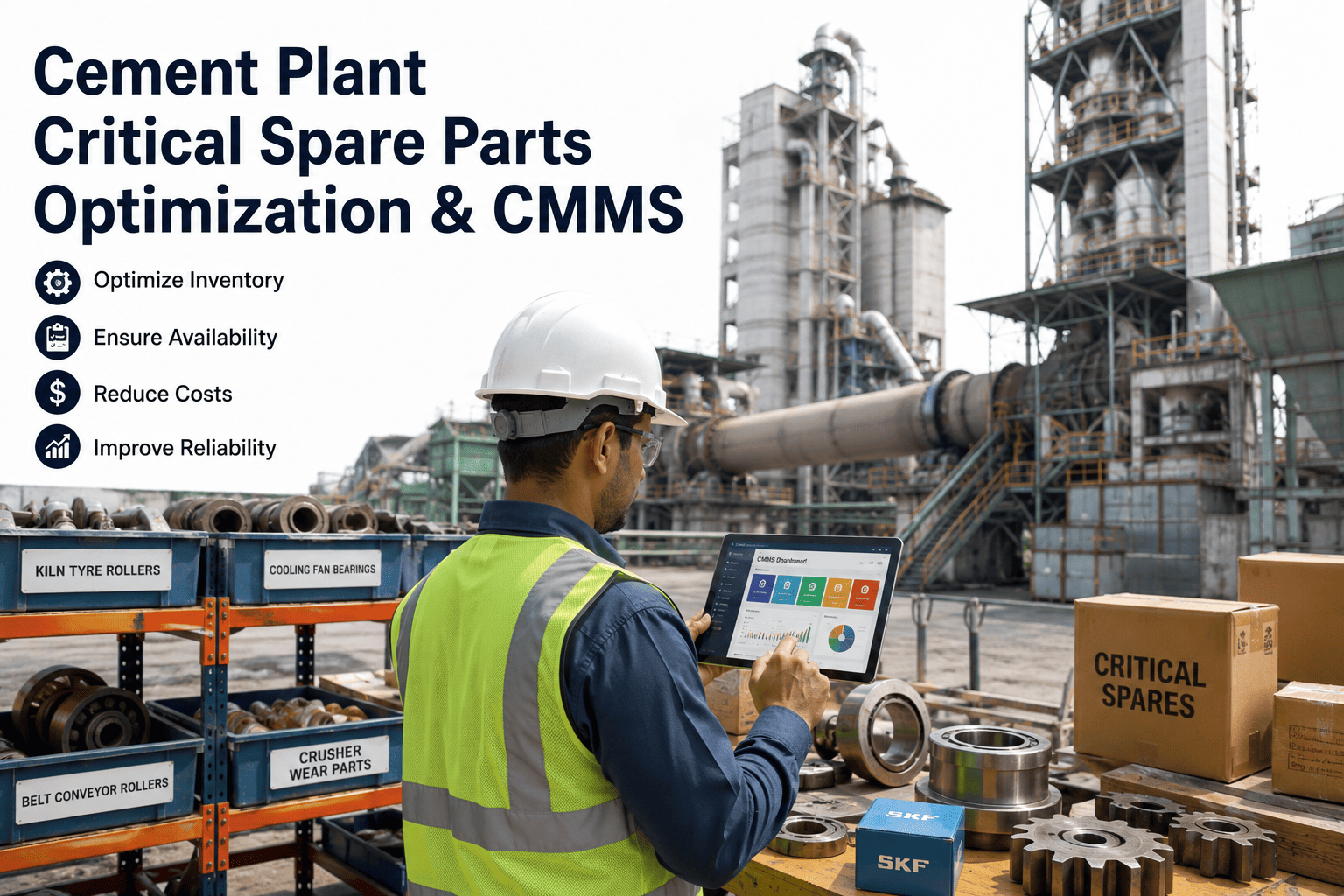
A cement plant in Kentucky lost $280,000 in a single shutdown because one $340 drone propeller was not in stock — the 4-day vendor lead time pushed kiln inspection past the relining contractor's arrival window. This is not an outlier. The average cement plant warehouse holds 8,000-15,000 unique spare parts, and without a structured management strategy, inventory accuracy degrades silently until the exact part needed for a critical repair simply is not there. Overstocking ties up $2-5 million in dead capital. Understocking halts $150,000/day production lines. The balance between these two extremes is not luck — it is strategy. Oxmaint's CMMS platform connects spare parts inventory directly to asset criticality, work order history, and automated reorder triggers so cement plants carry exactly what they need — nothing more, nothing less.
This guide covers every element of critical spares management for cement operations: ABC classification tailored to cement equipment, min-max calculation methods, lead time risk analysis, obsolescence prevention, and the CMMS workflows that turn inventory from a cost center into a reliability enabler.
Why Generic Inventory Rules Fail in Cement Plants
Cement manufacturing environments are uniquely destructive to spare parts planning assumptions. Standard manufacturer replacement intervals underestimate actual wear by 30-50% because they do not account for abrasive cement dust infiltrating bearings, seals, and electrical components. Kilns operating at 1,450°C create thermal cycling that accelerates fatigue in mechanical components. Fine clinker dust penetrates storage areas, degrading even warehoused spares before they are installed. Any spare parts strategy built on clean-room manufacturer specs will systematically understock — and the plant will pay the difference in emergency procurement premiums and extended downtime.
Without Spares Strategy
With CMMS-Driven Spares Strategy
ABC-XYZ Classification for Cement Plant Spares
Not all 15,000 spare parts deserve the same management attention. ABC-XYZ classification creates a two-dimensional framework that prioritizes inventory investment based on both value impact and demand predictability. In cement plants, this classification directly maps to asset criticality tiers — Tier 1 kiln components demand different stocking rules than Tier 4 office supplies. Oxmaint automatically links spare parts classification to asset criticality scores, ensuring that stocking levels reflect actual operational risk.
Spare Parts ABC Classification — Cement Plant Calibrated
Critical Spare Parts Identification: The Decision Framework
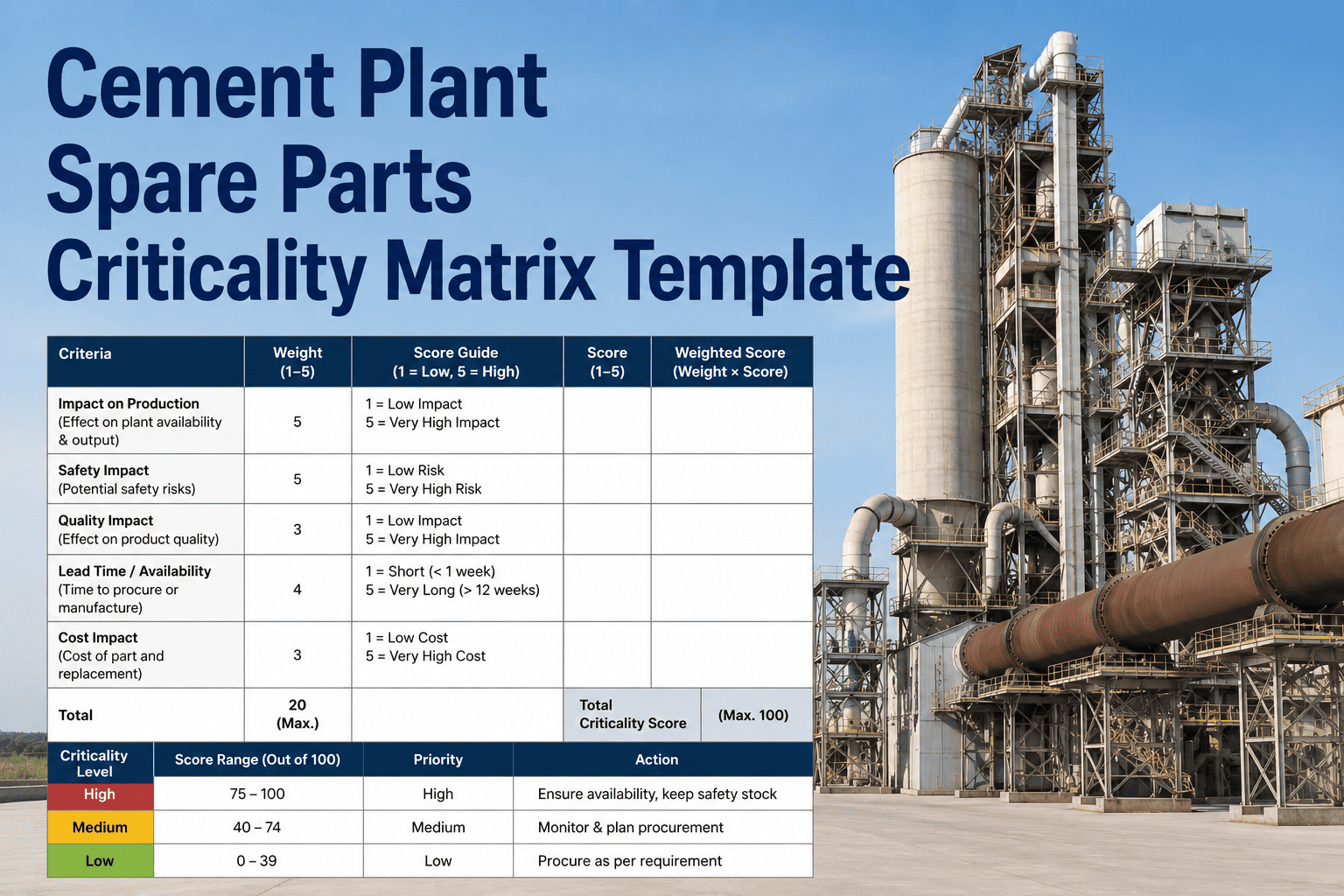
The hardest question in spare parts management is not what to stock — it is what qualifies as "critical." A part is critical when its absence during a breakdown extends downtime beyond acceptable limits. The framework below evaluates every spare part against four dimensions to determine whether it warrants critical spare designation and the corresponding investment in safety stock. Get started with Oxmaint to apply this framework across your entire parts inventory automatically. This directly connects to your asset lifecycle management strategy — because the criticality of a spare part mirrors the criticality of the asset it serves.
Critical Spare Qualification Matrix
Production Impact
Lead Time Risk
Substitutability
Failure Predictability
Automate Your Critical Spares Management
Oxmaint connects every spare part to the asset it serves, tracks consumption against work orders, and triggers reorder alerts before stockouts impact production. Built for cement — not adapted from generic templates.
Min-Max Calculation for Cement Plant Spares
Setting reorder points for cement plant spare parts requires cement-specific adjustment factors that standard ERP formulas do not include. The calculations below account for accelerated wear rates, seasonal demand variation, and the reality that cement plant shutdowns consume inventory in concentrated bursts rather than steady flows.
Minimum Stock Level (Reorder Point)
Maximum Stock Level (Order-Up-To)
Insurance Spares: The High-Stakes Inventory Decision
Insurance spares are the most expensive and most debated inventory category in any cement plant. These are high-value components — kiln shells, girth gears, large gearboxes, mill trunnion bearings — that cost $50,000-$500,000+ each and may sit in the warehouse for years without being used. The decision to stock them is not a standard inventory calculation. It is a risk management decision that compares the carrying cost of the spare against the production loss cost during the procurement lead time if the component fails without a spare available. Plants that actively manage unplanned downtime reduction build insurance spare decisions into their overall reliability strategy.
Insurance Spare Stocking Decision Model
CMMS Workflows That Drive Spares Performance
The gap between good spare parts strategy and actual inventory performance is the CMMS. Without system-enforced workflows, even the best-designed min-max calculations and ABC classifications degrade within months as technicians bypass processes and planners revert to habits. Book a demo to see how Oxmaint enforces these workflows automatically.
Work Order-Linked Parts Consumption
Every part issued from the warehouse is linked to a specific work order, asset, and failure code. No part leaves without a digital trail. This creates the consumption data that drives future reorder calculations and identifies which assets consume the most inventory value.
Automated Reorder Point Alerts
When stock hits the minimum level, the CMMS generates a purchase requisition automatically — routed to the correct approver based on the part's ABC classification. Class A items go to the maintenance manager. Class C items auto-approve up to a spending threshold. No manual checking required.
Shutdown Parts Kitting
Before every planned shutdown, the CMMS generates a parts kit list based on the scheduled maintenance tasks. Parts availability is validated weeks in advance — missing items trigger expedited procurement before the shutdown window opens, not during it.
Vendor Performance Tracking
The CMMS tracks actual delivery times, quality rejection rates, and pricing trends for every vendor and every part. When a supplier consistently delivers late or ships defective components, the data supports switching decisions before the next emergency proves the point painfully.
Obsolescence and Shelf-Life Management
Rubber seals, electronic modules, and chemical consumables degrade in storage — especially in dusty, high-temperature cement plant warehouses. The CMMS tracks shelf life by batch, alerts before expiration, and prevents issuing expired parts that could cause premature equipment failure.
Cross-Plant Inventory Visibility
For multi-plant operations, the CMMS provides real-time stock visibility across all locations. Before ordering externally, planners can check whether the needed part exists at a sister plant — reducing procurement cost and lead time simultaneously.
Turn Your Storeroom Into a Reliability Asset
Oxmaint gives cement plants automated reorder triggers, work order-linked consumption tracking, shutdown kitting, and vendor performance scoring — all in one platform. Stop losing production to missing parts.
Cement-Specific Spare Parts Challenges and Solutions
Every industry claims unique inventory challenges, but cement genuinely operates in conditions that break standard spare parts assumptions. These five cement-specific factors must be addressed explicitly in your spares management strategy — ignoring any one of them creates systematic inventory failures that generic solutions cannot solve.
Abrasive Dust Infiltration
Cement dust with a Mohs hardness of 3-4 infiltrates bearings, seals, and electrical contacts even in sealed enclosures. Standard manufacturer MTBF data does not account for this. Parts wear 30-50% faster than published intervals.
Thermal Zone Variation
Parts installed near kilns, preheaters, and coolers wear 2-3x faster than identical parts in ambient-temperature zones. A motor bearing in the kiln house fails at completely different rates than the same bearing on a warehouse conveyor.
Shutdown Demand Spikes
Annual kiln shutdowns consume 3-6 months of normal spare parts inventory in a 2-3 week window. If procurement does not ramp 4-6 months before the shutdown, critical components arrive late and extend the outage.
Long-Lead OEM Dependencies
Kiln girth gears, large mill segments, and custom gearbox assemblies have 16-24 week lead times with single-source manufacturers. These cannot be rush-ordered. If the insurance spare decision was wrong, the plant waits months at $150K+/day.
Warehouse Storage Degradation
Cement plant warehouses are not climate-controlled clean rooms. Dust, humidity, and temperature swings degrade rubber seals, electronic components, and precision machined surfaces during storage. Parts can fail on installation because they degraded on the shelf.
Frequently Asked Questions
What makes spare parts management different in cement plants compared to other industries?
Cement plants face uniquely harsh operating conditions that invalidate standard spare parts assumptions. Abrasive dust with a Mohs hardness of 3-4 infiltrates every component, causing parts to wear 30-50% faster than manufacturer specifications. Kilns at 1,450°C create thermal zones where identical parts fail at completely different rates. Annual shutdowns create massive demand spikes that consume months of normal inventory in weeks. And cement plant warehouses themselves degrade stored parts through dust, humidity, and temperature swings. Any spares strategy not calibrated for these factors will systematically underperform.
How do you determine which spare parts should be classified as "critical"?
A spare part qualifies as critical when its absence during a breakdown extends downtime beyond acceptable operational limits. The decision evaluates four dimensions: production impact of the parent asset's failure, procurement lead time if the part is not in stock, availability of substitutes or workaround options, and whether condition monitoring can predict the failure with enough lead time to procure. Any part scoring high on production impact AND high on either lead time or substitutability automatically qualifies as critical, regardless of unit cost.
What is the typical inventory investment for a cement plant spare parts warehouse?
A typical mid-sized cement plant (1-2 kiln lines) carries $2-5 million in spare parts inventory across 8,000-15,000 unique SKUs. Of this, insurance spares for major components (kiln girth gears, large gearboxes, mill segments) can represent 30-40% of the total value while constituting less than 1% of the SKU count. Plants without structured ABC classification and obsolescence management often carry 20-30% excess inventory in dead or slow-moving stock that ties up capital without providing any reliability benefit.
Should we stock expensive insurance spares or rely on vendor relationships for emergency delivery?
This is a risk-versus-cost calculation, not a blanket policy decision. Stock the insurance spare when the annual holding cost (typically 15-25% of part value) is less than one day of production loss during the procurement lead time. For a $200,000 girth gear segment with a 20-week lead time serving a kiln that costs $150,000/day when down, the holding cost of $30,000-50,000/year is trivially justified. For multi-plant groups, shared insurance spare pools across nearby plants reduce per-plant holding cost while maintaining availability.
How does a CMMS improve spare parts management in cement plants?
A CMMS transforms spare parts management from intuition-based to data-driven by linking every part consumed to a specific work order, asset, and failure code — creating the consumption history that drives accurate reorder calculations. It automates reorder alerts when stock hits minimum levels, validates parts availability before scheduled maintenance begins, tracks vendor delivery performance, manages shelf life and expiration for degradable components, and provides cross-plant inventory visibility for multi-site operations. Without a CMMS, spare parts decisions revert to whoever remembers to check the shelf.
How often should spare parts inventory levels be reviewed and adjusted?
Class A (critical, high-value) items should be reviewed monthly with individual item attention to consumption trends, lead time changes, and vendor performance. Class B items warrant quarterly review of min-max settings and consumption patterns. Class C items need annual review with a focus on bulk contract renegotiation and obsolescence cleanup. Additionally, trigger a full review of affected spare parts whenever a major equipment modification occurs, a new asset is commissioned, or an asset is decommissioned — the parts that supported it may now be obsolete.
What is the best way to handle spare parts for planned cement kiln shutdowns?
Maintain a dedicated shutdown parts list in the CMMS linked to the shutdown task library. Auto-generate procurement requisitions 16 weeks before every planned shutdown to ensure long-lead items arrive with margin. Build a complete parts kit for every shutdown task — validated against actual stock levels — so that missing items are identified and ordered weeks in advance, not discovered when a technician reaches for a part that is not there. After each shutdown, capture actual versus planned consumption to improve the kit list for the next cycle.