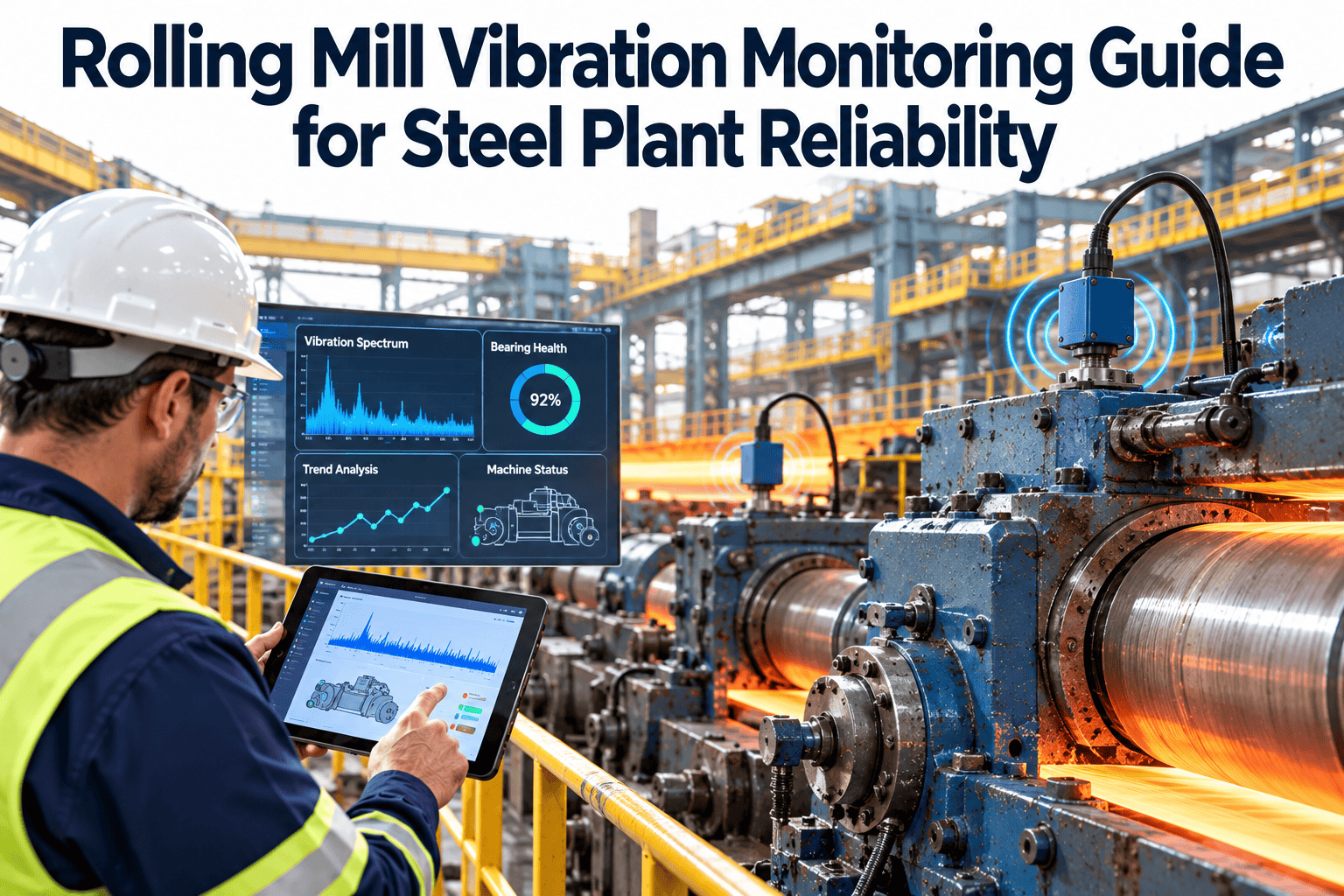
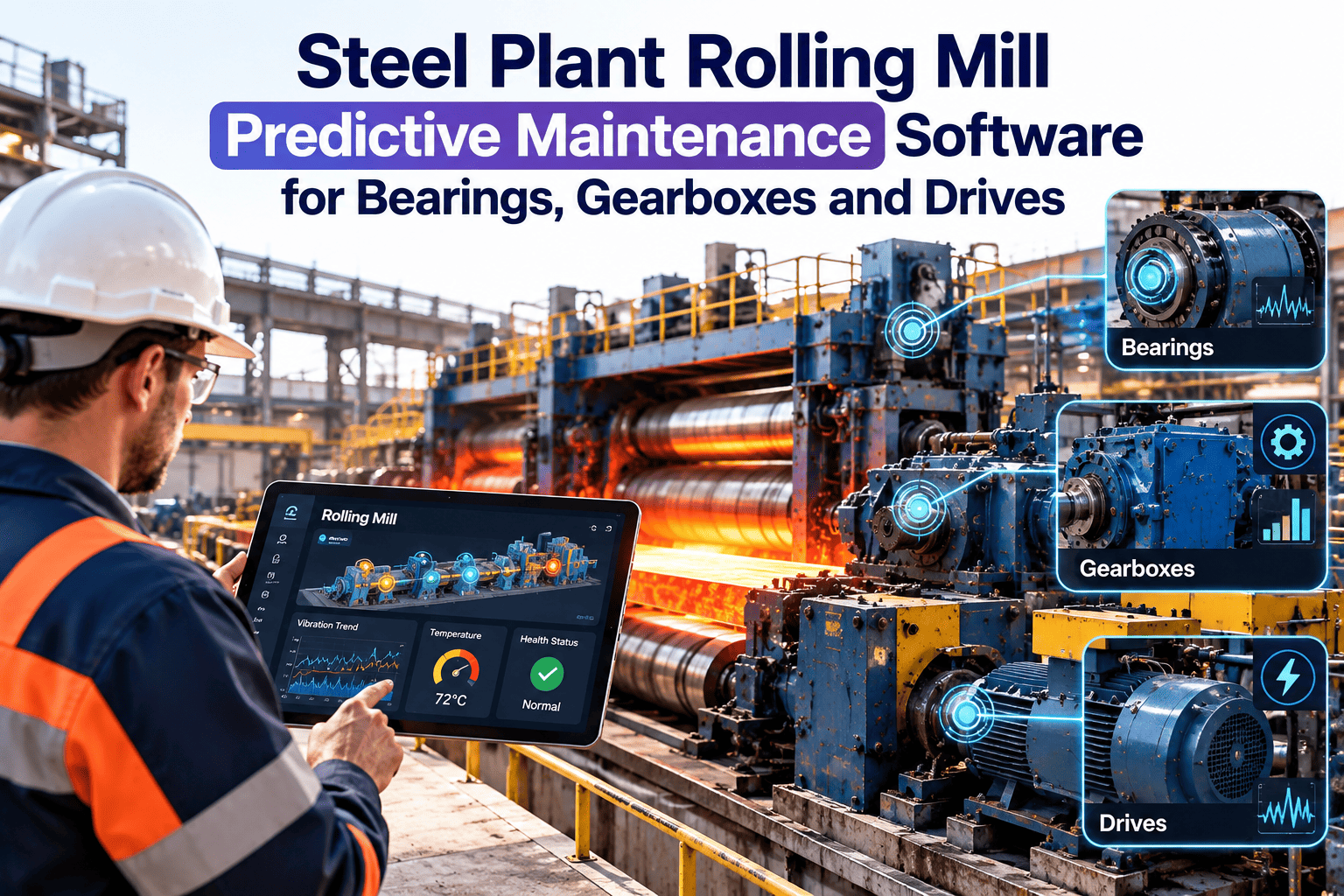
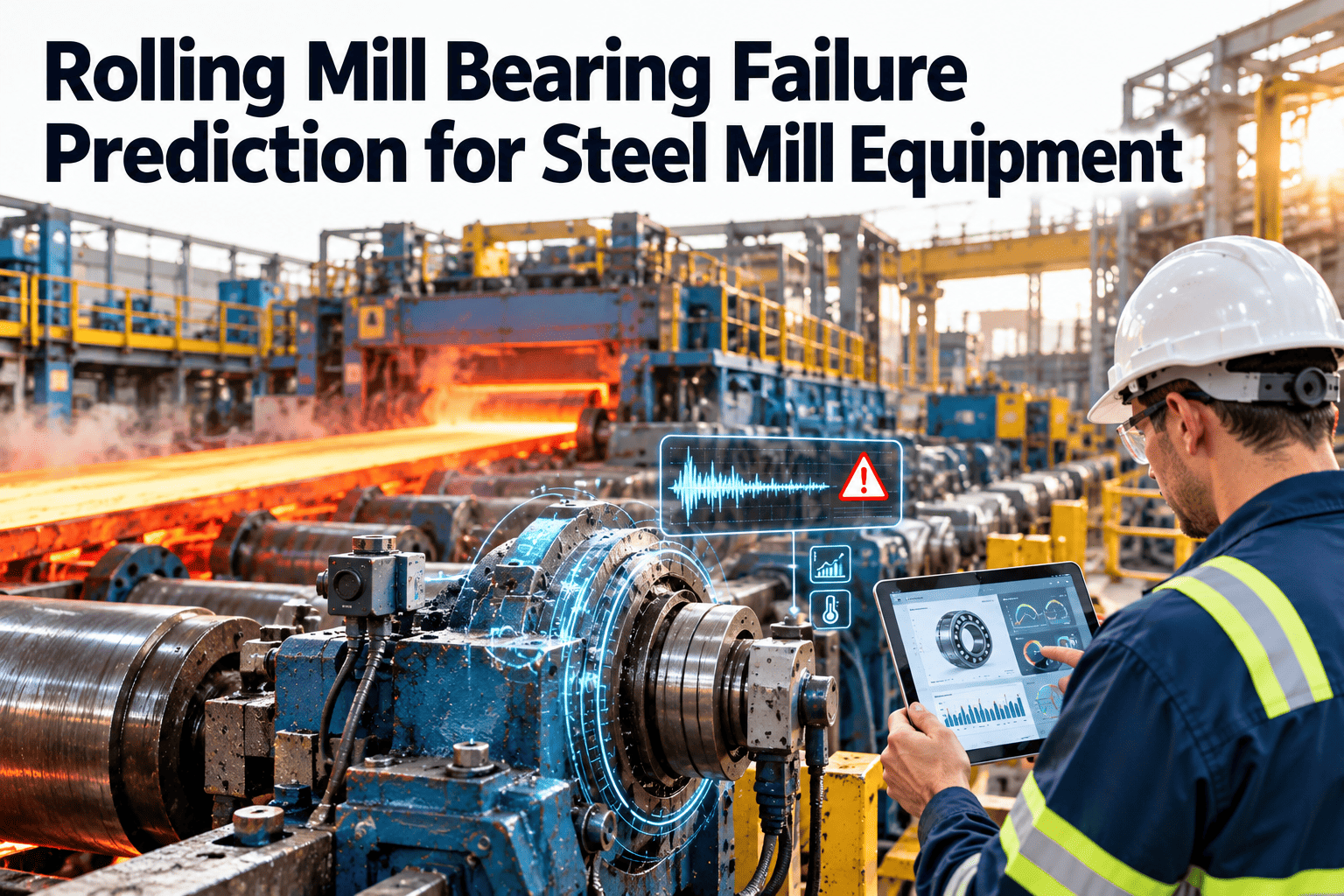
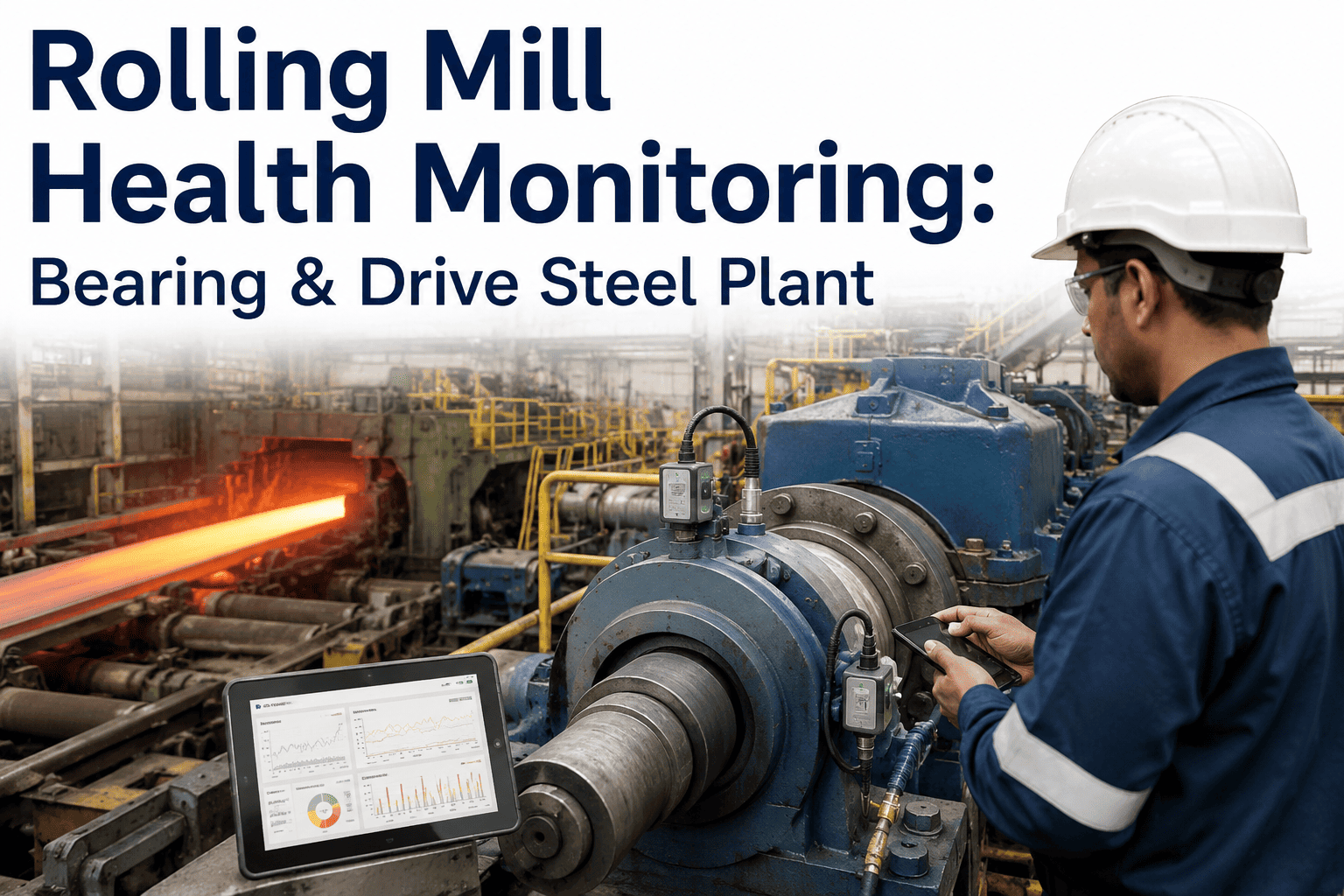
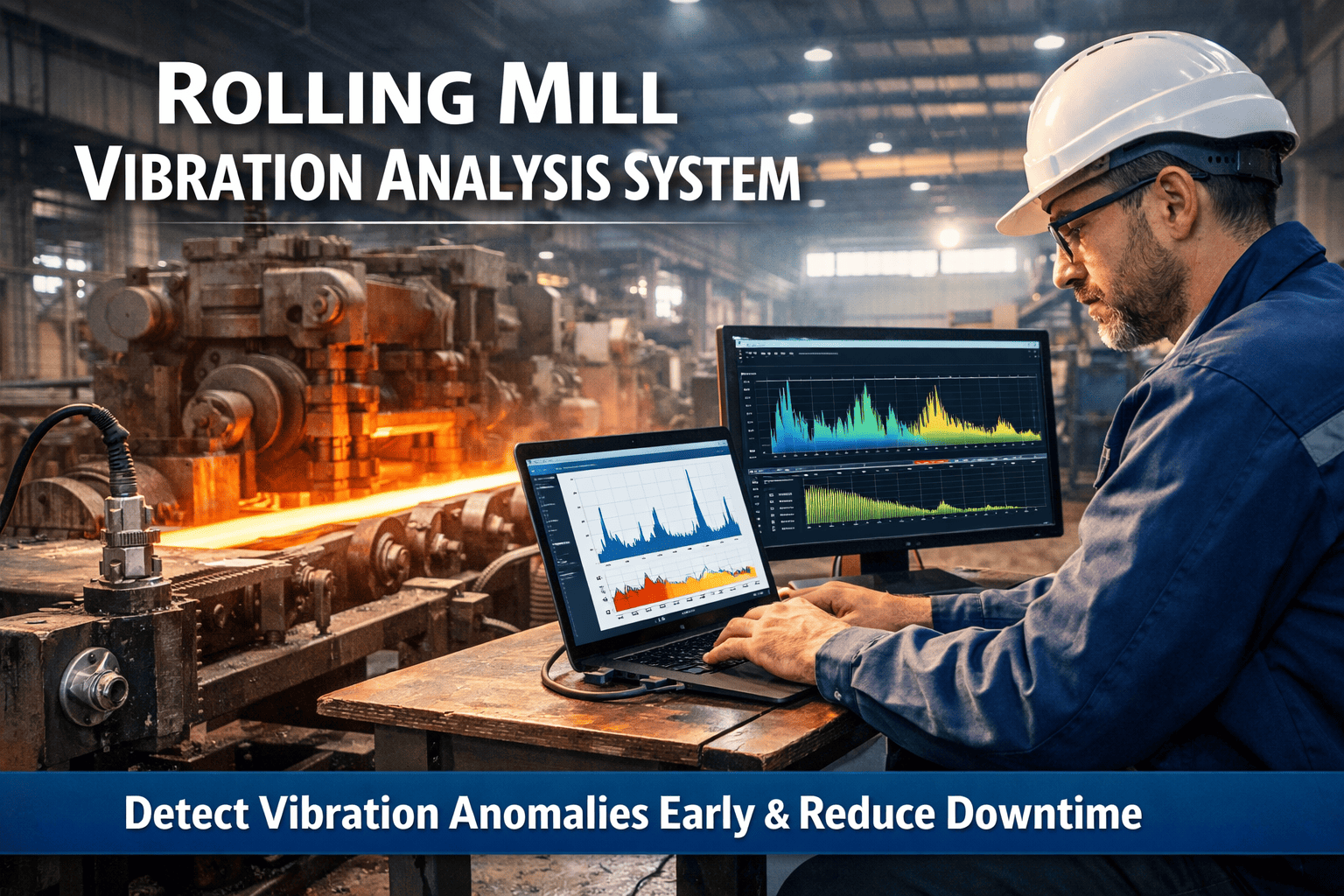
A hot rolling mill finishing stand running at 1,200 meters per minute generates enough vibration data from a single backup roll bearing to fill 40 gigabytes per day. The bearing inside that stand — one of 180 bearings across a seven-stand mill — can transition from Stage 2 defect to catastrophic spalling in 11 days under full production load. A handheld vibration check performed monthly by a technician captures 0.003% of that bearing's life. The rest is invisible. OxMaint's predictive maintenance platform connects continuous vibration, temperature, and failure-code analytics to work order execution — so the 5–7 week window between a detectable BPFO signal and a functional failure becomes a scheduled bearing swap during a planned stop, not an 18-hour emergency strip at $8,000–$12,000 per hour in lost production.
Rolling Mill Predictive Maintenance: Vibration, Temperature, and Failure-Code Analytics for Hot and Cold Mill Operations
A seven-stand finishing mill generates 400+ monitored parameters simultaneously. This article covers which failure modes claim the most production hours, what the sensor data actually shows before each failure, and how OxMaint translates condition signals into work orders before the breakdown window closes.
The Rolling Mill Failure Landscape: What Actually Stops Production
Before specifying sensors or configuring analytics, a rolling mill predictive maintenance programme requires a clear-eyed inventory of which failure modes cost the most production hours — and which of those are detectable in advance. Not every rolling mill failure is predictable weeks ahead; some are. The distinction determines where sensor investment delivers ROI and where it does not.
The data below is drawn from documented failure histories across multiple integrated hot strip mills and OxMaint's steel plant case study database. Bearing failures, gearbox degradation, and hydraulic AGC faults collectively account for 67% of all unplanned rolling mill downtime — and all three are detectable with 3–8 weeks of advance warning.
| Failure Mode | Avg Downtime per Event | Production Cost | Detectable Advance Warning | Primary Sensor Signal | OxMaint Detection |
|---|---|---|---|---|---|
| Work / Backup Roll Bearing Failure | 12–36 hrs | $96K–$432K | 3–7 weeks (BPFO/BPFI signal) | Vibration — envelope analysis | BPFO/BPFI frequency trending, temperature rate-of-rise |
| Main Drive Gearbox — Gear Tooth Wear | 48–120 hrs | $384K–$1.44M | 4–8 weeks (gear mesh harmonic growth) | Vibration — gear mesh frequency, oil analysis | GMF sideband amplitude trending, oil particle count alert |
| Hydraulic AGC Servo Valve — Response Degradation | 6–18 hrs + quality losses | $48K–$216K + off-gauge | 2–4 weeks (response time drift) | Hydraulic pressure pulsation, servo response time | Servo response time trending, pressure fluctuation pattern analysis |
| Pinion / Spindle Coupling Wear | 8–24 hrs | $64K–$288K | 3–6 weeks (imbalance + misalignment signal) | Vibration — 1× and 2× running speed amplitude | 1×/2× amplitude trending, phase angle monitoring |
| Roll Surface Degradation — Quality Cobble | 2–8 hrs + scrap loss | $16K–$96K + scrap | Condition-based (tons rolled + surface model) | Rolling force, strip gauge deviation, surface inspection system | Tons-rolled counter with surface degradation model, gauge deviation trending |
| Motor Winding / Rotor Bar Failure | 24–72 hrs | $192K–$864K | 4–12 weeks (current signature degradation) | Motor current signature analysis (MCSA) | Current harmonic trending, winding temperature monitoring |
Vibration Analytics: What the Frequency Spectrum Shows Before Each Failure Type
The reason rolling mill bearings fail without warning on calendar-based PM programmes is that the bearing defect signal appears in a specific frequency band — the bearing defect frequency — long before it appears in the overall vibration level that most handheld checks measure. A bearing running at Stage 2 defect severity can show entirely normal overall RMS vibration while its BPFO frequency amplitude has grown 400% over the previous six weeks. Understanding the full spectrum of vibration signatures in steel mill equipment is what separates a predictive programme from a monitoring exercise.
From Vibration Signal to Closed Work Order — Without a Single Manual Step
OxMaint connects rolling mill sensor data to work order execution. When BPFO amplitude crosses the configured threshold, a work order is generated — pre-populated with asset ID, failure mode, recommended procedure, and required bearing part number. See the full IoT-to-work-order workflow for rolling mills.
Failure-Code Analytics: Turning Historical Work Orders into Prediction Models
Vibration and temperature sensors detect developing faults in real time. Failure-code analytics do something different — they mine the pattern in your historical work order data to tell you which assets fail most, what they fail with, and when in their operational cycle they are most vulnerable. Together, the two approaches cover the full prediction spectrum: sensors catch what is developing now; failure-code analytics tell you what will develop next and where to focus monitoring resources.
This is the part of rolling mill predictive maintenance that most programmes underinvest in. The AI implementation roadmap for steel plants outlines how failure-code analysis feeds the machine learning layer that improves detection accuracy over the first 12 months of a predictive programme.
MTBF Analysis by Stand Position
Bearing MTBF is not uniform across a finishing mill. F6 and F7 stands — the last two in the train — run at higher strip speeds and carry more surface contact load per revolution than F1 and F2. OxMaint's failure-code analytics calculate MTBF per asset position, revealing which stands need tighter monitoring intervals and which can run longer campaigns safely. A plant that discovers F6 backup roll MTBF is 40% lower than F2 can justify additional sensor coverage on F6 from historical data alone — before the next failure.
Failure Mode Distribution per Asset Class
Work orders closed with failure codes build a failure mode frequency distribution for every asset class in the mill. If 68% of main drive gearbox work orders are closed with "gear tooth wear" and 22% with "oil contamination," the programme knows to prioritize oil analysis over other gearbox monitoring channels. OxMaint surfaces this distribution automatically from work order history — it does not require manual analysis or a reliability engineer running queries on a separate database.
Production Load Correlation
Calendar-based PM intervals fail rolling mill components because degradation rate depends on production volume and strip grade mix, not calendar time. A stand running heavy gauge carbon steel at 900 m/min accumulates bearing wear 3× faster than the same stand processing thin-gauge stainless at 400 m/min. OxMaint correlates failure events with preceding production data — tons rolled, strip grade, rolling speed — to build load-adjusted PM triggers that adapt as production mix changes.
Repeat Failure Identification
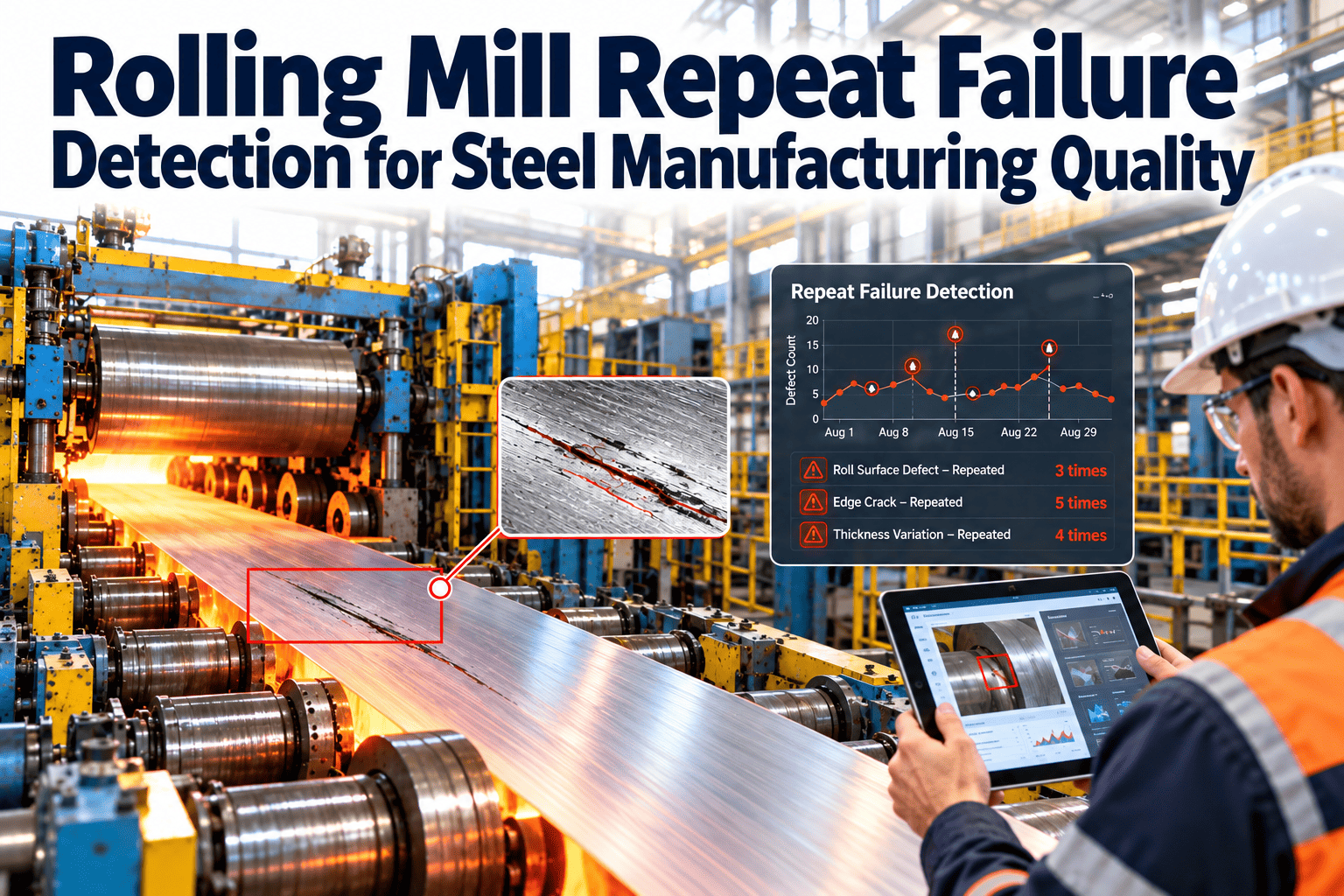
A bearing replaced on F5 that fails again within 90 days of installation is not a bearing quality problem — it is a root cause the first repair did not address. OxMaint flags repeat failures on the same asset within configurable windows and routes them to a root cause investigation workflow. Steel plants running OxMaint typically identify 15–25% of "chronic" assets generating disproportionate maintenance cost within the first 6 months of failure-code tracking.
Sensor Architecture for a Rolling Mill Predictive Programme
A complete predictive programme for a seven-stand finishing mill requires sensors across five measurement categories. OxMaint's IoT sensor integration guide for steel plants covers installation specifications, IP rating requirements for mill environments, and the data gateway architecture that handles 400+ parameter streams per mill. The summary below covers sensor priorities, placement logic, and the data quality issues specific to hot rolling environments.
| Sensor Category | Target Assets | Specification for Mill Environment | Count (7-stand mill) | OxMaint Integration |
|---|---|---|---|---|
| Triaxial Vibration Accelerometers | Roll bearings, gearbox housings, motor bearings, pinion stands | IP67+, 25.6 kHz sampling, stainless housing, high-temperature cable (200°C+) | 80–120 units | Real-time frequency analysis, BPFO/GMF trending, threshold alerts |
| RTD / Thermocouple Temperature Sensors | Bearing housings, oil return lines, hydraulic fluid, motor windings | Type K (−200°C to 1,000°C), IP65 minimum, 1-second sampling interval | 60–90 units | Rate-of-rise tracking, delta monitoring (housing vs. oil return) |
| Hydraulic Pressure Transducers | AGC cylinders, hydraulic power units, balance cylinders | Hastelloy wetted parts, 0–600 bar range, 100 Hz sampling for pulsation analysis | 40–60 units | Servo response time measurement, pulsation pattern analysis |
| Motor Current Transformers | Main drive motors, edger drives, table roller drives | Split-core CT, 0.5% accuracy class, compatible with existing MCC infrastructure | 20–30 units | MCSA (Motor Current Signature Analysis), rotor bar fault detection |
| Oil Quality / Particle Count Sensors | Main drive gearboxes, hydraulic power units, centralized lube systems | Inline optical particle counter, ISO 4406 compliant, 4–6 bar line pressure tolerance | 10–15 units | ISO cleanliness code trending, contamination event alerting |
From Detection to Work Order: How OxMaint Closes the Prediction-to-Action Gap
The technology capable of detecting a BPFO signal 5 weeks before failure has existed for 15 years. The reason rolling mills still suffer predictable bearing failures is not detection — it is the gap between what the monitoring system shows and what the maintenance team does about it. Detection without automated work order generation creates a dashboard that is checked when someone remembers to check it. By the time the alarm appears on screen, the plant may be two weeks inside the failure window. OxMaint's rolling mill maintenance platform closes this gap by treating condition signals as automatic work order triggers — not alerts for a person to interpret and act on manually.
Rolling Mill Predictive Maintenance ROI: The Numbers from Live Deployments
The ROI case for rolling mill predictive maintenance is well-documented across hot strip mill and cold rolling mill deployments. The figures below are consistent with ArcelorMittal's published Sentinel platform outcomes and the OxMaint steel plant case study database.
The hardest thing to explain to a rolling mill maintenance manager who has been running handheld vibration routes for twenty years is that the reason those routes work is not the vibration measurement — it is the frequency analysis that happens in the instrument. What monthly routes cannot do is detect a bearing that goes from Stage 1 to Stage 3 in 11 days under heavy production load. We had a F6 backup roll bearing at one plant that passed its monthly route check with no anomalies and then catastrophically spalled 13 days later. The overall RMS was clean. The BPFO at 3,200 Hz had been growing for nine weeks in data that no one was collecting. When we went back and fitted the continuous sensors after the failure and ran them for the first year, we caught the same failure pattern developing on the adjacent stand four times — four times we replaced a bearing on a planned roll change instead of standing down for an 18-hour emergency. That is $640,000 in avoided downtime from one bearing position on one stand.
Frequently Asked Questions
Rolling Mill Bearings Fail on a Schedule Your Sensors Can Read. Stop Finding Out After the Breakdown.
OxMaint connects rolling mill vibration and temperature analytics to automated work order execution — so BPFO signals become planned bearing swaps, not emergency callouts at 2 AM. Sensor data, failure-code history, and condition-based scheduling in a single platform your maintenance team already knows how to use.